Category: Defense and National Security

  • Contractors to Pay $3.6M Over False Veteran-Owned Small Business Certification

    Contractors to Pay $3.6M Over False Veteran-Owned Small Business Certification

    Two government contractors agreed to pay more than $3.6 million to resolve allegations involving False Claims Act and Contract Disputes Act liability tied to federal set-aside contracts, according to the DOJ.

    The settlement involves Officium Global LLC and Loyal Source Government Services LLC. Prosecutors said Officium Global allegedly submitted false or fraudulent claims for payment on seven service-disabled veteran-owned small business set-aside contracts awarded between May 2017 and June 2018.

    According to the settlement agreement, Officium Global was allegedly not entitled to those contracts because its management and daily business operations were not controlled by a service-disabled veteran. The DOJ said the company submitted, or caused to be submitted, false certifications and statements representing that it met all requirements to be a service-disabled veteran-owned small business when it did not.

    Officium Global will pay more than $1.8 million to resolve the False Claims Act allegations. Loyal Source Government Services will separately pay more than $1.8 million to resolve Contract Disputes Act allegations tied to alleged breaches of the same seven contracts.

    The case began as a qui tam lawsuit filed by relator Jeremy Lavin in the Middle District of Florida. Under the False Claims Act, private citizens may sue on behalf of the United States and share in the recovery.

    The DOJ said Lavin will receive more than $680,000 from the settlement proceeds.

    The case is United States ex rel. Lavin v. Loyal Source Government Services, LLC et al., No. 6:19-cv-958, in the U.S. District Court for the Middle District of Florida. 

    Find Corporate Waste tracks False Claims Act recoveries involving government contracting fraud, small-business set-asides, and eligibility certifications. Anyone with inside knowledge of set-aside control failures, pass-through contracting arrangements, or false small-business certifications may have information relevant to public-fraud enforcement.

  • Canadian Steel Companies to Pay $19M Over False Claims Act Trade Fraud Allegations

    Canadian Steel Companies to Pay $19M Over False Claims Act Trade Fraud Allegations

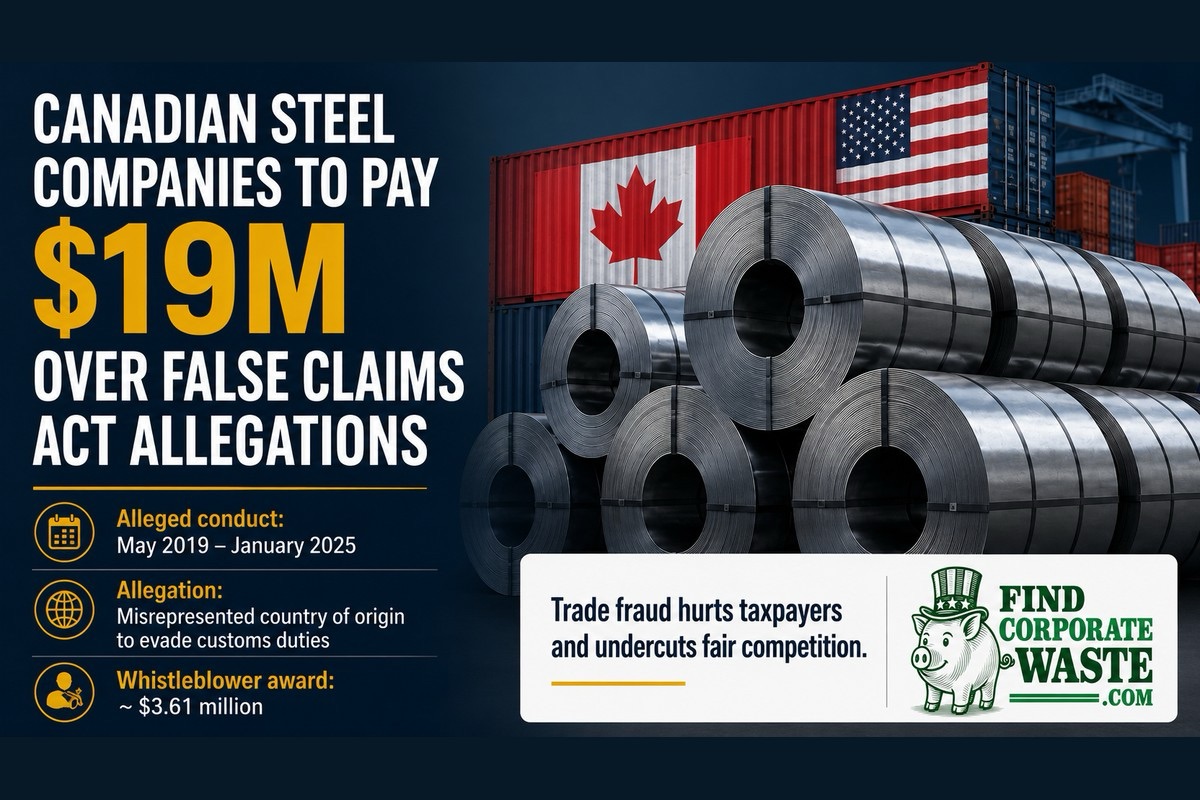
    Two Canada-based steel companies and their owner have agreed to pay $19 million to resolve False Claims Act allegations involving evaded customs duties on imported steel.

    According to the DOJ, Farjess Inc., Royal Canadian Steel Inc., and part-owner and president Feroz Jessani allegedly failed to pay duties owed on flat-rolled steel manufactured in Europe and Asia.

    Federal officials said the companies represented that certain steel originated in Canada or the United States, when they allegedly knew the steel actually came from China, Indonesia, Italy, Turkey, or Vietnam.

    The alleged conduct occurred from May 2019 through January 2025.

    This case matters because trade fraud is not just a customs issue. It is a taxpayer issue, a market fairness issue, and a direct threat to American businesses that follow the rules.

    Importers are required to accurately declare the country of origin, value, duty status, and amount of duties owed when goods enter the United States. When those declarations are false, the government can lose revenue while competitors gain an unfair advantage.

    That is exactly why the False Claims Act remains one of the government’s strongest tools against corporate fraud.

    The statute allows the government to recover funds when false statements or fraudulent conduct cause financial harm to the United States.

    It also allows whistleblowers to bring cases on behalf of the government and share in any recovery.

    The whistleblower in this case was Shamsh Dhala, a broker who worked with Farjess Inc.

    Dhala filed the case under the qui tam provisions of the False Claims Act in the Eastern District of Michigan.

    The case is captioned United States ex rel. Dhala v. Royal Canadian Steel Inc. et al., No. 2:23-cv-12097.

    As part of the settlement, Dhala will receive approximately $3.61 million.

    For Find Corporate Waste, the message is clear: corporate fraud often hides in ordinary paperwork. A customs form, shipment record, invoice, certification, billing file, or loan application can become the starting point for a major federal recovery.

    This settlement also fits into a broader enforcement pattern. The DOJ said the case was coordinated through its Trade Fraud Task Force, a cross-agency effort focused on tariff evasion, customs fraud, prohibited imports, threats to domestic industry, and conduct that weakens national security.

    The same logic applies across the areas covered by Find Corporate Waste: False Claims Act cases, government contracting abuse, pandemic relief fraud, healthcare fraud, customs fraud, and other schemes involving public money.

    When companies cheat the system, the cost does not disappear. It is shifted onto taxpayers, lawful competitors, American workers, and the public.

    If you have information about customs fraud, government contract abuse, healthcare billing fraud, pandemic relief misuse, or other misuse of taxpayer funds, Find Corporate Waste wants to hear from you.

    The strongest cases often begin with a person willing to connect the dots.
  • Illumina’s $9.8M Cybersecurity Settlement Explained

    Illumina’s $9.8M Cybersecurity Settlement Explained

    Cybersecurity protection is a vital area where the federal government spends billions of dollars to ensure safety. A recent False Claims Act settlement in the District of Rhode Island is a clear example. Companies that fail to meet the standards they claim to uphold risk huge financial penalties.

    Illumina Inc., a leading genomic sequencing company, agreed to pay $9.8 million after the Justice Department alleged it sold systems to federal agencies that had serious cybersecurity vulnerabilities between 2016 and 2023.

    A whistleblower inside the company triggered the case. Erica Lenore, a former Director for Platform Management, received $1.9 million for stepping forward under the False Claims Act.  

    If you work in cybersecurity, IT, compliance, or product management for a company that sells to the federal government, you may have noticed similar failures. These include unpatched vulnerabilities or a lack of essential security testing.

    Under the False Claims Act, neglecting these failures can result in multimillion-dollar liabilities for your employer. It can also lead to multimillion-dollar rewards for you if you take action.

    For professionals concerned about exposure, Find Corporate Waste (FCW) protects whistleblowers who want to remain anonymous. We submit filings through the corporation, not you personally. This ensures maximum confidentiality. It also allows you to receive your fair share of any recovery.  

  • Lockheed Martin Pays $70 Million to Settle False Claims Allegations Over Defective Pricing in Missile Contracts

    In a significant enforcement action announced by the U.S. Department of Justice, Lockheed Martin Corporation has agreed to pay $70 million to resolve allegations that it violated the False Claims Act (FCA) by submitting defectively priced contracts for missile sales to the Department of Defense.

    Click For Details

    The case centers on the Terminal High Altitude Area Defense (THAAD) system, a key component of U.S. missile defense architecture. DOJ officials alleged that Lockheed Martin’s subcontractor, L3Harris Technologies, intentionally provided inaccurate cost data during negotiations, which Lockheed Martin then passed on to the government without adequate disclosure or correction. As a result, the U.S. Army Missile Command allegedly awarded contracts based on inflated cost and pricing data, causing the government to overpay for missile components.

    This case was brought to light by a private whistleblower, known legally as a relator, who filed a lawsuit under the qui tam provisions of the False Claims Act. These provisions empower private citizens to sue on behalf of the federal government when they possess non-public evidence of fraud involving taxpayer dollars.

    In return, whistleblowers may be eligible to receive a portion of the recovery. In this case, the relator will receive $13.7 million from the settlement—a recognition of the role that private citizens can play in holding large corporations accountable.

    At Find Corporate Waste, we believe that the integrity of public spending starts with accountability. This case against Lockheed Martin highlights how whistleblowers can protect taxpayer dollars and expose fraudulent schemes that would otherwise go unchecked. We are committed to supporting those who step forward, guiding them through the complex landscape of False Claims Act litigation, and ensuring their efforts lead to meaningful recovery for the American people. If you have information about fraud, waste, or abuse of government funds, Find Corporate Waste is here to help you take the first step.