Category: Data Mining

  • DOJ’s $6.5B Health Care Fraud Takedown Shows Why FOCUS Matters

    DOJ’s $6.5B Health Care Fraud Takedown Shows Why FOCUS Matters

    The Department of Justice announced⁠ a national health care fraud takedown charging 455 defendants, including 90 licensed medical professionals, in alleged schemes exceeding $6.5 billion.

    The DOJ credited analytics with identifying suspicious billing patterns, including alleged wound-care schemes, hospice fraud, opioid diversion, Medicaid billing fraud, kickbacks, and claims for services that were medically unnecessary, never provided, or billed while patients were hospitalized elsewhere.

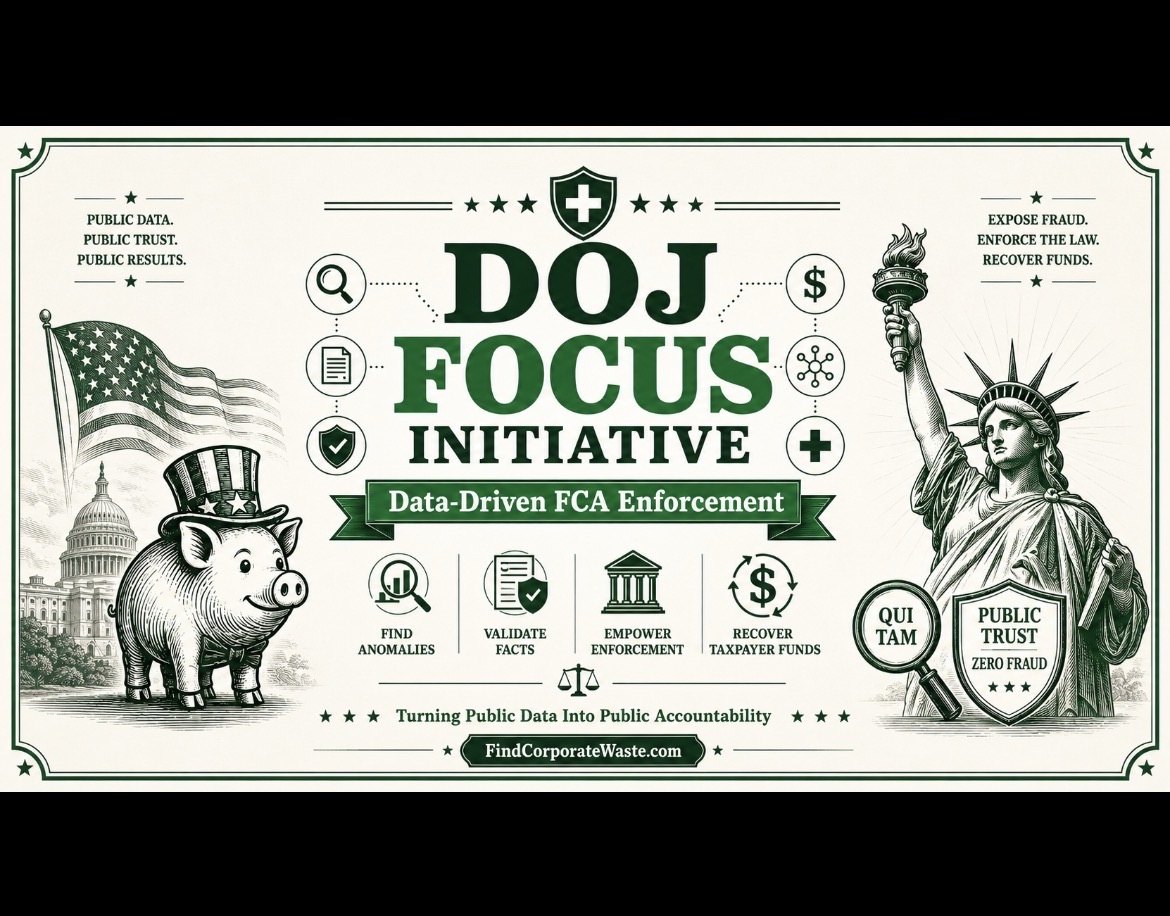
    That is exactly where DOJ’s FOCUS Initiative⁠ must be tied in. FOCUS was designed to prioritize high-quality qui tam actions from data miners who apply public government data to regulatory frameworks in ways that identify fraud otherwise likely to go undetected.

    This takedown proves the model. Public data is not proof of fraud, but it can expose patterns requiring verification: abnormal billing spikes, excluded providers receiving federal funds, Medicaid providers with impossible utilization, related entities moving across programs, and relief recipients whose certifications deserve review.

    For Find Corporate Waste, the connection is direct. Pandemic-era programs such as the Provider Relief Fund⁠ required recipients to satisfy eligibility terms, including restrictions tied to exclusion from federal health care programs.

    Operation Clawback applies that same principle in FCW’s relator activities: comparing relief-payment data against exclusion, billing, ownership, and enforcement records, then referring those documented anomalies for recovery review.

    FOCUS must not be siloed off from health care enforcement. It should become a valuable intake lane for disciplined, sourced, public-record leads that help DOJ, HHS-OIG, CMS, and Medicaid Fraud Control Units examine, expose, and recover taxpayer funds.

  • Circle Medical to Pay $3.325M Over Alleged False Healthcare Claims

    Circle Medical to Pay $3.325M Over Alleged False Healthcare Claims

    San Francisco-based Circle Medical Care of California, Circle Medical Technologies, Inc., and Chief Medical Officer Dr. Nicole Tsang, D.O., agreed to pay $3,325,000 to resolve allegations that they submitted false claims to federal healthcare programs and California commercial insurers.

    According to the DOJ⁠, Circle operates an online telehealth platform offering mental health and primary care services through contract providers, including nurse practitioners and physician assistants. The government alleged that from January 1, 2018 through May 31, 2025, Circle submitted claims using the names and NPI numbers of rendering providers who did not actually provide or supervise the services billed. The claims allegedly involved programs including Medicare, Medicaid, and TRICARE.  

    The settlement allocates $475,000 to the United States and $2.85 million to California. The matter began as a qui tam whistleblower case filed by Jason Vellen, who will receive $80,750 from the federal recovery and $997,500 from California.  

    This case fits the broader Find Corporate Waste focus on healthcare payment integrity: claims data, provider identifiers, supervision rules, and federal program billing requirements can expose recoverable taxpayer losses. 

  • Contractors to Pay $3.6M Over False Veteran-Owned Small Business Certification

    Contractors to Pay $3.6M Over False Veteran-Owned Small Business Certification

    Two government contractors agreed to pay more than $3.6 million to resolve allegations involving False Claims Act and Contract Disputes Act liability tied to federal set-aside contracts, according to the DOJ.

    The settlement involves Officium Global LLC and Loyal Source Government Services LLC. Prosecutors said Officium Global allegedly submitted false or fraudulent claims for payment on seven service-disabled veteran-owned small business set-aside contracts awarded between May 2017 and June 2018.

    According to the settlement agreement, Officium Global was allegedly not entitled to those contracts because its management and daily business operations were not controlled by a service-disabled veteran. The DOJ said the company submitted, or caused to be submitted, false certifications and statements representing that it met all requirements to be a service-disabled veteran-owned small business when it did not.

    Officium Global will pay more than $1.8 million to resolve the False Claims Act allegations. Loyal Source Government Services will separately pay more than $1.8 million to resolve Contract Disputes Act allegations tied to alleged breaches of the same seven contracts.

    The case began as a qui tam lawsuit filed by relator Jeremy Lavin in the Middle District of Florida. Under the False Claims Act, private citizens may sue on behalf of the United States and share in the recovery.

    The DOJ said Lavin will receive more than $680,000 from the settlement proceeds.

    The case is United States ex rel. Lavin v. Loyal Source Government Services, LLC et al., No. 6:19-cv-958, in the U.S. District Court for the Middle District of Florida. 

    Find Corporate Waste tracks False Claims Act recoveries involving government contracting fraud, small-business set-asides, and eligibility certifications. Anyone with inside knowledge of set-aside control failures, pass-through contracting arrangements, or false small-business certifications may have information relevant to public-fraud enforcement.

  • Regions Bank to Pay $4.9M Over Ineligible PPP Forgiveness Approval

    Regions Bank to Pay $4.9M Over Ineligible PPP Forgiveness Approval

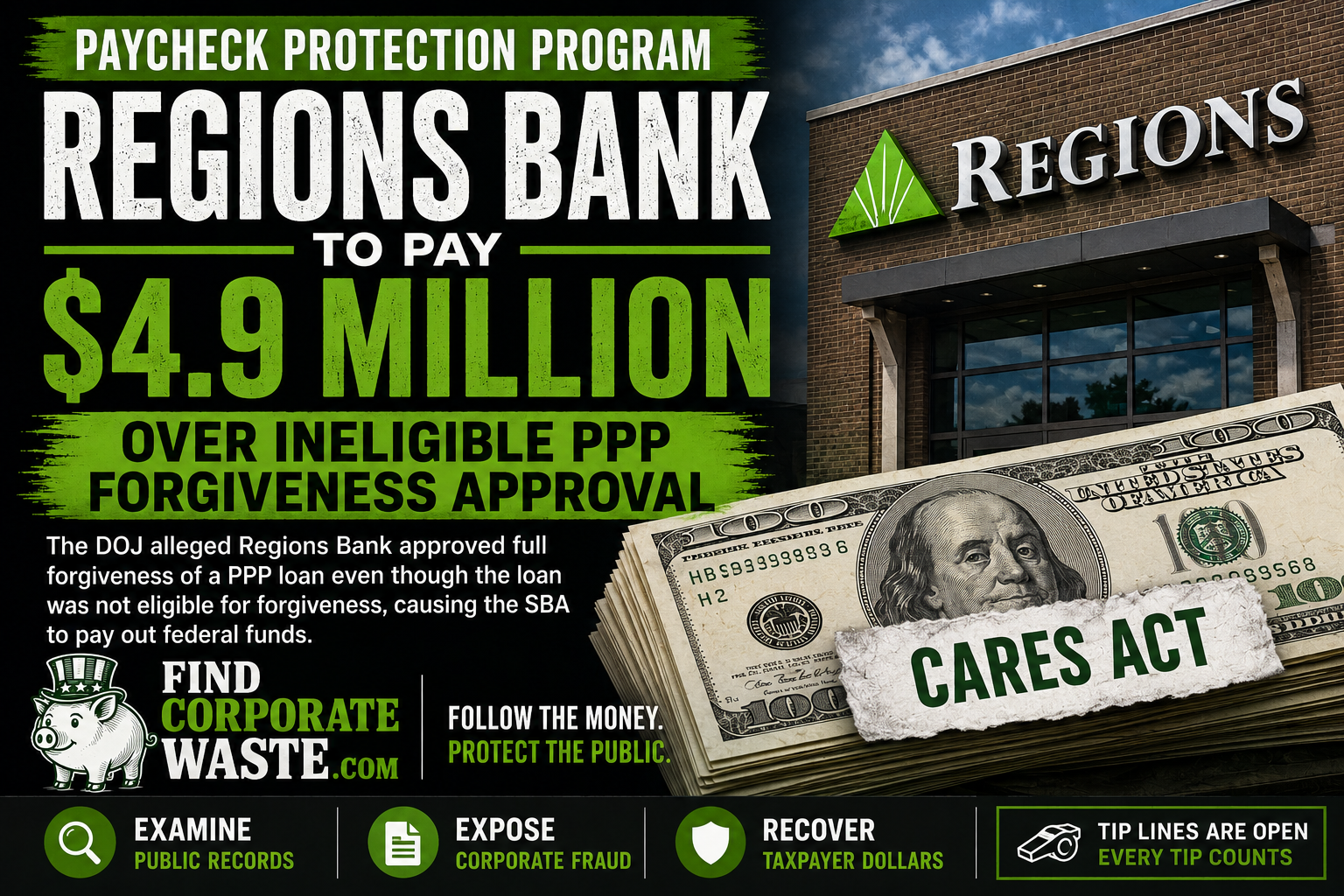
    Regions Bank has agreed to pay the United States $4.9 million to resolve civil allegations connected to a Paycheck Protection Program loan forgiveness approval that the government says should not have been granted.

    According to the DOJ, the matter involved a PPP loan obtained by Gregory A. DeLine, who owned or operated several businesses, including Midwest Mortgage Associates Corporation d/b/a Total Lending Concepts, Amega Sales Inc., and GKD Management, L.P.

    The government alleged that Regions approved full forgiveness of the loan even though the loan was not eligible for forgiveness.

    The public settlement documents do not identify the exact defect that made the loan ineligible. That distinction matters. The case should not be overstated as a public finding that the borrower committed fraud or that Regions admitted wrongdoing.

    The DOJ framed the civil resolution against Regions under an unjust enrichment theory, meaning the government alleged Regions received money it should not have received after approving forgiveness.

    The Paycheck Protection Plan (PPP) was created under the CARES Act to provide emergency relief during the COVID-19 pandemic. Borrowers could seek forgiveness if funds were used for payroll and other approved expenses. Once forgiveness was approved, the SBA paid the lender the forgiven principal and interest.

    For Find Corporate Waste, this case highlights why public-data review must examine the full structure of relief programs: borrower eligibility, certifications, lender review, forgiveness approval, and federal reimbursement. A single improper forgiveness approval can create millions in taxpayer exposure.

    Public records can identify the pattern, but insider knowledge transform that pattern into an actionable lead potentially worth millions.

  • Minnesota Medicaid Fraud Takedown Charges 15 Defendants in Alleged $90M Scheme

    Minnesota Medicaid Fraud Takedown Charges 15 Defendants in Alleged $90M Scheme

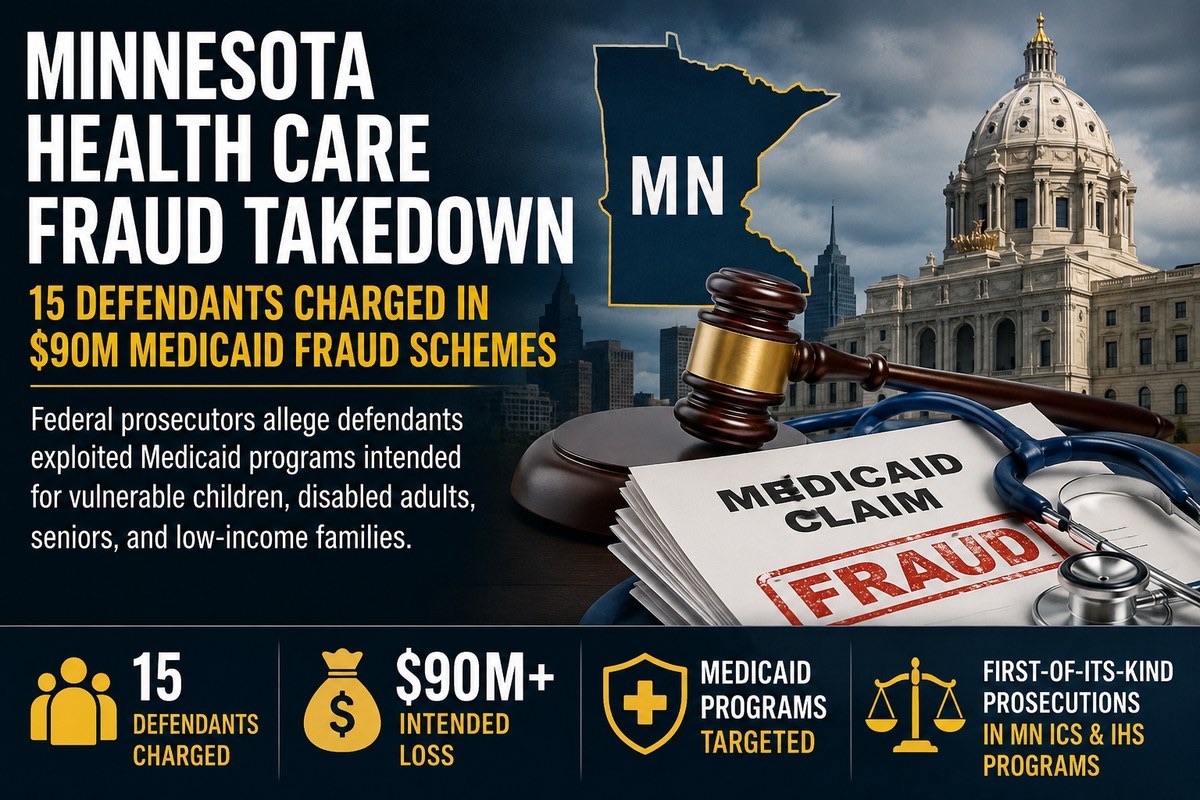
    The DOJ announced a major Minnesota health care fraud takedown on May 21, 2026, charging 15 defendants in alleged schemes involving more than $90 million in intended loss.

    The charges target owners of child care centers, autism-service providers, housing-support operators, and other Medicaid-linked providers accused of exploiting public programs designed for vulnerable children, disabled adults, seniors, and low-income families.

    According to the DOJ, the largest case involves Minnesota’s Early Intensive Developmental and Behavioral Intervention program, known as EIDBI, which provides services for people under 21 with autism spectrum disorder.

    Two defendants were charged in connection with an alleged $46.6 million scheme involving kickbacks to parents, medically unnecessary autism diagnoses, and billing for autism services that were not actually provided.

    The growth of the program is staggering. The DOJ said EIDBI claims rose from more than $600,000 in 2018 to more than $400 million by 2025. That kind of explosion is exactly why health care fraud enforcement increasingly depends on data analytics, billing-pattern review, and cross-agency scrutiny.

    The takedown also includes first-of-their-kind criminal prosecutions involving Minnesota’s Integrated Community Supports and Individualized Home Supports programs. In the ICS case, prosecutors allege a defendant billed Medicaid for services that were not provided as represented, including for a vulnerable recipient who required 24-hour care and was later found deceased. In the IHS case, two defendants allegedly concealed financial interests in more than 20 residences while billing Medicaid for services tied to adults with disabilities.

    The DOJ also charged eight defendants in alleged Housing Stabilization Services fraud totaling approximately $15.7 million. That program was created to help people with disabilities, seniors, and people with mental health or substance-use disorders find and maintain housing. But prosecutors said low barriers to entry and minimal documentation requirements made the program vulnerable to fraud. Minnesota eventually shuttered the program on October 31, 2025, after fraud concerns overwhelmed its integrity.

    This announcement is not just about Minnesota. The DOJ also announced funding for 15 new Trial Attorney positions to expand Medicaid fraud enforcement nationwide. The department said these prosecutors will support existing strike forces in states including California, Florida, New York, and Texas, while also expanding rapid-response enforcement across the country.

    For Find Corporate Waste, the message is clear: Medicaid fraud is not a paperwork problem. It is a taxpayer-integrity problem. These programs exist to serve people with serious needs, but weak controls, loose provider entry standards, shell-provider structures, and explosive billing growth can turn public benefits into private revenue machines.

    The DOJ also emphasized that its Health Care Fraud Section’s Data Fusion Center used advanced data analytics to identify and support the Minnesota cases. That matters. Public records, provider data, corporate filings, exclusion lists, addresses, ownership patterns, billing spikes, and program-growth anomalies can reveal serious fraud signals long before a prosecution is announced.

    This is the kind of enforcement environment where public-interest data mining matters. Find Corporate Waste tracks fraud, waste, abuse, and False Claims Act enforcement because taxpayers deserve to know how public money is being spent, who is exploiting weak oversight, and our country will not survive the looting of our government for personal gain.

  • California Doctor Convicted in $45M Botox Medicare Fraud Scheme

    California Doctor Convicted in $45M Botox Medicare Fraud Scheme

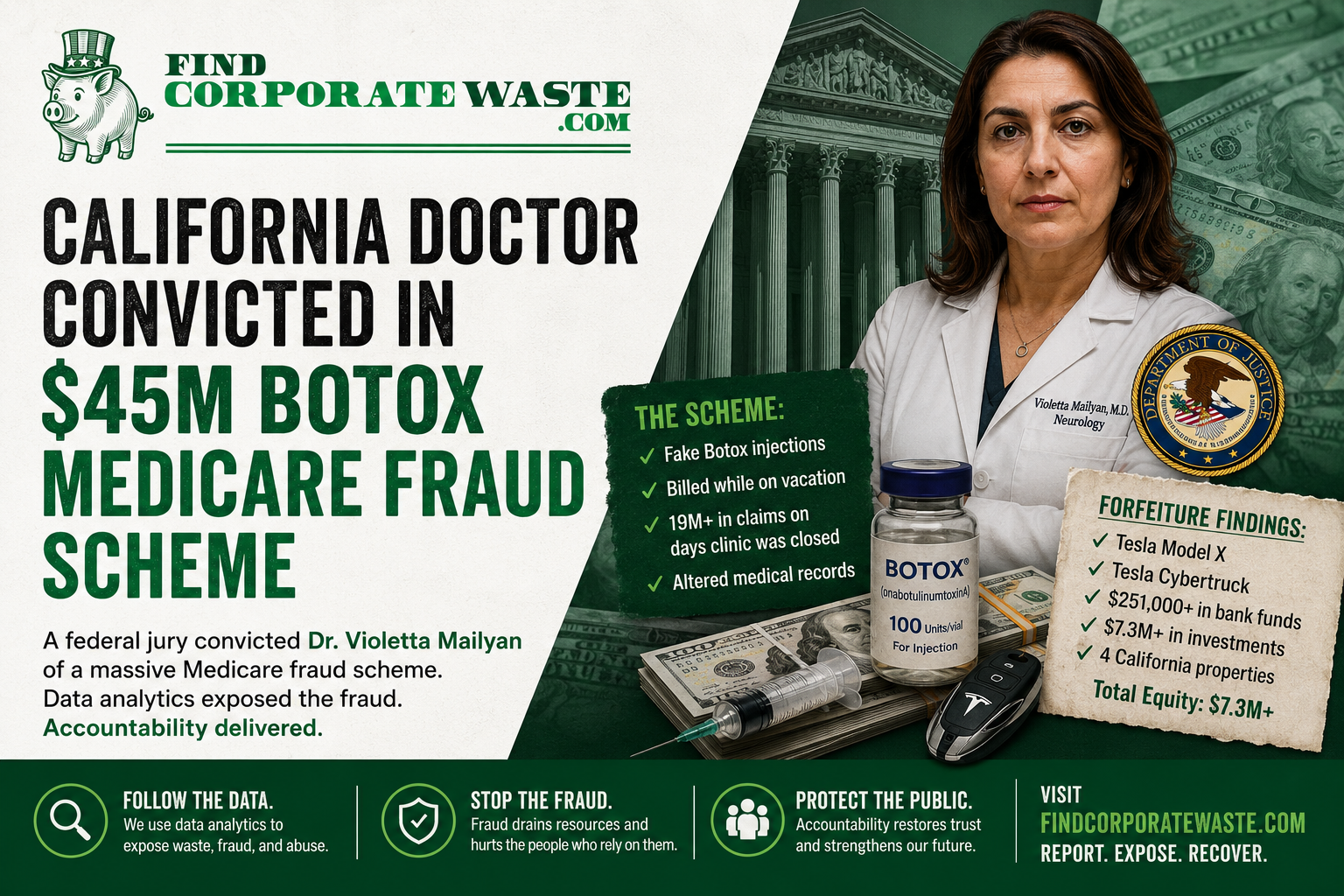
    A federal jury in the Central District of California convicted Dr. Violetta Mailyan, 45, of Glendale, California, for her role in a $45 million Medicare fraud scheme built around Botox billing. According to the DOJ, Mailyan submitted claims for Botox injections that were either never provided, medically unnecessary, cosmetic in nature, or unsupported by the medical records required for Medicare reimbursement. 

    The DOJ said the investigation began after the Health Care Fraud Section’s Data Analytics Team flagged Mailyan as an extreme Medicare outlier: she had been paid more for Botox injections than any other doctor in the country.

    At one point, she had received more than $24 million over four years, roughly six times more than the next highest comparison group, all of whom were neurologists.  

    The details are staggering. Prosecutors said Mailyan billed Medicare for Botox treatments while she was vacationing in Cabo, Maui, Las Vegas, Pennsylvania, and New York. She also allegedly billed for a Medicare beneficiary who was incarcerated in federal prison and submitted over $19 million in claims for injections supposedly performed on days when her clinic was closed.  

    According to trial evidence, Mailyan backdated claims, fabricated patient consent forms, altered medical records after receiving a grand jury subpoena, and tried to make it appear that patients suffered from chronic migraines requiring treatment. The jury convicted her of nine counts of wire fraud and three counts of obstruction. Sentencing is scheduled for September 10, 2026

    The forfeiture findings tell the rest of the story: a Tesla Model X, a Tesla Cybertruck, more than $251,000 in bank funds, brokerage accounts valued at over $7.3 million, and four California properties with estimated equity above $7.3 million were found subject to forfeiture as fraud proceeds. 

    This case shows that investigators must follow abnormal billing patterns, outlier providers, ownership trails, and public data signals before the money disappears.

    The DOJ’s new Fraud Division and Health Care Fraud Strike Force are now openly leaning into analytics, and that shift matters. Find Corporate Waste exists to follow that trail.

    If you have information about government funds being misused, inflated, concealed, or routed through questionable claims, now is the time to come forward.

  • FCW Welcomes DOJ FOCUS Initiative to Combat Waste, Fraud, and Abuse With Data Science

    FCW Welcomes DOJ FOCUS Initiative to Combat Waste, Fraud, and Abuse With Data Science

    The Department of Justice’s Civil Division has announced the new FOCUS initiative, short for Fraud Oversight through Careful Use of Statistics. The initiative is aimed at data miners who use public government records to identify potential False Claims Act cases. Find Corporate Waste has developed a sophisticated methodology for addressing Medicare Fraud committed during the COVID-19 Pandemic.

    DOJ Is Recognizing What Serious Data Miners Already Know

    For years, traditional whistleblower cases have often depended on insiders: employees, contractors, billing staff, compliance officers, or executives who saw misconduct from the inside.

    Under the leadership of Acting Attorney General Todd Blanche, the federal government now appears to be recognizing that some fraud patterns can also be found by carefully analyzing public records, payment data, provider databases, and regulatory rules.

    DOJ made clear that it welcomes data miners, but not sloppy work. The Department says it will prioritize data miners who can explain their methodology, validate their findings, understand the relevant program rules, and identify legally sufficient False Claims Act matters.  That is exactly the standard serious public-record investigators should want.

    FCW Welcomes the FOCUS Initiative

    At Find Corporate Waste, we welcome the FOCUS initiative because it encourages a disciplined approach to public-data fraud detection.

    The point is not to accuse every recipient of federal funds of wrongdoing, rather the FOCUS is to identify situations where public records raise a serious, documentable question about whether federal money was obtained or retained in violation of program rules.

    That requires matching payment data to eligibility rules, compliance obligations, provider identifiers, corporate records, exclusion data, licensing data, and other government sources.

    Why PRF Data Deserves Careful Review

    One area FCW plans to continue reviewing is the Provider Relief Fund, commonly known as PRF.

    The PRF was created to support healthcare providers during the COVID-19 emergency. Public PRF data identifies providers that received and accepted payments and agreed to the applicable Terms and Conditions. HRSA has stated that public PRF data reflects providers who received one or more payments, attested to receiving at least one payment, and agreed to the related Terms and Conditions.  

    That attestation piece is important.

    When a provider accepts federal relief money and agrees to Terms and Conditions, the question becomes whether the recipient was actually eligible, whether the money was properly retained, and whether any later reporting or compliance obligations were satisfied.

    How the Medicare Opt-Out Database Fits In

    FCW also plans to use the Medicare Opt-Out Affidavits database as part of its review process.

    The CMS opt-out dataset identifies providers who have decided not to participate in Medicare. CMS states that the dataset includes information such as provider NPI, specialty, address, and opt-out effective dates.  

    That database is useful because PRF payments were connected to healthcare providers operating within federal healthcare programs and subject to specific eligibility and compliance rules.

    If public PRF records appear to overlap with Medicare opt-out records, that does not automatically prove fraud. But it does create a legitimate line of inquiry worth reviewing.

    The key is timing, identity, and rule application.

    Data Mining Is Not Guesswork

    The strongest False Claims Act cases are built on public records.

    The goal is to determine whether a public-data anomaly is just an innocent mismatch, a clerical issue, or a real compliance problem involving federal funds.

    That distinction matters. It protects honest providers. It also helps the government focus on cases that are actually worth pursuing.

    Why This Matters for Taxpayers

    COVID-era relief programs moved enormous sums of federal money very quickly. Many recipients used those funds properly. Others may not have.

    The False Claims Act exists because public money comes with rules. When companies or providers accept federal funds, they do not get to ignore the conditions attached to those funds.

    The DOJ’s FOCUS initiative sends a clear message: public data can help uncover fraud, but only when it is used responsibly.

    FCW’s Position

    FCW welcomes DOJ’s FOCUS initiative and supports a high standard for data-driven False Claims Act work.

    Public records are an untapped way to identify waste, fraud, and abuse that would otherwise remain obscure and buried.

    Think You Have Information About Federal Healthcare Fraud?

    If you worked for a provider, billing company, healthcare contractor, clinic, management company, or related entity that received federal funds during the COVID-19 period, your information may matter.

    FCW reviews public records and potential False Claims Act leads involving federal healthcare payments, relief funds, and government program compliance.

    Whistleblowers play a major role in protecting taxpayer money. In many cases, relators who bring successful False Claims Act cases may be eligible to receive a share of the government’s recovery.

    If you have credible information about federal funds being obtained, retained, or reported improperly, FCW can help evaluate whether the facts may warrant attorney review.

    Find Corporate Waste exists to help turn public records into accountability.