Category: Telemedicine

  • Circle Medical to Pay $3.325M Over Alleged False Healthcare Claims

    Circle Medical to Pay $3.325M Over Alleged False Healthcare Claims

    San Francisco-based Circle Medical Care of California, Circle Medical Technologies, Inc., and Chief Medical Officer Dr. Nicole Tsang, D.O., agreed to pay $3,325,000 to resolve allegations that they submitted false claims to federal healthcare programs and California commercial insurers.

    According to the DOJ⁠, Circle operates an online telehealth platform offering mental health and primary care services through contract providers, including nurse practitioners and physician assistants. The government alleged that from January 1, 2018 through May 31, 2025, Circle submitted claims using the names and NPI numbers of rendering providers who did not actually provide or supervise the services billed. The claims allegedly involved programs including Medicare, Medicaid, and TRICARE.  

    The settlement allocates $475,000 to the United States and $2.85 million to California. The matter began as a qui tam whistleblower case filed by Jason Vellen, who will receive $80,750 from the federal recovery and $997,500 from California.  

    This case fits the broader Find Corporate Waste focus on healthcare payment integrity: claims data, provider identifiers, supervision rules, and federal program billing requirements can expose recoverable taxpayer losses. 
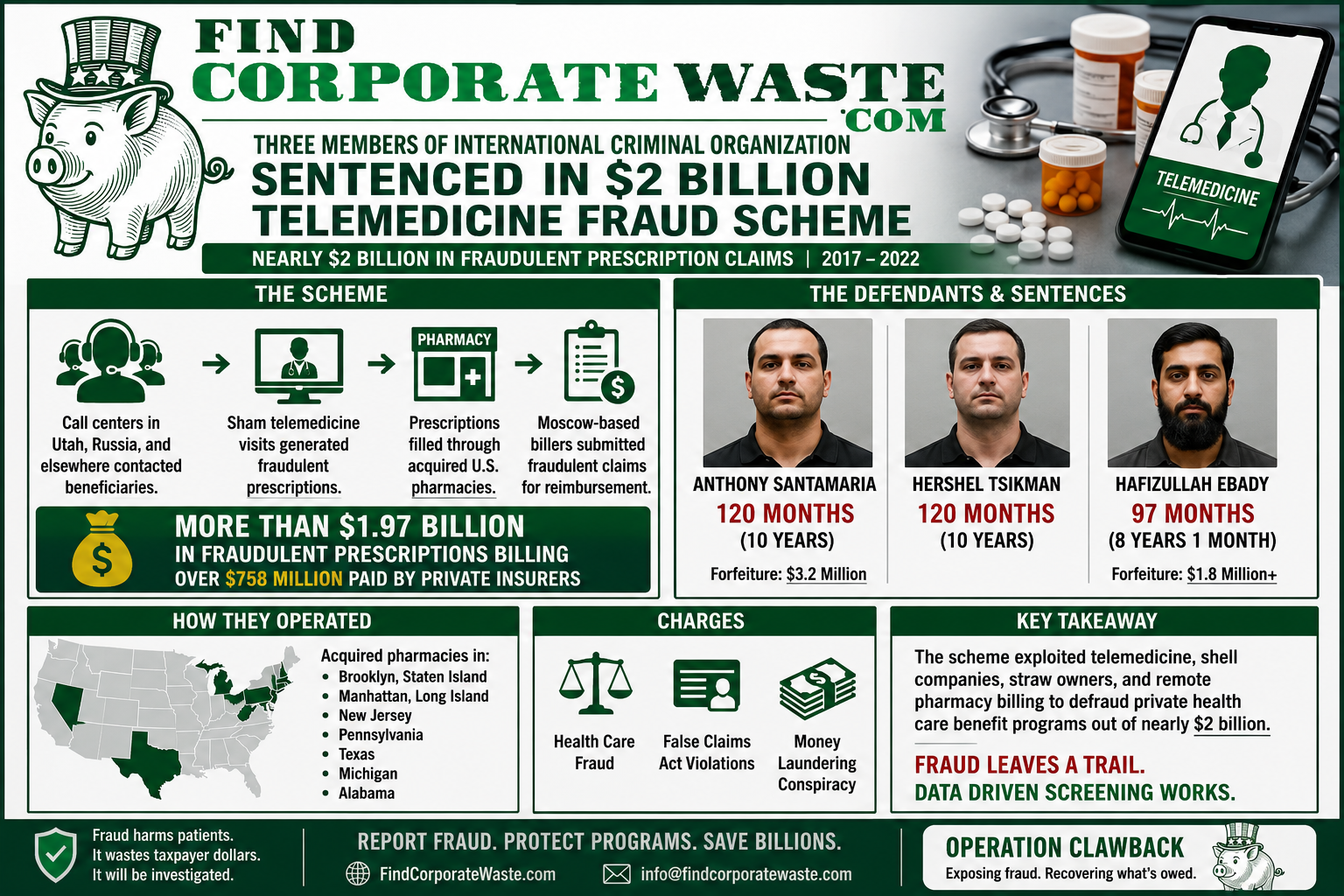
  • Three Members of International Criminal Organization Sentenced in $2 Billion Telemedicine Fraud Scheme

    Three Members of International Criminal Organization Sentenced in $2 Billion Telemedicine Fraud Scheme

    Three members of a Moscow-based international criminal organization have been sentenced for their roles in a massive telemedicine health care fraud scheme that generated nearly $2 billion in fraudulent prescription claims.

    According to the DOJ, Anthony Santamaria was sentenced in Brooklyn federal court to 10 years in prison. Co-defendants Hershel Tsikman and Hafizullah Ebady were sentenced earlier this month to 120 months and 97 months in prison, respectively. Santamaria was also ordered to forfeit $3.2 million, while Ebady was ordered to forfeit more than $1.8 million. Restitution will be determined later.  

    The scheme allegedly operated from 2017 through 2022 and targeted private health care benefit programs. Prosecutors said the organization used call centers in Utah, Russia, and elsewhere to contact beneficiaries and offer medications without proper medical exams.

    In many cases, beneficiaries allegedly never had real telemedicine visits, yet fraudulent prescriptions were generated under physicians’ names and National Provider Identifier numbers.  

    The DOJ said the defendants acquired pharmacies across the United States, including in Brooklyn, Staten Island, Manhattan, Long Island, New Jersey, Pennsylvania, Texas, Michigan, and Alabama. Moscow-based billers then remotely submitted reimbursement requests through those pharmacies. Third-party billing records showed more than $1.97 billion in fraudulent prescriptions, with private insurers paying over $758 million.  

    This case shows the same structural fraud signals that matter across health care enforcement: shell companies, straw owners, remote billing, identity misuse, NPI abuse, and weak gatekeeping around payment systems. For Find Corporate Waste, the lesson is simple: complex fraud often leaves a public-data trail before prosecutors ever announce charges.

    Whether the target is private insurance fraud, Medicare billing abuse, or pandemic relief eligibility, the work begins by matching names, entities, addresses, program rules, and exclusion records.

    Operation Clawback applies that same logic to pandemic-era health care relief by reviewing PRF/CARES recipients against exclusion and eligibility data, including OIG LEIE records and PRF eligibility conditions.