Category: Medicare Fraud

  • Health Care Fraud Can Carry a Life Sentence When Patients Die

    Health Care Fraud Can Carry a Life Sentence When Patients Die

    Did you know? Federal health care fraud can carry a life sentence when the fraud results in a patient’s death.

    Under 18 U.S.C. § 1347, knowingly and willfully executing—or attempting to execute—a scheme to defraud a health care benefit program can ordinarily result in up to 10 years in federal prison.

    But the penalties escalate sharply when the fraudulent conduct causes physical harm.

    If the violation results in serious bodily injury, the defendant may face up to 20 years in prison.

    If the violation results in death, federal law permits a sentence of any term of years or life imprisonment, in addition to a potential fine.

    That makes § 1347 more than a statute aimed solely at protecting programs such as Medicare and Medicaid from financial loss. Congress expressly tied the severity of punishment to the human consequences of health care fraud.

    What Does 18 U.S.C. § 1347 Prohibit?

    Section 1347 makes it a federal crime to knowingly and willfully execute, or attempt to execute, a scheme:

    • to defraud a health care benefit program; or
    • to obtain money or property controlled by a health care benefit program through false or fraudulent pretenses, representations, or promises.

    The conduct must be connected to the delivery of, or payment for, health care benefits, items, or services.

    Health Care Fraud Is Not Always Just Financial Fraud

    Health care fraud cases often involve false billing, services never provided, falsified diagnoses, medically unnecessary treatment, kickbacks, fraudulent prescriptions, or other misrepresentations used to obtain payment from government health programs.

    Those same patterns also frequently appear in civil False Claims Act enforcement, where the government and whistleblowers can pursue recovery of taxpayer funds lost through false or fraudulent claims.

    But criminal health care fraud becomes considerably more serious when the scheme places patients in danger.

    For example, Find Corporate Waste previously reported on the conviction of a Brooklyn clinic owner in a $52 million health care fraud and kickback scheme. Prosecutors said patients received prescriptions from a practitioner who had not seen or spoken with them and were subjected to medically unnecessary testing while Medicare and Medicaid were billed.

    Cases like these illustrate why federal health care fraud law is not concerned only with the amount of money stolen.

    When fraudulent conduct causes serious bodily injury or death, § 1347 allows the criminal consequences to increase dramatically.

    The amount fraudulently billed therefore is not the only factor that can determine the seriousness of a federal health care fraud prosecution.

    The consequences suffered by patients can matter just as much.

    Congress Also Lowered a Potential Knowledge Barrier

    Congress amended § 1347 in 2010 to add subsection (b).

    That provision states that, for purposes of a § 1347 prosecution, a person does not need to have actual knowledge of the statute itself or a specific intent to violate that particular statutory provision.

    The government must still prove the elements of the underlying offense, including that the defendant knowingly and willfully executed or attempted to execute the fraudulent scheme.

    Why It Matters

    Federal health care fraud enforcement is often described in terms of taxpayer losses, including cases where millions or even billions of dollars are improperly billed to Medicare, Medicaid, and other health care programs.

    But § 1347 shows that Congress contemplated something more serious than financial loss alone.

    When a fraudulent scheme crosses the line from stealing health care dollars to seriously injuring or killing someone, federal criminal exposure can escalate from years in prison to life imprisonment.

    For more on fraud involving federal health care programs, see Find Corporate Waste’s coverage of Medicare fraud, Medicaid fraud, and the False Claims Act.
  • Pennsylvania Medical Supplier Billed $1.3B in Five Months, DOJ Says

    Pennsylvania Medical Supplier Billed $1.3B in Five Months, DOJ Says

    A Pennsylvania medical supplier allegedly submitted $1.3 billion in fraudulent health care claims during a five-month period, according to the Department of Justice⁠.

    Federal prosecutors charged Erekle Gugava, 33, a Georgian national, with conspiring to launder proceeds from the alleged scheme.

    Gugava purportedly owned ND Medical Solutions LLC from February through July 2025. During that period, the durable medical equipment company allegedly billed Medicare, supplemental insurers, employer-sponsored plans and other insurers for equipment that patients never received.

    Insurers paid ND Medical approximately $6.5 million.

    Prosecutors allege the claims relied partly on stolen identities belonging to elderly and disabled Americans. Many beneficiaries reportedly contacted Medicare and its contractors after receiving benefit statements listing equipment they had never requested, doctors they had never visited and a supplier they did not recognize.

    Gugava allegedly opened several ND Medical bank accounts, deposited insurance payments and helped transfer the proceeds to overseas accounts benefiting a transnational criminal organization based in Russia and elsewhere.

  • Complete Health Pays $14.1M Over Inflated Medicare Advantage Diagnoses

    Complete Health Pays $14.1M Over Inflated Medicare Advantage Diagnoses

    Complete Health Partners Holdings will pay $14.1 million to settle allegations that it used unsupported patient diagnoses to increase Medicare Advantage payments.

    The Jacksonville, Florida-based company manages and operates affiliated medical groups in Florida, Alabama and Colorado.

    Under its contracts with Medicare Advantage insurers, Complete Health received a percentage of the payments those insurers collected from the Centers for Medicare & Medicaid Services. Because CMS pays more for patients coded as having serious medical conditions, Complete Health stood to profit when patient risk scores increased.

    According to the Justice Department⁠, Complete Health submitted unsupported diagnoses between 2020 and 2023 involving drug and alcohol dependence, major depression, bipolar disorder and paranoid disorders.

    Federal officials alleged that the company distributed incorrect coding guidance, searched medical records for additional diagnoses and prompted physicians to add conditions that were not clinically justified or properly supported.

    Those diagnoses increased payments from CMS to Medicare Advantage insurers. The insurers then passed part of the additional money to Complete Health.

    The case was brought under the False Claims Act by Karen Bowers, a former associate director of risk adjustment at VIVA Health. Bowers will receive approximately $2.47 million from the federal recovery.

    The settlement shows why insiders remain critical to exposing Medicare Advantage fraud. Employees who understand coding guidance, physician prompts, risk-adjustment reviews and payment arrangements may be able to identify when patient conditions are being exaggerated to extract more taxpayer money.

  • Boston Eye Practice to Pay $3.9M Over Unsupported Medicare Billing

    Boston Eye Practice to Pay $3.9M Over Unsupported Medicare Billing

    Ophthalmic Consultants of Boston, Inc. has agreed to pay $3.9 million to resolve allegations that it improperly billed Medicare and MassHealth for office visits performed alongside eye injections.

    According to the Justice Department⁠, OCB submitted the claims between January 2015 and July 2025. Federal and state billing rules generally prohibit providers from separately charging for an office visit when it is conducted as part of an intravitreal injection appointment, except under limited circumstances.

    Prosecutors alleged that OCB used Modifier 25 to bill for additional office visits without documentation establishing that the services were separately identifiable and medically necessary.

    The settlement credits OCB for cooperating with the government’s investigation. It resolves allegations and does not constitute a determination of liability.

    The case began with a sealed whistleblower lawsuit filed under the False Claims Act. The unidentified relator will receive an undisclosed portion of the recovery.

    The settlement demonstrates how unsupported billing modifiers can turn routine coding practices into substantial taxpayer losses. For healthcare insiders, recurring use of Modifier 25 without matching clinical documentation may provide the evidence needed to expose systematic overbilling.

  • Abusive Michigan Day Care Owner Billed Medicare for Dead Patients

    Abusive Michigan Day Care Owner Billed Medicare for Dead Patients

    A Michigan adult day care owner pleaded guilty to billing Medicare for psychotherapy services that were never provided, including sessions supposedly performed after patients had died.

    According to the Justice Department⁠, Yolanda Matthews, 58, of Farmington Hills, submitted more than $539,000 in false Medicare claims.

    Matthews admitted billing for services while beneficiaries were hospitalized and filing claims under the names of social workers who no longer worked at her adult day care center. She also billed Medicare for treating beneficiaries after their deaths.

    Matthews pleaded guilty to conspiracy to commit health care fraud after being charged through the 2026 National Health Care Fraud Takedown. She faces up to 10 years in prison when sentenced on Nov. 18.

    Both Matthews and her husband were previously found responsible for abusing patients in their care.

    Link to allegations: https://adultfostercare.apps.lara.state.mi.us/Home/ViewReport/341911
  • SSM Health Pays Nearly $1M After Pharmacy Copay Waiver Allegations

    SSM Health Pays Nearly $1M After Pharmacy Copay Waiver Allegations

    This case is an example of how the Trump Administration’s Department of Justice is clawing back billions of taxpayer dollars from fraud schemes throughout the country.

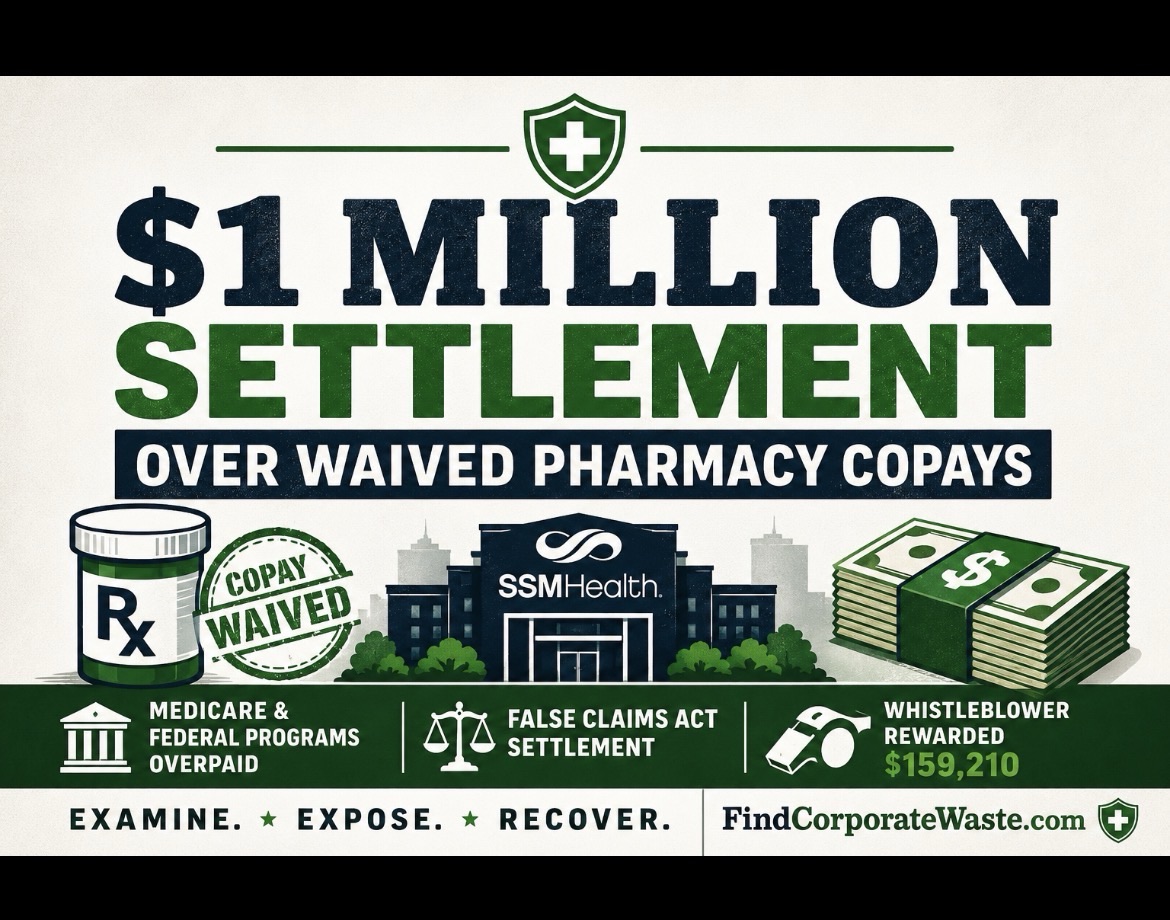
    The United States has reached a $939,290 civil settlement⁠ with SSM Health Care over allegations that the retail pharmacy at Saint Louis University Hospital routinely waived patient copays, causing Medicare and the Federal Employees Health Benefits Program to overpay for prescriptions.  

    DOJ says the conduct ran from September 2020 through February 2023, with pharmacy employees allegedly waiving or failing to collect copays. That is not a harmless discount. Routine copay waivers can steer patients to one pharmacy, hide the real prescription cost, and inflate what federal programs pay.

    The case began with a qui tam whistleblower suit filed under the False Claims Act. The whistleblower will receive $159,210, while SSM will also pay $150,000 in fees and costs. SSM did not admit liability and DOJ credited the company’s cooperation and remedial action.  

    For FCW, the takeaway is direct: when providers manipulate the economics behind federally reimbursed claims, the taxpayer is left holding the bill. Copays are not paperwork. They are part of the program-integrity firewall.

  • Circle Medical to Pay $3.325M Over Alleged False Healthcare Claims

    Circle Medical to Pay $3.325M Over Alleged False Healthcare Claims

    San Francisco-based Circle Medical Care of California, Circle Medical Technologies, Inc., and Chief Medical Officer Dr. Nicole Tsang, D.O., agreed to pay $3,325,000 to resolve allegations that they submitted false claims to federal healthcare programs and California commercial insurers.

    According to the DOJ⁠, Circle operates an online telehealth platform offering mental health and primary care services through contract providers, including nurse practitioners and physician assistants. The government alleged that from January 1, 2018 through May 31, 2025, Circle submitted claims using the names and NPI numbers of rendering providers who did not actually provide or supervise the services billed. The claims allegedly involved programs including Medicare, Medicaid, and TRICARE.  

    The settlement allocates $475,000 to the United States and $2.85 million to California. The matter began as a qui tam whistleblower case filed by Jason Vellen, who will receive $80,750 from the federal recovery and $997,500 from California.  

    This case fits the broader Find Corporate Waste focus on healthcare payment integrity: claims data, provider identifiers, supervision rules, and federal program billing requirements can expose recoverable taxpayer losses. 

  • Ahold Delhaize USA to Pay $40M Over Allegedly Inflated Pharmacy Prices

    Ahold Delhaize USA to Pay $40M Over Allegedly Inflated Pharmacy Prices

    Ahold Delhaize USA Inc.⁠, the parent company behind supermarket pharmacy brands including Giant, Hannaford, Stop & Shop, Food Lion, and others, has agreed to pay $40 million to resolve False Claims Act allegations involving prescription drug pricing.

    According to the DOJ⁠, Ahold Delhaize allegedly reported inflated “usual and customary” prices on claims submitted to Medicare Part D, Medicaid, and TRICARE. Prosecutors said the company operated prescription savings programs that offered discounted prices to enrolled customers, but allegedly failed to report those discounted prices as the pharmacies’ usual and customary prices.

    That distinction matters because usual and customary prices can operate as ceiling prices in federal health care reimbursement formulas. The government alleged that by reporting higher prices, Ahold Delhaize caused federal health care programs to pay more than they should have paid on pharmacy claims.

    Of the $40 million settlement, $32.9 million represents the federal share, with the remainder going to participating states.

    The case began as a whistleblower action filed by Lawrence LaBenne, a Pennsylvania pharmacist at an Ahold Delhaize supermarket.

    He will receive $6,083,587 from the federal recovery.

    The settlement is another example of how pricing representations, claim-level billing data, and insider knowledge drive many False Claims Act recoveries.

    For Find Corporate Waste⁠, the case fits the broader enforcement pattern: federal programs rely on accurate certifications and truthful claim data, and public money can be recovered when those representations are allegedly false.

  • Brooklyn Clinic Manager Convicted in $8M Medicare Fraud Scheme

    Brooklyn Clinic Manager Convicted in $8M Medicare Fraud Scheme

    A federal jury convicted Olga Popovych, a New York clinic manager, for her role in an $8 million Medicare fraud scheme, according to the DOJ.  

    Prosecutors said Popovych managed several physical therapy clinics that paid cash kickbacks to ambulette drivers who brought Medicare patients to the clinics. The DOJ said she was personally involved in paying the kickbacks and falsifying medical records to claim that physical therapists treated patients when they were not actually present.  

    Between 2018 and 2020, Medicare paid the clinics more than $8 million. Trial witnesses also testified that Popovych used coded text messages to discuss kickbacks and took steps to conceal the scheme after suspecting law enforcement was watching the clinics.  

    The jury convicted Popovych of conspiracy to commit health care fraud, conspiracy to make false statements relating to health care matters, four counts of health care fraud, and three counts of making false statements relating to health care matters.

    She faces up to 10 years for each health care fraud conviction and up to 5 years for each false-statement conviction. A federal judge will determine the sentence under the U.S. Sentencing Guidelines and other statutory factors.  

    The case was investigated by HHS-OIG and the FBI.

    Anyone with inside knowledge of kickback arrangements, false billing, fabricated medical records, or patient-recruitment schemes involving federal health care programs may have information relevant to public-fraud enforcement.

    Find Corporate Waste protects confidential sources and helps preserve the right to report fraud.

  • $56.5M Settlement Targets Medicare Diagnosis Codes Scheme

    $56.5M Settlement Targets Medicare Diagnosis Codes Scheme

    Community Care Health Network LLC, doing business as Matrix Medical Network, DPN USA, doing business as HealthFair, and Shahriah “James” Ekbatani agreed to pay $56.5 million to resolve False Claims Act allegations over unsupported Medicare Advantage diagnosis codes, the DOJ announced.

    Matrix will pay $36.5 million, HealthFair will pay $5 million, and Ekbatani will pay $15 million.

    The DOJ alleged the defendants caused Medicare Advantage Organizations to submit false or invalid diagnosis codes to CMS, increasing risk-adjusted taxpayer payments.

    Matrix allegedly used in-home assessments to report unsupported conditions. HealthFair allegedly used mobile assessment buses to report unsupported diagnoses under Ekbatani’s direction.

    The whistleblowers will receive major awards. Former Matrix employee Nancy Cahill will receive $7.3 million. Former HealthFair chief medical officer Dr. Robert Oristaglio Jr. will receive $3.6 million.

    Insiders with knowledge of unsupported diagnosis coding, chart-review pressure, mobile assessments, or Medicare Advantage billing failures may have information relevant to public-fraud enforcement.

    Find Corporate Waste helps protect insiders while exposing fraud, waste, and abuse in taxpayer-funded programs.