
The Department of Justice announced a national health care fraud takedown charging 455 defendants, including 90 licensed medical professionals, in alleged schemes exceeding $6.5 billion.
The DOJ credited analytics with identifying suspicious billing patterns, including alleged wound-care schemes, hospice fraud, opioid diversion, Medicaid billing fraud, kickbacks, and claims for services that were medically unnecessary, never provided, or billed while patients were hospitalized elsewhere.
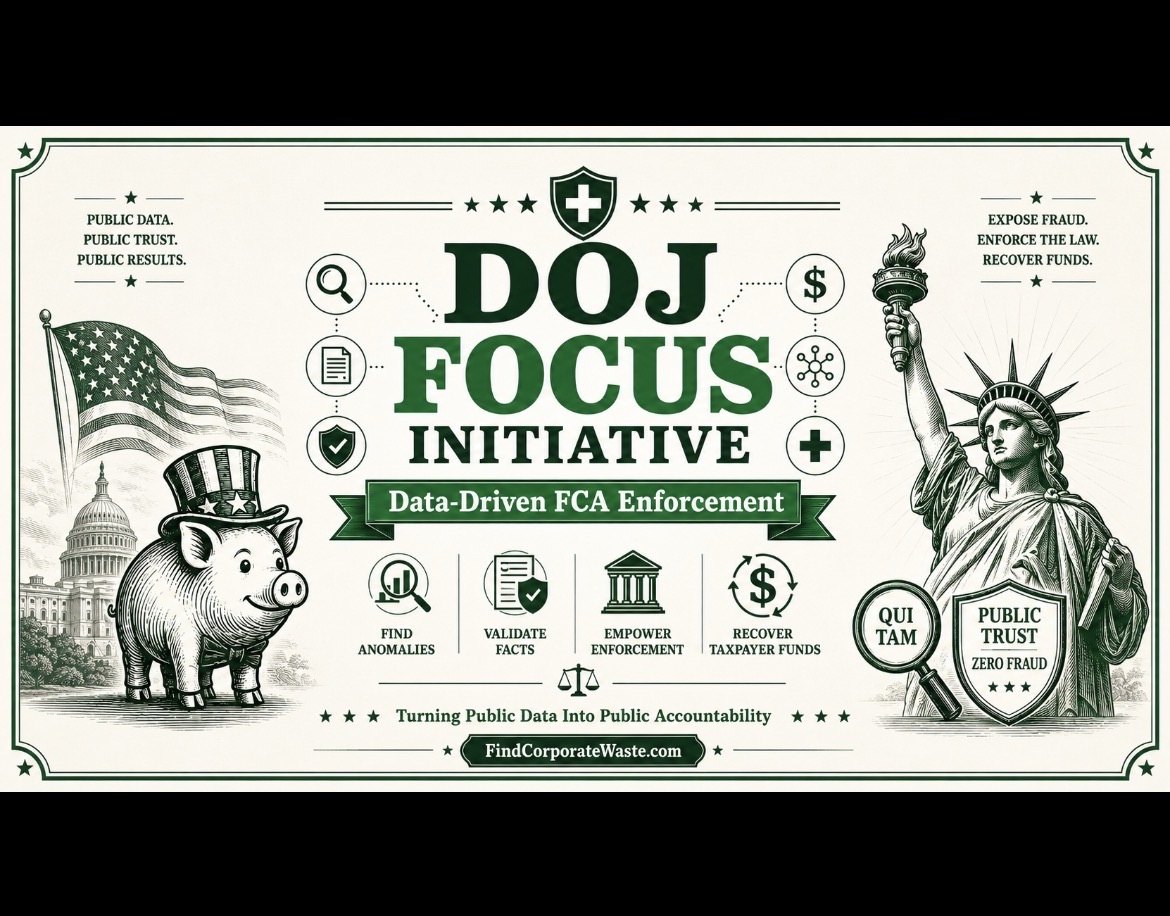
That is exactly where DOJ’s FOCUS Initiative must be tied in. FOCUS was designed to prioritize high-quality qui tam actions from data miners who apply public government data to regulatory frameworks in ways that identify fraud otherwise likely to go undetected.
This takedown proves the model. Public data is not proof of fraud, but it can expose patterns requiring verification: abnormal billing spikes, excluded providers receiving federal funds, Medicaid providers with impossible utilization, related entities moving across programs, and relief recipients whose certifications deserve review.
For Find Corporate Waste, the connection is direct. Pandemic-era programs such as the Provider Relief Fund required recipients to satisfy eligibility terms, including restrictions tied to exclusion from federal health care programs.
Operation Clawback applies that same principle in FCW’s relator activities: comparing relief-payment data against exclusion, billing, ownership, and enforcement records, then referring those documented anomalies for recovery review.
FOCUS must not be siloed off from health care enforcement. It should become a valuable intake lane for disciplined, sourced, public-record leads that help DOJ, HHS-OIG, CMS, and Medicaid Fraud Control Units examine, expose, and recover taxpayer funds.
Leave a Reply