Tag: Taxpayer

  • Three Members of International Criminal Organization Sentenced in $2 Billion Telemedicine Fraud Scheme

    Three Members of International Criminal Organization Sentenced in $2 Billion Telemedicine Fraud Scheme

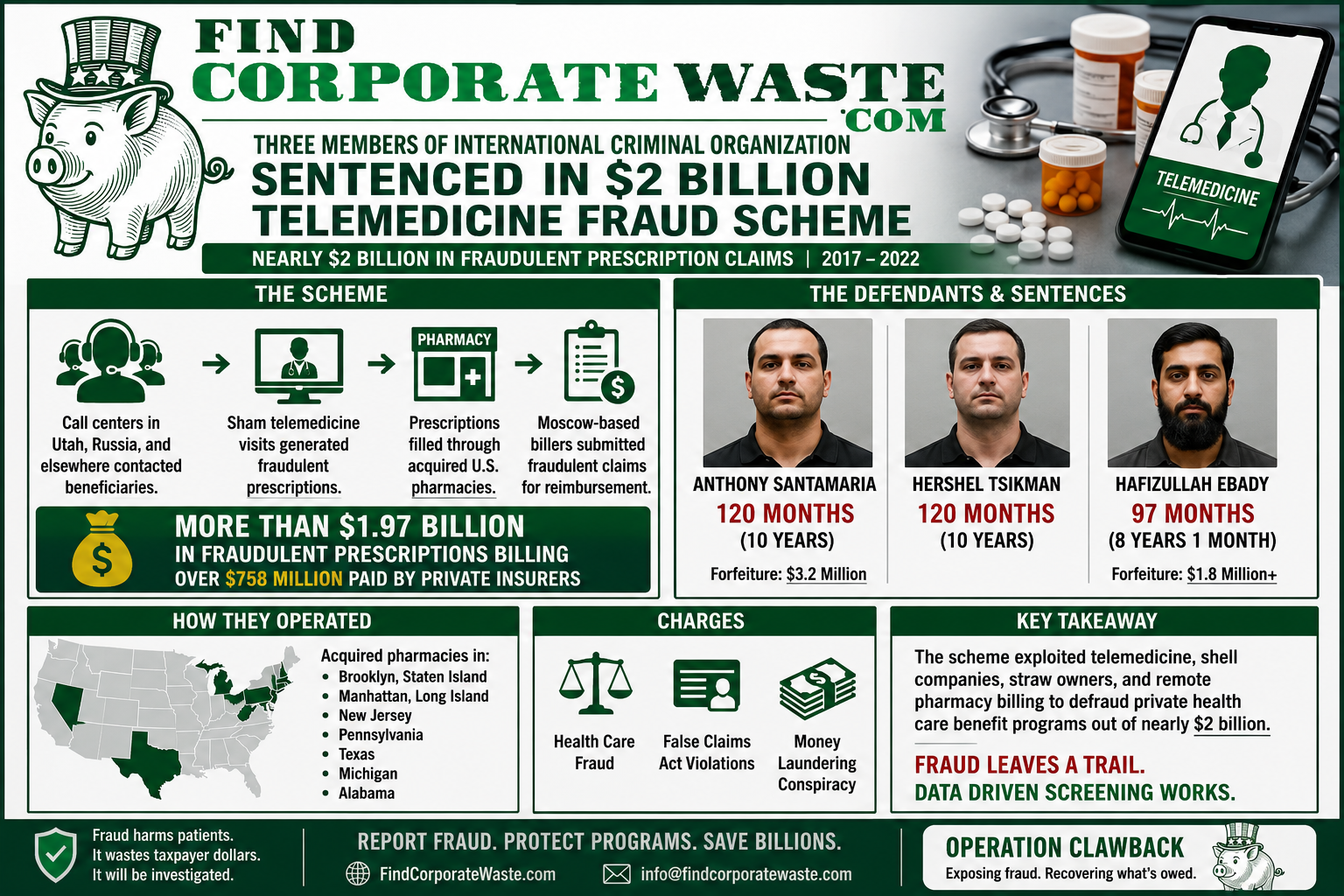
    Three members of a Moscow-based international criminal organization have been sentenced for their roles in a massive telemedicine health care fraud scheme that generated nearly $2 billion in fraudulent prescription claims.

    According to the DOJ, Anthony Santamaria was sentenced in Brooklyn federal court to 10 years in prison. Co-defendants Hershel Tsikman and Hafizullah Ebady were sentenced earlier this month to 120 months and 97 months in prison, respectively. Santamaria was also ordered to forfeit $3.2 million, while Ebady was ordered to forfeit more than $1.8 million. Restitution will be determined later.  

    The scheme allegedly operated from 2017 through 2022 and targeted private health care benefit programs. Prosecutors said the organization used call centers in Utah, Russia, and elsewhere to contact beneficiaries and offer medications without proper medical exams.

    In many cases, beneficiaries allegedly never had real telemedicine visits, yet fraudulent prescriptions were generated under physicians’ names and National Provider Identifier numbers.  

    The DOJ said the defendants acquired pharmacies across the United States, including in Brooklyn, Staten Island, Manhattan, Long Island, New Jersey, Pennsylvania, Texas, Michigan, and Alabama. Moscow-based billers then remotely submitted reimbursement requests through those pharmacies. Third-party billing records showed more than $1.97 billion in fraudulent prescriptions, with private insurers paying over $758 million.  

    This case shows the same structural fraud signals that matter across health care enforcement: shell companies, straw owners, remote billing, identity misuse, NPI abuse, and weak gatekeeping around payment systems. For Find Corporate Waste, the lesson is simple: complex fraud often leaves a public-data trail before prosecutors ever announce charges.

    Whether the target is private insurance fraud, Medicare billing abuse, or pandemic relief eligibility, the work begins by matching names, entities, addresses, program rules, and exclusion records.

    Operation Clawback applies that same logic to pandemic-era health care relief by reviewing PRF/CARES recipients against exclusion and eligibility data, including OIG LEIE records and PRF eligibility conditions.  

  • Florida Manufacturer Pays $2.6 Million To Resolve False Claims Act Allegations

    Florida Manufacturer Pays $2.6 Million To Resolve False Claims Act Allegations

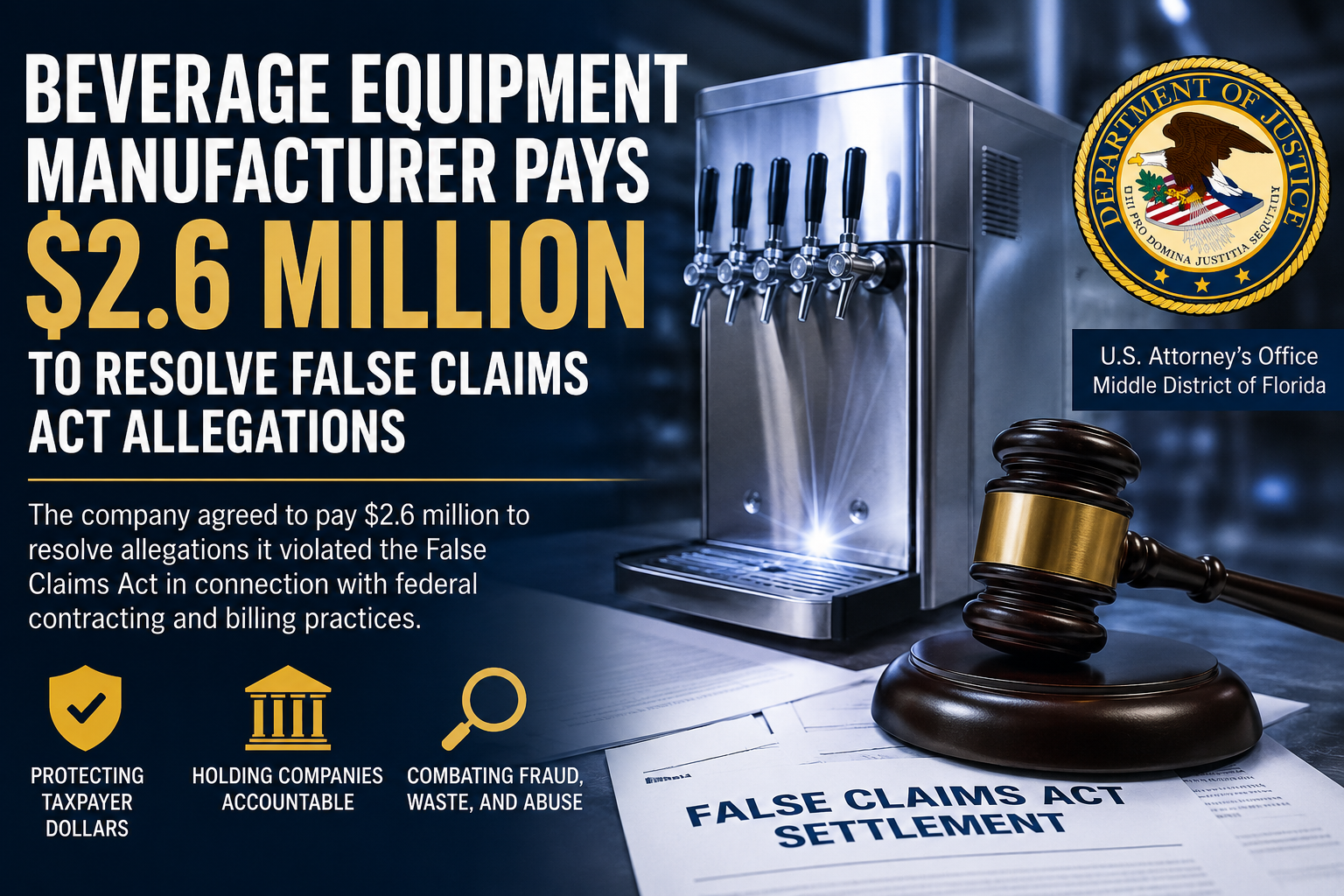
    Micro Matic USA, Inc., a beverage dispensing equipment manufacturer based in Brooksville, Florida, has agreed to pay $2,593,219.18 to resolve allegations that it improperly obtained a Paycheck Protection Program (PPP) loan.

    The settlement was announced by the U.S. Attorney’s Office for the Middle District of Florida on May 12, 2026. According to DOJ, Micro Matic allegedly violated the False Claims Act by obtaining a PPP loan despite being ineligible under the program’s rules.  

    Under the second round of PPP, businesses generally needed 300 or fewer employees to qualify. SBA affiliation rules required applicants to count employees and revenue from related companies, including foreign affiliates. The DOJ alleged that Micro Matic was not eligible because it was not a small business once its foreign affiliates were included.  

    The case began with a qui tam complaint filed by GNGH2, Inc., which alleged that Micro Matic improperly obtained a $2 million PPP loan. The settlement concludes the litigation, and GNGH2 will receive $259,321.91 as its share of the recovery.  

    This is exactly the kind of case Find Corporate Waste (FCW) tracks. A company certifies eligibility, federal money goes out, and later a relator identifies the missing connection between the application and the rules.

    The case also fits squarely within DOJ’s renewed fraud-enforcement posture. The announcement states that the matter is part of the Trump Administration’s Task Force to Eliminate Fraud and follows DOJ’s creation of the National Fraud Enforcement Division, whose mission includes investigating and prosecuting fraudulent misuse of taxpayer dollars.  

    At Find Corporate Waste, we specialize in identifying the discrepancies that led to the $2.59 million settlement with Micro Matic USA, Inc.

    Our investigation model is built on cross-referencing databases the government maintains but fails to connect. We use data science to detect patterns that suggest fraud, waste, and abuse.

    These cases are not rare. They are a symptom of the broader pattern of pandemic relief fraud. For more information about these cases, or to report potential waste of federal funds, reach out to info@findcorporatewaste.com and be sure to subscribe.

  • FCW Welcomes DOJ FOCUS Initiative to Combat Waste, Fraud, and Abuse With Data Science

    FCW Welcomes DOJ FOCUS Initiative to Combat Waste, Fraud, and Abuse With Data Science

    The Department of Justice’s Civil Division has announced the new FOCUS initiative, short for Fraud Oversight through Careful Use of Statistics. The initiative is aimed at data miners who use public government records to identify potential False Claims Act cases. Find Corporate Waste has developed a sophisticated methodology for addressing Medicare Fraud committed during the COVID-19 Pandemic.

    DOJ Is Recognizing What Serious Data Miners Already Know

    For years, traditional whistleblower cases have often depended on insiders: employees, contractors, billing staff, compliance officers, or executives who saw misconduct from the inside.

    Under the leadership of Acting Attorney General Todd Blanche, the federal government now appears to be recognizing that some fraud patterns can also be found by carefully analyzing public records, payment data, provider databases, and regulatory rules.

    DOJ made clear that it welcomes data miners, but not sloppy work. The Department says it will prioritize data miners who can explain their methodology, validate their findings, understand the relevant program rules, and identify legally sufficient False Claims Act matters.  That is exactly the standard serious public-record investigators should want.

    FCW Welcomes the FOCUS Initiative

    At Find Corporate Waste, we welcome the FOCUS initiative because it encourages a disciplined approach to public-data fraud detection.

    The point is not to accuse every recipient of federal funds of wrongdoing, rather the FOCUS is to identify situations where public records raise a serious, documentable question about whether federal money was obtained or retained in violation of program rules.

    That requires matching payment data to eligibility rules, compliance obligations, provider identifiers, corporate records, exclusion data, licensing data, and other government sources.

    Why PRF Data Deserves Careful Review

    One area FCW plans to continue reviewing is the Provider Relief Fund, commonly known as PRF.

    The PRF was created to support healthcare providers during the COVID-19 emergency. Public PRF data identifies providers that received and accepted payments and agreed to the applicable Terms and Conditions. HRSA has stated that public PRF data reflects providers who received one or more payments, attested to receiving at least one payment, and agreed to the related Terms and Conditions.  

    That attestation piece is important.

    When a provider accepts federal relief money and agrees to Terms and Conditions, the question becomes whether the recipient was actually eligible, whether the money was properly retained, and whether any later reporting or compliance obligations were satisfied.

    How the Medicare Opt-Out Database Fits In

    FCW also plans to use the Medicare Opt-Out Affidavits database as part of its review process.

    The CMS opt-out dataset identifies providers who have decided not to participate in Medicare. CMS states that the dataset includes information such as provider NPI, specialty, address, and opt-out effective dates.  

    That database is useful because PRF payments were connected to healthcare providers operating within federal healthcare programs and subject to specific eligibility and compliance rules.

    If public PRF records appear to overlap with Medicare opt-out records, that does not automatically prove fraud. But it does create a legitimate line of inquiry worth reviewing.

    The key is timing, identity, and rule application.

    Data Mining Is Not Guesswork

    The strongest False Claims Act cases are built on public records.

    The goal is to determine whether a public-data anomaly is just an innocent mismatch, a clerical issue, or a real compliance problem involving federal funds.

    That distinction matters. It protects honest providers. It also helps the government focus on cases that are actually worth pursuing.

    Why This Matters for Taxpayers

    COVID-era relief programs moved enormous sums of federal money very quickly. Many recipients used those funds properly. Others may not have.

    The False Claims Act exists because public money comes with rules. When companies or providers accept federal funds, they do not get to ignore the conditions attached to those funds.

    The DOJ’s FOCUS initiative sends a clear message: public data can help uncover fraud, but only when it is used responsibly.

    FCW’s Position

    FCW welcomes DOJ’s FOCUS initiative and supports a high standard for data-driven False Claims Act work.

    Public records are an untapped way to identify waste, fraud, and abuse that would otherwise remain obscure and buried.

    Think You Have Information About Federal Healthcare Fraud?

    If you worked for a provider, billing company, healthcare contractor, clinic, management company, or related entity that received federal funds during the COVID-19 period, your information may matter.

    FCW reviews public records and potential False Claims Act leads involving federal healthcare payments, relief funds, and government program compliance.

    Whistleblowers play a major role in protecting taxpayer money. In many cases, relators who bring successful False Claims Act cases may be eligible to receive a share of the government’s recovery.

    If you have credible information about federal funds being obtained, retained, or reported improperly, FCW can help evaluate whether the facts may warrant attorney review.

    Find Corporate Waste exists to help turn public records into accountability.
  • South Carolina Man Charged in Medicare and Private Jet Fraud Schemes

    Generated image

    This next case exemplifies how taxpayer dollars have been abused, and demonstrates the importance of recovering such funds when obtained under false circumstances.

    Two separate federal indictments allege that Patrick Britton-Harr, a 41-year old businessman from Charleston, South Carolina, used his company, Provista Health, to fraudulently bill Medicare more than $15 million for respiratory pathogen panel (RPP) tests during the COVID-19 Pandemic.

    The government alleges that over $5 million was paid out by Medicare for these bogus claims.

    In addition, Britton-Harr ran a Ponzi scheme where he banked $1.5 million in payments from individuals who allegedly trusted him to purchase airplanes for their usage as part of an exclusive group through the corporation AeroVanti Inc.

    At Find Corporate Waste, we illustrate the critical role that the False Claims Act serves in safeguarding taxpayer funds. While the indictments do not directly mention a qui tam relator in this case, this tool can be used to recover government funds in cases relating to Defense and National Security, Manufacturing and Tariffs, and PPP Loans.