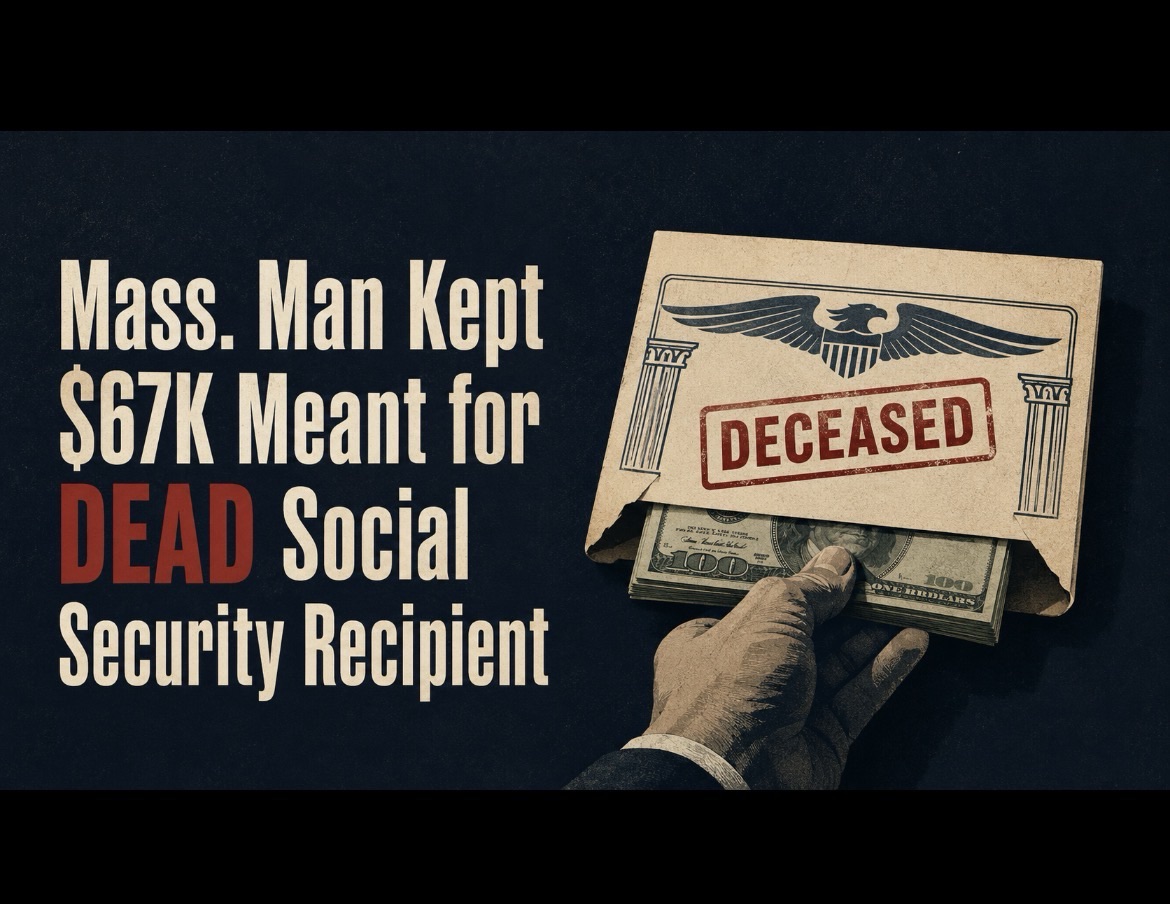
A Massachusetts man kept collecting federal benefits for six years after the intended recipient died.
James C. Burdulis, 57, of Lynn, MA received $63,959 in Social Security benefits and $3,200 in pandemic stimulus payments intended for a beneficiary who died in May 2019.
Burdulis had served as the beneficiary’s representative payee.
Instead, prosecutors said Burdulis filed five fraudulent reports between 2020 and 2024 claiming the money had been spent for the deceased beneficiary.
He also submitted a September 2020 verification form stating that the beneficiary remained alive at the same address.
Burdulis pleaded guilty in April to receiving stolen government money and making false statements. He was sentenced to one day in prison, deemed served, followed by three years of supervised release. He must repay $67,159.
The Department of Homeland Security announced Tuesday that ICE Homeland Security Investigations arrested Denise Nataly Migliore, a lawful permanent resident from Australia.
Federal prosecutors allege Migliore falsely claimed U.S. citizenship to register to vote in 2022 and 2024, then cast ballots in both federal election cycles.
That raises a second question for Find Corporate Waste: what systems processed those registrations, and what were taxpayers told those systems could do?
Under the Help America Vote Act, states must maintain centralized statewide voter-registration databases. The U.S. Election Assistance Commission recognizes those systems as combinations of software, hardware and related technology used to manage voter records.
FCW is examining whether private contractors were paid to provide identity matching, data integration, eligibility controls or exception reporting, and whether those capabilities were accurately represented to government customers.
If a taxpayer-funded vendor knowingly overstated system capabilities or falsely certified required controls, the issue could extend into procurement fraud and potentially False Claims Act exposure.
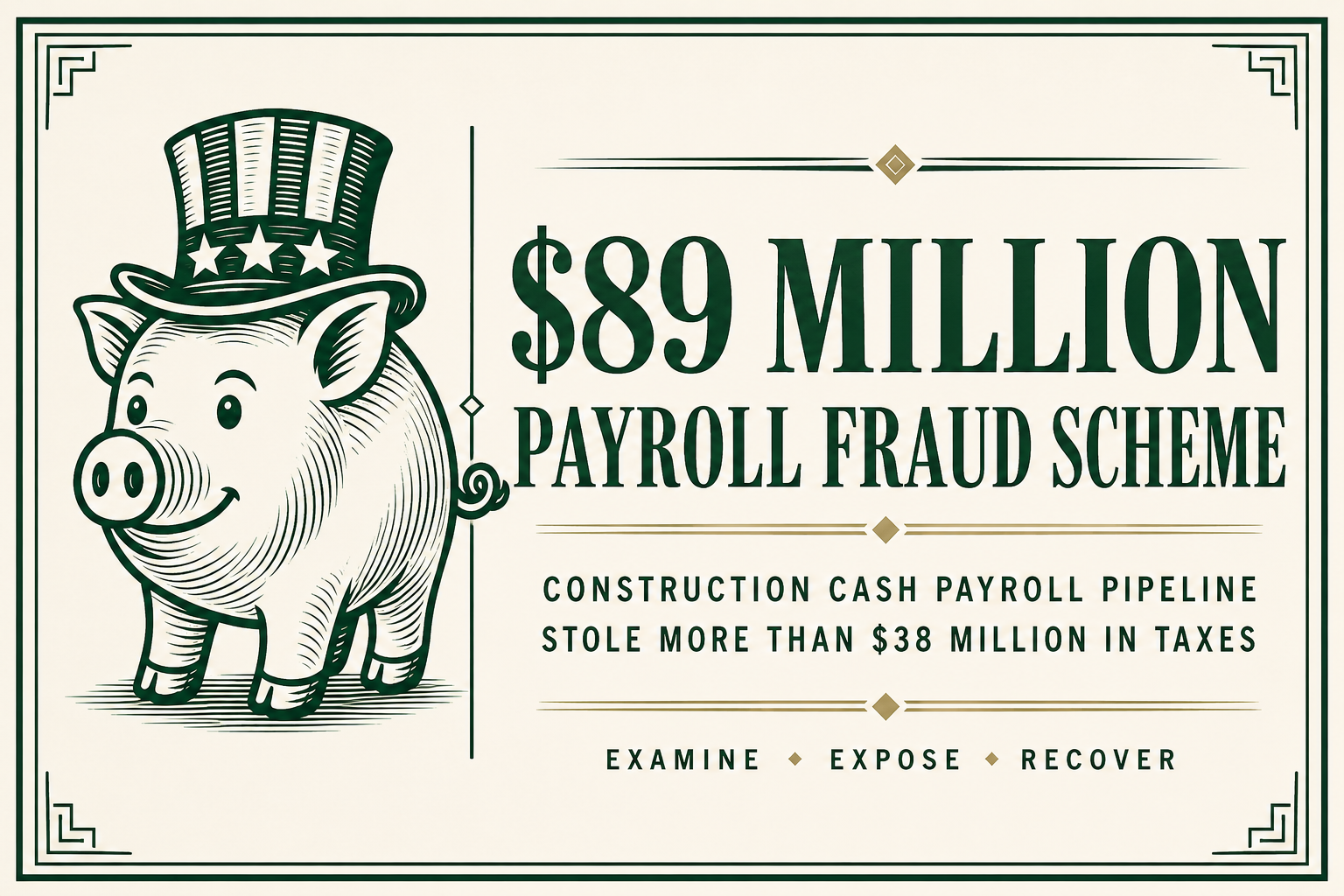
The IRS announced that Mario Flores, a Honduran national, was sentenced to 96 months in prison for his role in an off-the-books payroll scheme tied to the construction industry based in Orlando, FL.
The sentencing record shows the scale. Flores received eight years in prison. Co-conspirator Iris Villafranca was previously sentenced to 17 years, ordered to pay more than $38 million in restitution, and ordered to forfeit $89 million in criminal proceeds.
According to the IRS Criminal Investigation, Flores and his co-conspirators used shell companies to cash approximately $89 million in checks from construction subcontractors between 2015 and 2022.
The scheme converted contractor checks into cash so workers could be paid off the books. That structure helped contractors avoid payroll taxes, falsify tax filings, and conceal the true size of their workforce.
This was not just illegal hiring. It was a fraud model. Through this scheme, The United States lost more than $38 million.
Off-the-books payroll gives dishonest contractors an artificial advantage over lawful employers. They avoid taxes, insurance costs, reporting duties, and worker-authorization rules while competitors are forced to comply.
The scheme also targeted workers’ compensation insurance. Prosecutors said the conspirators leased insurance certificates to contractors and submitted false information about the number of workers covered and the amount they were paid.
For Find Corporate Waste, the relevance is the fraud architecture. Shell companies, false filings, subcontractor pass-throughs, cash payroll, and insurance misrepresentations are not isolated paperwork issues. They are vital data signals.
Eligibility must be testable and traceable, such that disqualifying facts can be presented to trigger recovery through qui tam proceedings.
The underground economy drains public revenue, rewards unlawful contractors, and forces taxpayers to subsidize businesses that refuse to follow the rules.
Find Corporate Waste is here to track every lead and to provide assistance to federal partners in addressing the systematic fraud issue that has plagued our country for far too long.
This case is an example of how the Trump Administration’s Department of Justice is clawing back billions of taxpayer dollars from fraud schemes throughout the country.
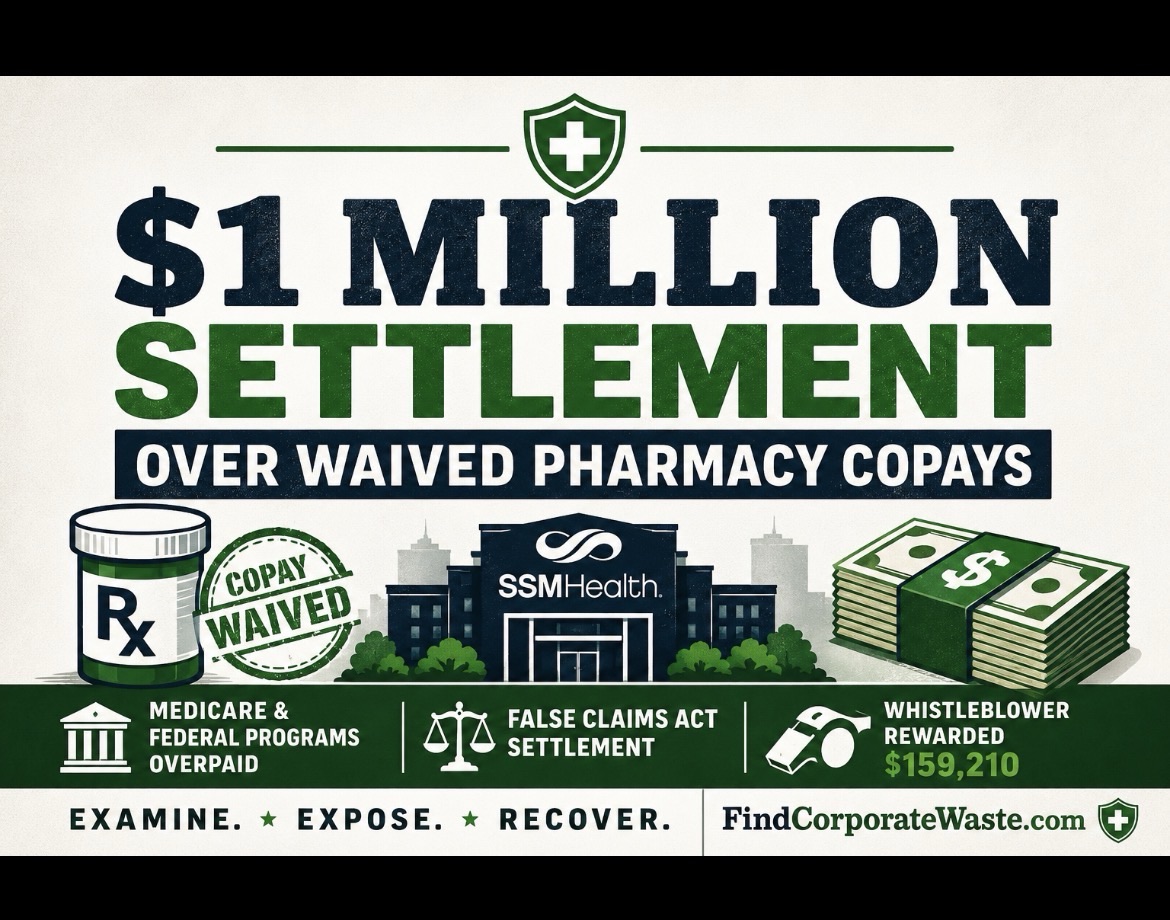
The United States has reached a $939,290 civil settlement with SSM Health Care over allegations that the retail pharmacy at Saint Louis University Hospital routinely waived patient copays, causing Medicare and the Federal Employees Health Benefits Program to overpay for prescriptions.
DOJ says the conduct ran from September 2020 through February 2023, with pharmacy employees allegedly waiving or failing to collect copays. That is not a harmless discount. Routine copay waivers can steer patients to one pharmacy, hide the real prescription cost, and inflate what federal programs pay.
The case began with a qui tam whistleblower suit filed under the False Claims Act. The whistleblower will receive $159,210, while SSM will also pay $150,000 in fees and costs. SSM did not admit liability and DOJ credited the company’s cooperation and remedial action.
For FCW, the takeaway is direct: when providers manipulate the economics behind federally reimbursed claims, the taxpayer is left holding the bill. Copays are not paperwork. They are part of the program-integrity firewall.
The latest pandemic-relief fraud case out of North Carolina is a story about tax preparers who abused their gatekeeping role, converted federal relief into a refund machine, and helped drain money from programs Congress created for people and businesses in legitimate distress.
According to the Department of Justice, the preparers used false tax returns to claim fraudulent COVID-era paid sick and family leave credits. The conspiracy allegedly ran from approximately April 2022 through May 2023 and involved refund claims tied to relief provisions meant for legitimate businesses.
DOJ says Nejlai Mitchell, owner of a tax preparation business operating in Lumberton and Hope Mills, pleaded guilty to conspiracy and assisting in the preparation of false returns. Seven other preparers also pleaded guilty for their roles in the scheme.
For FCW, this case reinforces why pandemic-relief enforcement cannot stop at PPP or Provider Relief Fund reviews. Relief fraud moved through tax credits, refund claims, payroll representations, and professional intermediaries.
Operation Clawback is built around that same premise: COVID-era funds must be screened against eligibility rules, exclusion indicators, and public-record red flags.
The Department of Justice announced a national health care fraud takedown charging 455 defendants, including 90 licensed medical professionals, in alleged schemes exceeding $6.5 billion.
The DOJ credited analytics with identifying suspicious billing patterns, including alleged wound-care schemes, hospice fraud, opioid diversion, Medicaid billing fraud, kickbacks, and claims for services that were medically unnecessary, never provided, or billed while patients were hospitalized elsewhere.
That is exactly where DOJ’s FOCUS Initiative must be tied in. FOCUS was designed to prioritize high-quality qui tam actions from data miners who apply public government data to regulatory frameworks in ways that identify fraud otherwise likely to go undetected.
This takedown proves the model. Public data is not proof of fraud, but it can expose patterns requiring verification: abnormal billing spikes, excluded providers receiving federal funds, Medicaid providers with impossible utilization, related entities moving across programs, and relief recipients whose certifications deserve review.
For Find Corporate Waste, the connection is direct. Pandemic-era programs such as the Provider Relief Fund required recipients to satisfy eligibility terms, including restrictions tied to exclusion from federal health care programs.
Operation Clawback applies that same principle in FCW’s relator activities: comparing relief-payment data against exclusion, billing, ownership, and enforcement records, then referring those documented anomalies for recovery review.
FOCUS must not be siloed off from health care enforcement. It should become a valuable intake lane for disciplined, sourced, public-record leads that help DOJ, HHS-OIG, CMS, and Medicaid Fraud Control Units examine, expose, and recover taxpayer funds.
Federal prosecutors have charged eight defendants in an alleged $38 million Medicaid fraud scheme involving two Brooklyn social adult day care centers: APNA Adult Daycare and Ashiana Social Adult Daycare, according to the New York Post.
The reported indictment alleges that Medicaid recipients were paid cash kickbacks to enroll, recruiters were paid to bring in beneficiaries, and the centers then billed New York Medicaid for services that were not actually provided. Prosecutors also reportedly allege fake sign-in sheets, Pakistan-based billing support, and shell-company transfers labeled as “gifts,” “dividends,” “medicine,” or “laddu.”
For Find Corporate Waste, the relevance is the public-funds mechanism: Medicaid claims allegedly tied to false attendance, kickback-driven enrollment, and non-rendered services.
That is the same fraud structure FCW tracks across taxpayer-funded health care programs, including provider eligibility, billing integrity, ownership/control relationships, and public-payment exposure.
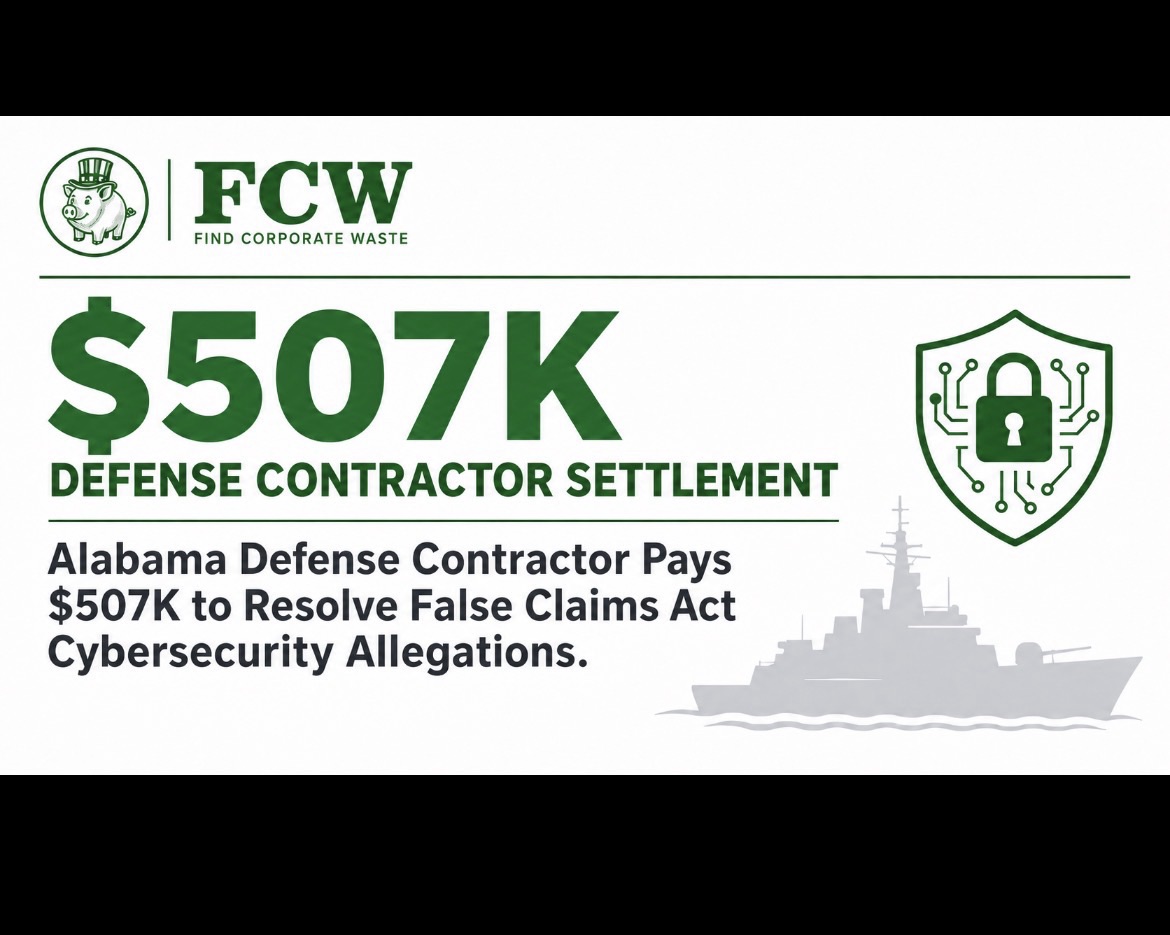
The Department of Justice announced that LOGZONE Inc. agreed to pay $507,144 to resolve False Claims Act liability related to alleged cybersecurity noncompliance on Department of the Navy contracts.
LOGZONE, a Huntsville, Alabama defense contractor, provided logistical, inventory, and facilities support services for the Naval Oceanographic Command Property Management Program at Stennis Space Center in Mississippi.
According to DOJ, the Navy contracts required LOGZONE to comply with cybersecurity obligations under DFARS contract clauses, including requirements tied to NIST SP 800-171, which governs protection of controlled unclassified information in nonfederal systems.
The government alleged that LOGZONE submitted claims for payment while failing to fully implement required cybersecurity controls.
The DOJ also alleged that LOGZONE submitted a perfect cybersecurity self-assessment score of 110 in October 2021, but a later government assessment in February 2024 produced a score of -170.
The settlement agreement states that the covered conduct occurred from May 5, 2021, through March 8, 2025. The $507,144 settlement includes $253,572 in restitution.
This case reflects DOJ’s continued use of the False Claims Act to pursue government contractors that allegedly seek federal payment while failing to meet material contract requirements.
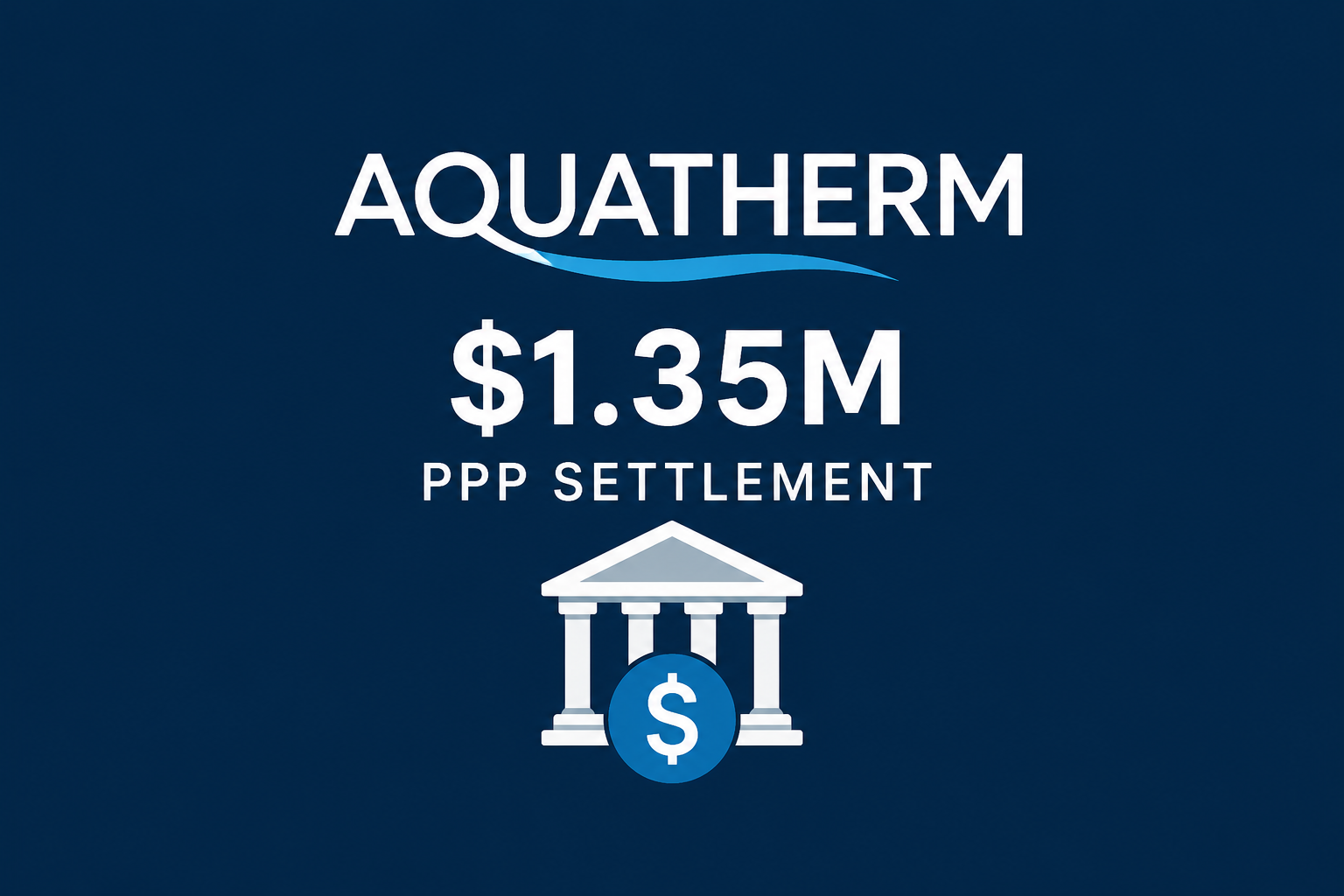
DOJ said Aquatherm received an $864,982 PPP loan in March 2021 after certifying that it and its affiliates had fewer than 300 employees. Under the applicable PPP rule, that employee count included domestic and foreign affiliates.
According to DOJ, Aquatherm is 99% owned by Aquatherm Besitzgesellschaft mbH & Co. KG, a German company. The government alleged that Aquatherm exceeded the 300-employee limit when its domestic and foreign affiliates were included, making it ineligible for the loan. Aquatherm later received full forgiveness from the SBA.
The settlement also resolved claims brought under the qui tam provisions of the False Claims Act. DOJ said the whistleblower will receive a share of the recovery.
The case highlights a recurring PPP enforcement issue: affiliate headcount. For public-record screening, foreign ownership, control, affiliated entities, employee count, and forgiveness records can all create eligibility questions requiring verification.
An Arkansas pathology lab and its owners agreed to pay $30 million to resolve federal allegations that their business model turned physician referrals and add-on testing into a taxpayer-funded billing pipeline.
Federal prosecutors also alleged APS caused special stains and confirmatory testing to be ordered automatically before a pathologist determined whether the tests were medically necessary.
In essence, the government alleged extra testing was built into the process first, while medical necessity came second.
The case originated from three whistleblower lawsuits filed under the False Claims Act. As part of the resolution, APS entered into a five-year Corporate Integrity Agreement with HHS-OIG requiring compliance reforms, training, auditing, and review of physician referral relationships.
For Find Corporate Waste, the settlement shows how federal health care fraud can hide inside ordinary-looking referral networks, lab protocols, and billing defaults. When financial incentives shape where specimens go and testing is added before necessity is established, taxpayers are left paying for a system designed around revenue rather than care.