The latest pandemic-relief fraud case out of North Carolina is a story about tax preparers who abused their gatekeeping role, converted federal relief into a refund machine, and helped drain money from programs Congress created for people and businesses in legitimate distress.
According to the Department of Justice, the preparers used false tax returns to claim fraudulent COVID-era paid sick and family leave credits. The conspiracy allegedly ran from approximately April 2022 through May 2023 and involved refund claims tied to relief provisions meant for legitimate businesses.
DOJ says Nejlai Mitchell, owner of a tax preparation business operating in Lumberton and Hope Mills, pleaded guilty to conspiracy and assisting in the preparation of false returns. Seven other preparers also pleaded guilty for their roles in the scheme.
For FCW, this case reinforces why pandemic-relief enforcement cannot stop at PPP or Provider Relief Fund reviews. Relief fraud moved through tax credits, refund claims, payroll representations, and professional intermediaries.
Operation Clawback is built around that same premise: COVID-era funds must be screened against eligibility rules, exclusion indicators, and public-record red flags.
DOJ said Aquatherm received an $864,982 PPP loan in March 2021 after certifying that it and its affiliates had fewer than 300 employees. Under the applicable PPP rule, that employee count included domestic and foreign affiliates.
According to DOJ, Aquatherm is 99% owned by Aquatherm Besitzgesellschaft mbH & Co. KG, a German company. The government alleged that Aquatherm exceeded the 300-employee limit when its domestic and foreign affiliates were included, making it ineligible for the loan. Aquatherm later received full forgiveness from the SBA.
The settlement also resolved claims brought under the qui tam provisions of the False Claims Act. DOJ said the whistleblower will receive a share of the recovery.
The case highlights a recurring PPP enforcement issue: affiliate headcount. For public-record screening, foreign ownership, control, affiliated entities, employee count, and forgiveness records can all create eligibility questions requiring verification.
Federal prosecutors have charged two Provo, Utah men in an alleged scheme to defraud the IRS and the Small Business Administration out of more than $5.5 million tied to COVID-era relief programs.
According to the SBA Office of Inspector General, David Starling, 61, and Benjamin Young, 39, were charged with conspiring to defraud the United States. Young was also charged with twelve counts of wire fraud. A third defendant, Adam Starling of Oregon, previously pleaded guilty.
The government alleges the defendants owned or controlled eight companies and falsely listed family members — including spouses and children — as employees. Prosecutors say they created false tax documents reporting more than $4 million in wages, then used those documents to obtain COVID-relief benefits.
The alleged proceeds included $3 million in tax credits and $200,000 in Paycheck Protection Program loans, which were later forgiven based on alleged false statements.
The case also includes a separate SBA-backed loan angle. Prosecutors allege Young used fraud proceeds and embezzled funds to buy commercial space in Provo, then relied on fabricated documents to obtain a $2.5 million SBA-secured bank loan.
For Find Corporate Waste, this case is another reminder that COVID-relief enforcement is not just about the original loan. It is about payroll records, forgiveness certifications, tax filings, affiliated entities, and the paper trail behind taxpayer-backed money.
A Louisiana woman pleaded guilty for her role in a multi-state Paycheck Protection Program fraud scheme that allegedly used ineligible borrowers, fake tax forms, and kickbacks to obtain pandemic-relief funds.
According to the DOJ, Lisa Lemoine, 38, of Bossier City, Louisiana, pleaded guilty to one count of conspiracy to commit wire fraud.
Federal prosecutors said Lemoine worked with alleged co-conspirators Sniders Jean-Jacques, Lorne Johnson, Tanya Pierre, Ashley Spike, and others to submit fraudulent PPP applications for borrowers and collect up to 30% of the loan proceeds as a fee.
Beginning in March 2021, Lemoine allegedly recruited borrowers who were not eligible for PPP loans, claimed they operated qualifying businesses, and created fake tax forms to support the applications.
Prosecutors said she received kickbacks from borrowers who obtained PPP funds and shared those payments with co-conspirators.
Jean-Jacques, Johnson, Pierre, and Spike were charged separately in connection with the same alleged scheme.
The charge carries a maximum sentence of 20 years in prison, three years of supervised release, and a fine of $250,000 or twice the gross gain or loss from the scheme.
This case underscores why Find Corporate Waste tracks PPP cases. Anyone with inside knowledge of PPP application brokers, fake tax forms, borrower-recruitment networks, or lender-side approval failures may have information relevant to public-fraud enforcement.
Contact Find Corporate Waste if you know how taxpayer funds were obtained, approved, or forgiven despite false statements.
Brian Graham, 49, of Lithia Springs, Georgia, was sentenced to 37 months in federal prison after pleading guilty to wire fraud in a COVID-relief scheme involving the PPP and EIDL programs.
According to the U.S. Attorney’s Office for the District of Colorado, Graham prepared and submitted fraudulent loan applications between April 2020 and August 2021 for several business entities he controlled. Prosecutors said the applications misstated employee counts, gross revenues, cost of goods sold, and payroll.
The court ordered Graham to pay $441,546 in restitution, serve three years of supervised release, and forfeit proceeds tied to the offense. The SBA also highlighted the sentence.
The critical allegation was not just bad paperwork. Graham certified that the information was accurate and that the funds would be used for payroll and other approved business expenses. Prosecutors said he instead used the bulk of the money for himself.
The case, United States v. Graham, 1:25-cr-00079-JLK, was investigated by TIGTA and the SBA Office of Inspector General.
Brian Graham allegedly used his role as a notary to defraud the American taxpayer.
For Find Corporate Waste, the Graham case is a reminder that pandemic fraud often hides in plain sight: controlled entities, inflated numbers, false certifications, and taxpayer-backed money converted into personal gain.
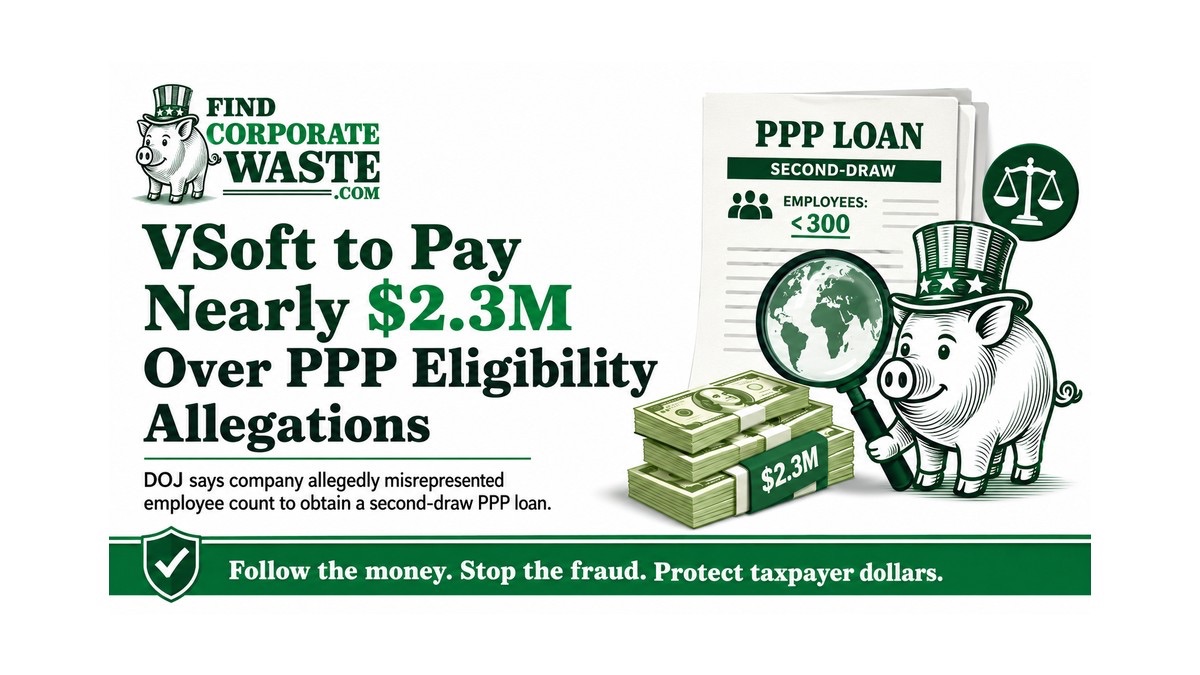
VSoft Corporation has agreed to pay $2,291,927.07 to resolve False Claims Act allegations that it improperly obtained a second-draw Paycheck Protection Program loan.
According to the DOJ, VSoft, an Atlanta-based banking and payment solutions provider, allegedly certified that it qualified as a small business with fewer than 300 employees when applying for a $1,259,732 PPP loan. Prosecutors alleged that VSoft was actually part of an international corporate structure with multiple locations worldwide and employee totals well above the second-draw PPP limit.
This is exactly the kind of case Find Corporate Waste was built to track: follow the money, stop the fraud, and protect taxpayer dollars. Pandemic relief was designed to keep legitimate small businesses alive, not to subsidize companies that allegedly avoided size and affiliation rules.
The case began as a whistleblower action under the False Claims Act: United States ex rel. GHGH2, Inc. v. Vsoft Technologies Corporation, Case No. 3:24-cv-999 (W.D.N.C.).
The settlement resolves allegations only, with no determination of liability. But the message is clear: insiders, competitors, lenders, and data reviewers remain essential to exposing improper relief claims and helping recover public funds.
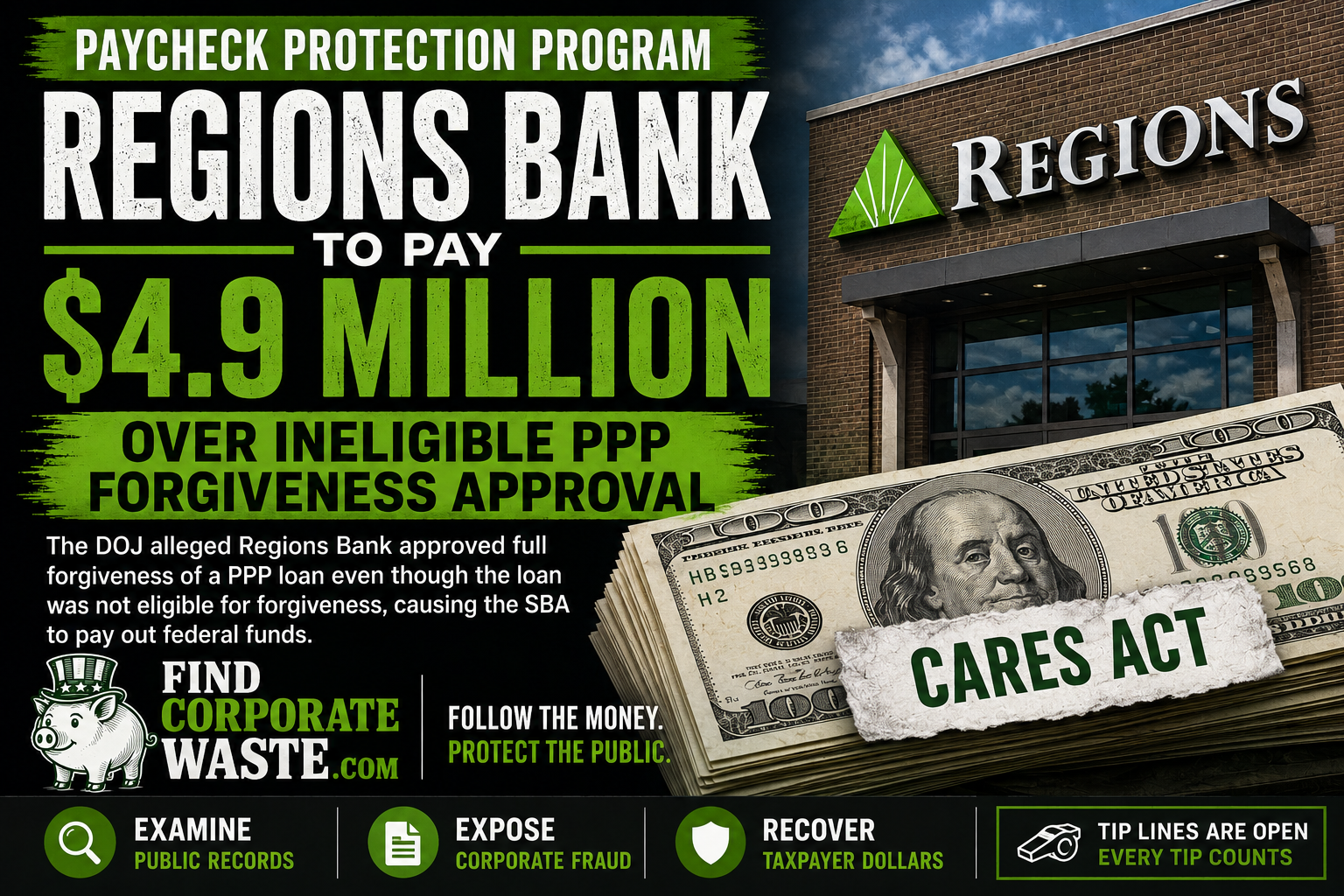
Regions Bank has agreed to pay the United States $4.9 million to resolve civil allegations connected to a Paycheck Protection Program loan forgiveness approval that the government says should not have been granted.
According to the DOJ, the matter involved a PPP loan obtained by Gregory A. DeLine, who owned or operated several businesses, including Midwest Mortgage Associates Corporation d/b/a Total Lending Concepts, Amega Sales Inc., and GKD Management, L.P.
The government alleged that Regions approved full forgiveness of the loan even though the loan was not eligible for forgiveness.
The public settlement documents do not identify the exact defect that made the loan ineligible. That distinction matters. The case should not be overstated as a public finding that the borrower committed fraud or that Regions admitted wrongdoing.
The DOJ framed the civil resolution against Regions under an unjust enrichment theory, meaning the government alleged Regions received money it should not have received after approving forgiveness.
The Paycheck Protection Plan (PPP) was created under the CARES Act to provide emergency relief during the COVID-19 pandemic. Borrowers could seek forgiveness if funds were used for payroll and other approved expenses. Once forgiveness was approved, the SBA paid the lender the forgiven principal and interest.
For Find Corporate Waste, this case highlights why public-data review must examine the full structure of relief programs: borrower eligibility, certifications, lender review, forgiveness approval, and federal reimbursement. A single improper forgiveness approval can create millions in taxpayer exposure.
Public records can identify the pattern, but insider knowledge transform that pattern into an actionable lead potentially worth millions.
A California medical business owner has pleaded guilty to stealing more than $1 million from federal pandemic relief programs.
According to the DOJ, Mehrdad Tabrizi owned Life Fleet Inc. and Resonante Group, two Orange County medical businesses. During the COVID-19 pandemic, he used those companies to submit fraudulent applications for Paycheck Protection Program and Economic Injury Disaster Loan funds.
The DOJ said Tabrizi falsely claimed Life Fleet was operating and had employees who received wages in 2019 and 2020. In reality, the company had been shuttered in 2018 and was no longer operational. Those false PPP applications caused approximately $696,565 to be disbursed into bank accounts he controlled.
Tabrizi also submitted fraudulent EIDL applications claiming Life Fleet and Resonante Group had revenue and business expenses before January 2020. Those applications brought in another $319,800, even though neither company was entitled to the money. The DOJ also said he withdrew $60,000 of the fraud proceeds to help buy a 2019 Porsche Turbo Cabriolet.
He pleaded guilty to four counts of wire fraud and one count of money laundering. Sentencing is scheduled for September 28, 2026.
For Find Corporate Waste, this case shows why pandemic relief fraud remains a major public-accountability issue. Relief programs moved quickly, but speed created opportunities for false certifications, inactive companies, inflated payroll claims, and misuse of taxpayer funds. FCW will continue tracking pandemic relief cases, False Claims Act recoveries, and public-record signals that expose waste, fraud, and abuse.
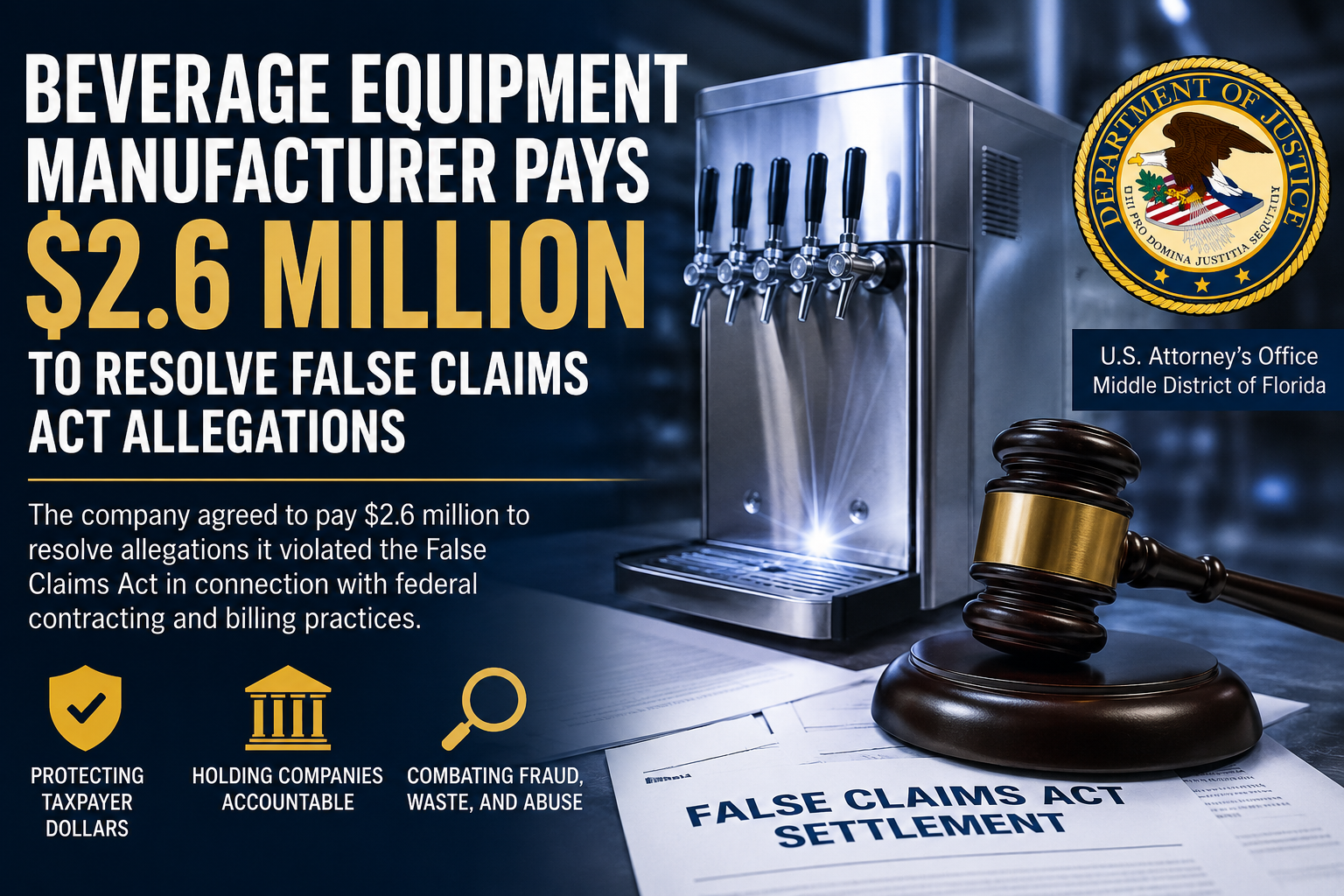
Micro Matic USA, Inc., a beverage dispensing equipment manufacturer based in Brooksville, Florida, has agreed to pay $2,593,219.18 to resolve allegations that it improperly obtained a Paycheck Protection Program (PPP) loan.
The settlement was announced by the U.S. Attorney’s Office for the Middle District of Florida on May 12, 2026. According to DOJ, Micro Matic allegedly violated the False Claims Act by obtaining a PPP loan despite being ineligible under the program’s rules.
Under the second round of PPP, businesses generally needed 300 or fewer employees to qualify. SBA affiliation rules required applicants to count employees and revenue from related companies, including foreign affiliates. The DOJ alleged that Micro Matic was not eligible because it was not a small business once its foreign affiliates were included.
The case began with a qui tam complaint filed by GNGH2, Inc., which alleged that Micro Matic improperly obtained a $2 million PPP loan. The settlement concludes the litigation, and GNGH2 will receive $259,321.91 as its share of the recovery.
This is exactly the kind of case Find Corporate Waste (FCW) tracks. A company certifies eligibility, federal money goes out, and later a relator identifies the missing connection between the application and the rules.
The case also fits squarely within DOJ’s renewed fraud-enforcement posture. The announcement states that the matter is part of the Trump Administration’s Task Force to Eliminate Fraud and follows DOJ’s creation of the National Fraud Enforcement Division, whose mission includes investigating and prosecuting fraudulent misuse of taxpayer dollars.
At Find Corporate Waste, we specialize in identifying the discrepancies that led to the $2.59 million settlement with Micro Matic USA, Inc.
Our investigation model is built on cross-referencing databases the government maintains but fails to connect. We use data science to detect patterns that suggest fraud, waste, and abuse.
These cases are not rare. They are a symptom of the broader pattern of pandemic relief fraud. For more information about these cases, or to report potential waste of federal funds, reach out to info@findcorporatewaste.com and be sure to subscribe.
The Justice Department’s latest COVID-relief fraud case shows where federal enforcement is heading.
In California, tax preparer Kerwin Aldric Jordan pleaded guilty after DOJ said he helped file false tax returns and fraudulently obtained pandemic relief loans. Prosecutors said the conduct caused more than $25 million in tax losses and involved false claims for PPP and EIDL funds. DOJ Press Release
DOJ Is Moving Toward Centralized Fraud Enforcement
This DOJ is no longer treating pandemic fraud as a series of disconnected prosecutions.
The Department is increasingly framing these cases as part of a broader effort to identify fraud, recover taxpayer money, and hold applicants accountable when federal funds were obtained through false statements or false certifications.
That matters for the False Claims Act.
The FCA remains one of the government’s strongest tools for recovering money obtained from the United States through false claims. DOJ reported that FCA settlements and judgments exceeded $2.9 billion in fiscal year 2024, with fraud in pandemic relief programs listed among the Department’s enforcement priorities.
What This Means for Future FCA Cases
COVID-relief programs created a massive paper trail.
Applicants made certifications, which claimed eligibility. They submitted business records, tax information, provider data, and other representations to the government.
Now the DOJ can compare those claims against public records, exclusion lists, agency databases, tax filings, payroll records, and later-discovered facts.
That is the future enforcement model: follow the money, test the certification, and recover funds where the record does not match the claim.
Why Operation Clawback Fits This Model
This is exactly the logic behind Operation Clawback.
Operation Clawback focuses on pandemic-era healthcare relief recipients, including Provider Relief Fund recipients, whose eligibility may not match the public record. One key issue is whether providers excluded from Medicare, Medicaid, or other federal healthcare programs received relief funds despite being barred from participation.
The California case is not a Provider Relief Fund case. It involves tax fraud, PPP loans, and EIDL loans.
But the principle is the same: when federal money was paid based on false information, the government can come back years later.
FCW Bottom Line
DOJ’s reorganization points toward a more data-driven future for FCA enforcement.
Not every suspicious loan is fraud. Not every mismatch proves a case. But when the documents show that federal money was received through false eligibility claims, false certifications, or hidden disqualifying facts, the False Claims Act gives the government a path to recover that money.
Find Corporate Waste is tracking these cases because taxpayers deserve to know where pandemic relief money went, who was eligible to receive it, and whether public funds can still be clawed back when the rules were broken.