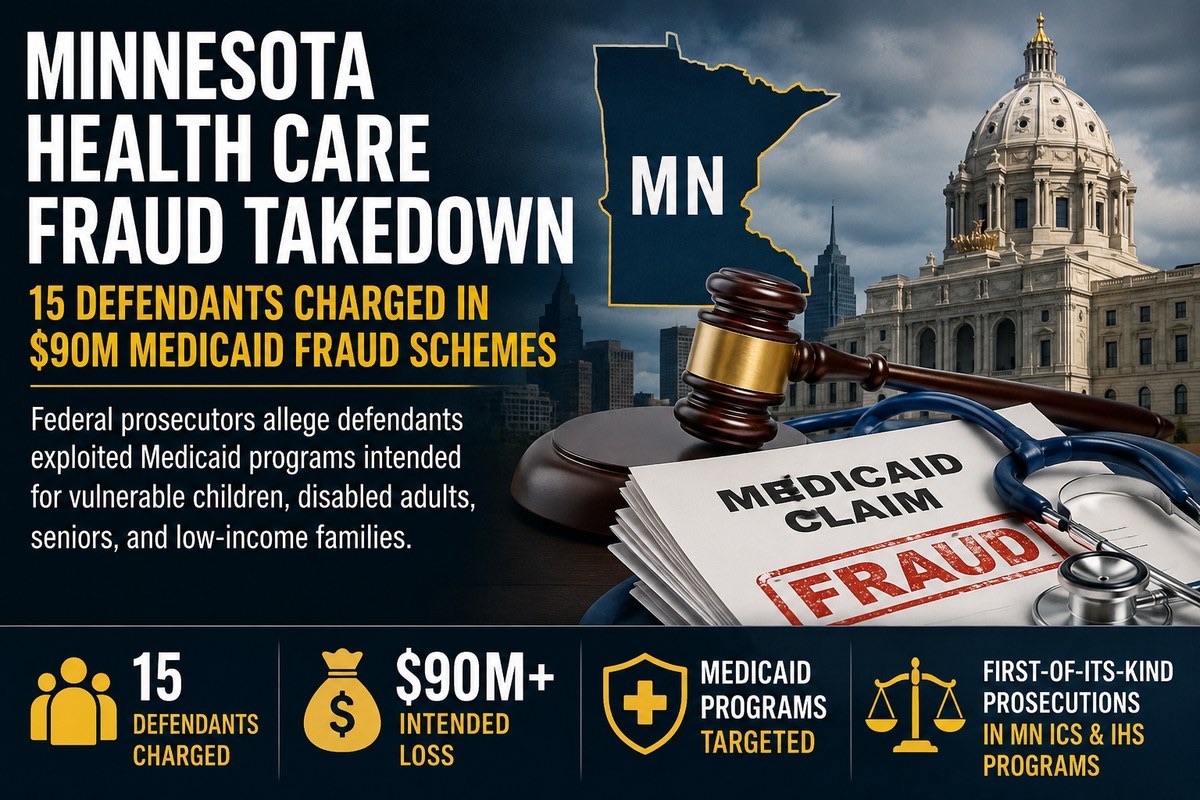
The DOJ announced a major Minnesota health care fraud takedown on May 21, 2026, charging 15 defendants in alleged schemes involving more than $90 million in intended loss.
The charges target owners of child care centers, autism-service providers, housing-support operators, and other Medicaid-linked providers accused of exploiting public programs designed for vulnerable children, disabled adults, seniors, and low-income families.
According to the DOJ, the largest case involves Minnesota’s Early Intensive Developmental and Behavioral Intervention program, known as EIDBI, which provides services for people under 21 with autism spectrum disorder.
Two defendants were charged in connection with an alleged $46.6 million scheme involving kickbacks to parents, medically unnecessary autism diagnoses, and billing for autism services that were not actually provided.
The growth of the program is staggering. The DOJ said EIDBI claims rose from more than $600,000 in 2018 to more than $400 million by 2025. That kind of explosion is exactly why health care fraud enforcement increasingly depends on data analytics, billing-pattern review, and cross-agency scrutiny.
The takedown also includes first-of-their-kind criminal prosecutions involving Minnesota’s Integrated Community Supports and Individualized Home Supports programs. In the ICS case, prosecutors allege a defendant billed Medicaid for services that were not provided as represented, including for a vulnerable recipient who required 24-hour care and was later found deceased. In the IHS case, two defendants allegedly concealed financial interests in more than 20 residences while billing Medicaid for services tied to adults with disabilities.
The DOJ also charged eight defendants in alleged Housing Stabilization Services fraud totaling approximately $15.7 million. That program was created to help people with disabilities, seniors, and people with mental health or substance-use disorders find and maintain housing. But prosecutors said low barriers to entry and minimal documentation requirements made the program vulnerable to fraud. Minnesota eventually shuttered the program on October 31, 2025, after fraud concerns overwhelmed its integrity.
This announcement is not just about Minnesota. The DOJ also announced funding for 15 new Trial Attorney positions to expand Medicaid fraud enforcement nationwide. The department said these prosecutors will support existing strike forces in states including California, Florida, New York, and Texas, while also expanding rapid-response enforcement across the country.
For Find Corporate Waste, the message is clear: Medicaid fraud is not a paperwork problem. It is a taxpayer-integrity problem. These programs exist to serve people with serious needs, but weak controls, loose provider entry standards, shell-provider structures, and explosive billing growth can turn public benefits into private revenue machines.
The DOJ also emphasized that its Health Care Fraud Section’s Data Fusion Center used advanced data analytics to identify and support the Minnesota cases. That matters. Public records, provider data, corporate filings, exclusion lists, addresses, ownership patterns, billing spikes, and program-growth anomalies can reveal serious fraud signals long before a prosecution is announced.
This is the kind of enforcement environment where public-interest data mining matters. Find Corporate Waste tracks fraud, waste, abuse, and False Claims Act enforcement because taxpayers deserve to know how public money is being spent, who is exploiting weak oversight, and our country will not survive the looting of our government for personal gain.