Tag: Medical Fraud

  • California Doctor Convicted in $45M Botox Medicare Fraud Scheme

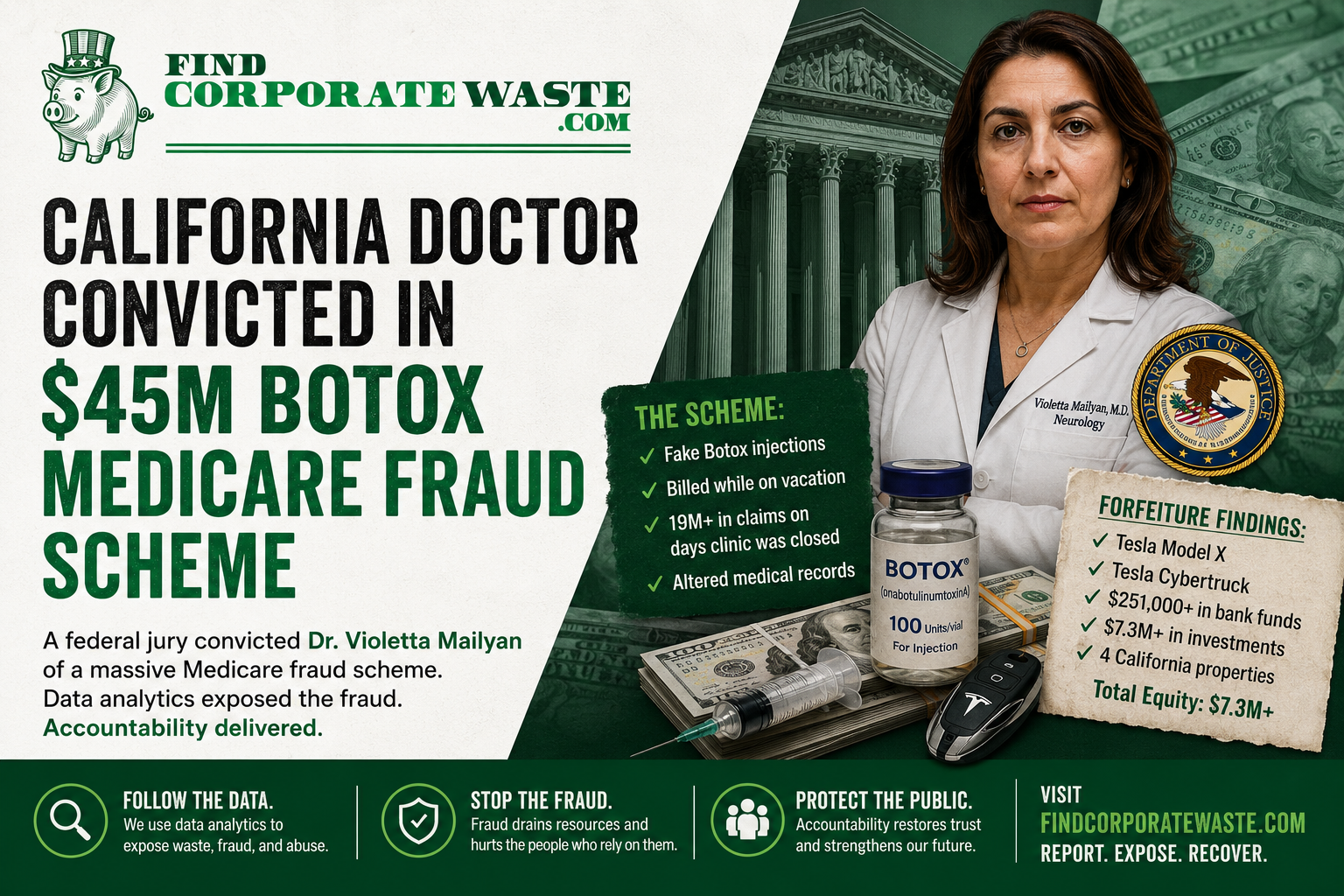
    California Doctor Convicted in $45M Botox Medicare Fraud Scheme

    A federal jury in the Central District of California convicted Dr. Violetta Mailyan, 45, of Glendale, California, for her role in a $45 million Medicare fraud scheme built around Botox billing. According to the DOJ, Mailyan submitted claims for Botox injections that were either never provided, medically unnecessary, cosmetic in nature, or unsupported by the medical records required for Medicare reimbursement. 

    The DOJ said the investigation began after the Health Care Fraud Section’s Data Analytics Team flagged Mailyan as an extreme Medicare outlier: she had been paid more for Botox injections than any other doctor in the country.

    At one point, she had received more than $24 million over four years, roughly six times more than the next highest comparison group, all of whom were neurologists.  

    The details are staggering. Prosecutors said Mailyan billed Medicare for Botox treatments while she was vacationing in Cabo, Maui, Las Vegas, Pennsylvania, and New York. She also allegedly billed for a Medicare beneficiary who was incarcerated in federal prison and submitted over $19 million in claims for injections supposedly performed on days when her clinic was closed.  

    According to trial evidence, Mailyan backdated claims, fabricated patient consent forms, altered medical records after receiving a grand jury subpoena, and tried to make it appear that patients suffered from chronic migraines requiring treatment. The jury convicted her of nine counts of wire fraud and three counts of obstruction. Sentencing is scheduled for September 10, 2026

    The forfeiture findings tell the rest of the story: a Tesla Model X, a Tesla Cybertruck, more than $251,000 in bank funds, brokerage accounts valued at over $7.3 million, and four California properties with estimated equity above $7.3 million were found subject to forfeiture as fraud proceeds. 

    This case shows that investigators must follow abnormal billing patterns, outlier providers, ownership trails, and public data signals before the money disappears.

    The DOJ’s new Fraud Division and Health Care Fraud Strike Force are now openly leaning into analytics, and that shift matters. Find Corporate Waste exists to follow that trail.

    If you have information about government funds being misused, inflated, concealed, or routed through questionable claims, now is the time to come forward.

  • California Medical Company Owner Pleads Guilty to Stealing More Than $1M in Pandemic Relief Funds

    California Medical Company Owner Pleads Guilty to Stealing More Than $1M in Pandemic Relief Funds

    A California medical business owner has pleaded guilty to stealing more than $1 million from federal pandemic relief programs.

    According to the DOJ, Mehrdad Tabrizi owned Life Fleet Inc. and Resonante Group, two Orange County medical businesses. During the COVID-19 pandemic, he used those companies to submit fraudulent applications for Paycheck Protection Program and Economic Injury Disaster Loan funds.  

    The DOJ said Tabrizi falsely claimed Life Fleet was operating and had employees who received wages in 2019 and 2020. In reality, the company had been shuttered in 2018 and was no longer operational. Those false PPP applications caused approximately $696,565 to be disbursed into bank accounts he controlled.  

    Tabrizi also submitted fraudulent EIDL applications claiming Life Fleet and Resonante Group had revenue and business expenses before January 2020. Those applications brought in another $319,800, even though neither company was entitled to the money. The DOJ also said he withdrew $60,000 of the fraud proceeds to help buy a 2019 Porsche Turbo Cabriolet.  

    He pleaded guilty to four counts of wire fraud and one count of money laundering. Sentencing is scheduled for September 28, 2026.

    For Find Corporate Waste, this case shows why pandemic relief fraud remains a major public-accountability issue. Relief programs moved quickly, but speed created opportunities for false certifications, inactive companies, inflated payroll claims, and misuse of taxpayer funds. FCW will continue tracking pandemic relief cases, False Claims Act recoveries, and public-record signals that expose waste, fraud, and abuse.

  • Children’s Medicaid Program Hit With $15.2M False Claims Judgment

    Children’s Medicaid Program Hit With $15.2M False Claims Judgment

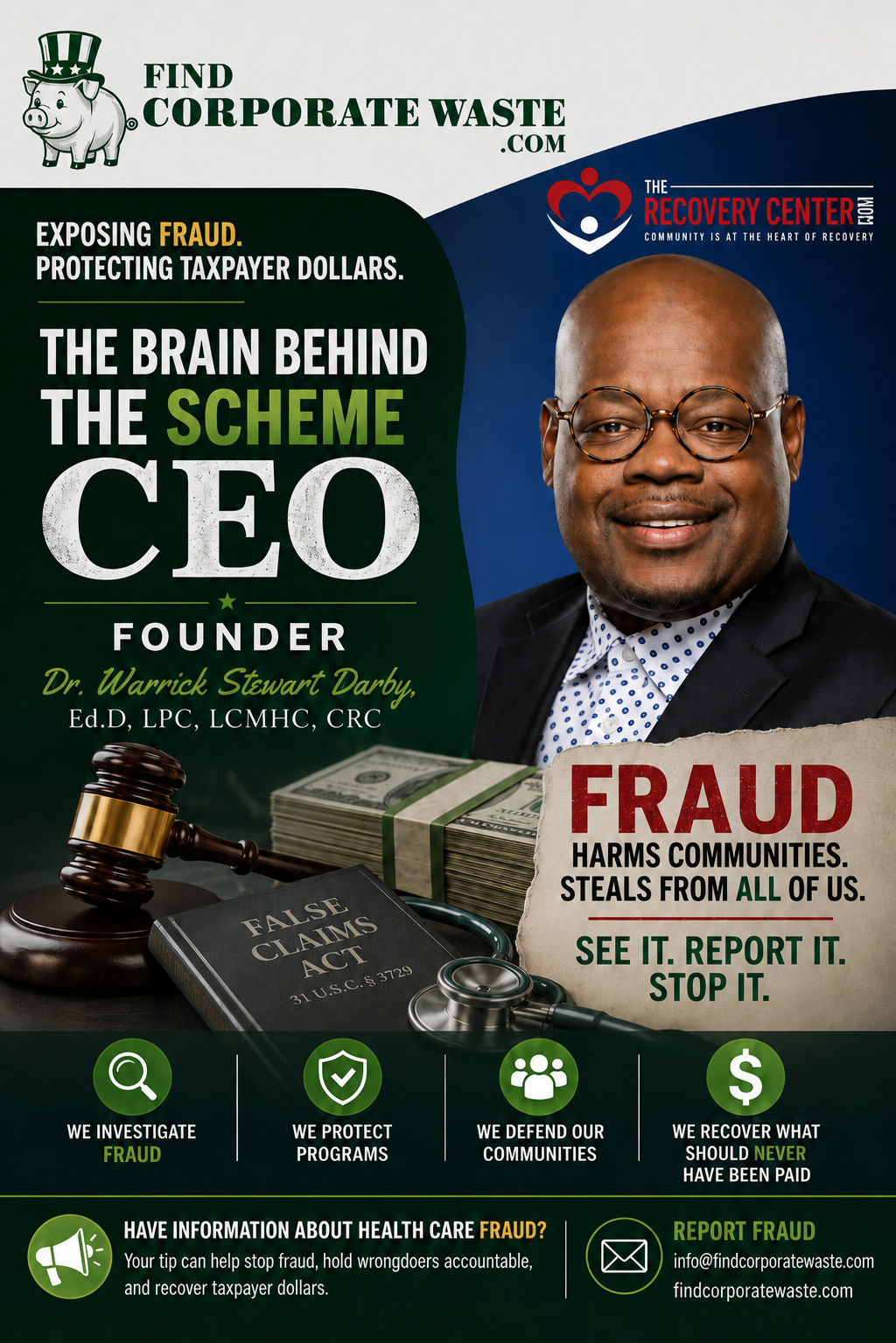
    The operators of a children’s day treatment program have agreed to a $15,248,240.66 civil judgment in favor of the United States to resolve allegations that they defrauded the Kentucky and Ohio Medicaid programs, according to the U.S. Attorney’s Office for the Eastern District of Kentucky. 

    The settlement involves Recovery Center of Kentucky, LLC, Recovery Center of Ohio, LLC, Recovery Center of Maryland, LLC, Recovery Center of USA, and CEO Dr. Warrick Stewart. The government alleged that the entities violated the False Claims Act, which prohibits submitting false claims for payment to government programs such as Medicaid.

    At issue was the Aspire Day Program, which served children with behavioral and mental health needs in Elizabethtown, Lexington, Louisville, and Radcliff, Kentucky, as well as Cincinnati, Ohio. These programs may include therapy and behavioral health services, sometimes alongside school or other activities.  

    The government alleged that, from August 2022 through June 2025, the Recovery Centers billed Medicaid for children’s time spent on education, recreation, and lunch breaks, even though Kentucky and Ohio Medicaid only covered time spent receiving behavioral health services.  

    The government also alleged that Recovery Center of Kentucky misrepresented staff qualifications to obtain higher Medicaid reimbursements. In some cases, services allegedly performed by lower-level staff were billed as if they had been provided by higher-level licensed professionals. In other cases, the government alleged that certain employees were not qualified to provide day treatment services at all.

    This case began as a qui tam lawsuit under the False Claims Act, meaning private whistleblowers helped bring the alleged misconduct to light. The docket information is United States ex rel. Harned, et al. v. Aspire Day School, LLC, et al., Case No. 3:23-cv-41-GFVT.

    As part of the resolution, Recovery Center entered into a five-year Corporate Integrity Agreement with HHS OIG, requiring strengthened compliance obligations going forward. The civil judgment will be satisfied under terms based on the defendants’ ability to pay.

    Find Corporate Waste tracks cases where taxpayer-funded health care dollars may have been misused through false billing, ineligible recipients, weak oversight, or improper certifications.

     If you have credible information about Medicaid, Medicare, PPP, Provider Relief Fund, or other government-funded health care fraud, your information may help expose waste and recover public money.

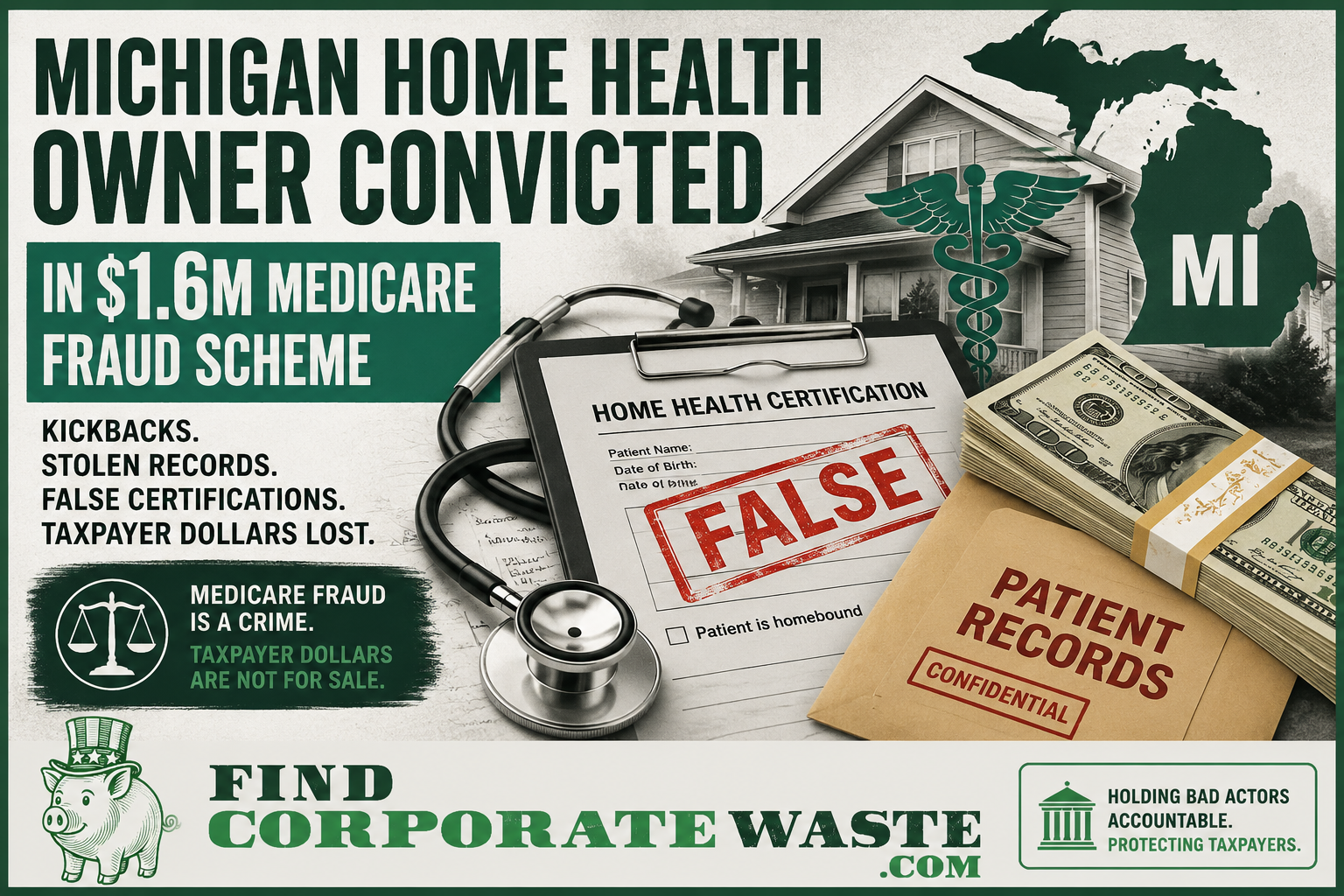
  • Michigan Home Health Owner Convicted in $1.6M Medicare Fraud Scheme

    Michigan Home Health Owner Convicted in $1.6M Medicare Fraud Scheme

    A federal jury in the Eastern District of Michigan convicted Ruby Scott, a Michigan nurse and owner of Delta Home Health Care LLC, for a $1.6 million Medicare fraud scheme involving illegal kickbacks, stolen patient records, and false home health billing.

    According to the DOJ, Scott paid a discharge nurse at a Detroit hospital to identify Medicare patients and send their confidential records to Delta without the patients’ knowledge.

    From 2018 through 2021, Scott allegedly used those records to bill Medicare for home health services. The DOJ said she paid the nurse more than $130,000 through CashApp, PayPal, checks, and cash, including roughly $300 per patient when Delta successfully billed Medicare.

    Prosecutors said Scott falsely represented that doctors had certified patients as eligible for home health care, including that they were homebound, even though no doctor had evaluated those patients for Delta’s services. In some cases, Scott allegedly used real doctors’ identities to fabricate evaluations. One witness testified that a patient for whom Delta received thousands of dollars in Medicare payments never received services from Scott’s company.

    Delta also failed to maintain patient files for more than one-third of the patients it billed Medicare for. Medicare paid Delta more than $1.2 million for those patients alone. The DOJ said Scott caused approximately $1.6 million in losses to Medicare.

    The jury convicted Scott of five counts of health care fraud, conspiracy to defraud the United States and pay illegal health care kickbacks, and four counts of paying illegal health care kickbacks. She is scheduled to be sentenced on September 24, 2026.

    For Find Corporate Waste, this case shows how public health care dollars can be drained through kickbacks, fake medical necessity, stolen patient information, and false billing records. Medicare fraud is not victimless. Every false claim takes money from taxpayers, legitimate providers, and patients who depend on the system

  • Takeda to Pay $13.6M Over False Claims Act Allegations Tied to Physician Payments

    Takeda to Pay $13.6M Over False Claims Act Allegations Tied to Physician Payments

    Takeda Pharmaceuticals U.S.A. Inc. has agreed to pay $13,670,921 to resolve False Claims Act allegations involving improper payments to physicians who prescribed Trintellix, an antidepressant medication marketed for major depressive disorder. The Department of Justice said the alleged conduct caused false claims to be submitted to Medicare and other federal health care programs.  

    The settlement centers on the federal Anti-Kickback Statute, which prohibits offering or paying anything of value to induce referrals or prescriptions covered by Medicare, Medicaid, TRICARE, and other federal health care programs.

    DOJ alleged that from January 2014 through October 2020, Takeda paid improper remuneration to health care providers, including speaker honoraria and meals at high-end restaurants, to encourage prescriptions of Trintellix.  

    According to the government, Takeda selected certain providers for its Trintellix speaker bureau and gave them paid speaking opportunities with the intent that those payments and related benefits would influence prescribing decisions.

    The DOJ also alleged that some prescribers attended multiple programs on the same topic, received meals and drinks, and gained no real educational value from repeated attendance.  

    The case is important because it shows how False Claims Act liability can arise even when the drug itself is legitimate and the prescription may appear ordinary on paper. The issue is not simply whether a medication was dispensed. The issue is whether federal health care dollars were tainted by payments, perks, or side benefits that improperly influenced medical judgment.

    Assistant Attorney General Brett Shumate said that the DOJ remains committed to pursuing False Claims Act violations arising from illegal kickbacks, warning that such conduct can undermine patient trust and increase drug costs for taxpayers. The Eastern District of California, HHS-OIG, and the Defense Criminal Investigative Service also participated in the investigation.  

    This settlement also fits into DOJ’s broader enforcement posture. The release specifically ties the case to the Administration’s Task Force to Eliminate Fraud and the National Fraud Enforcement Division, both aimed at fraud, waste, and abuse in federal programs. DOJ emphasized that False Claims Act enforcement remains central to recovering taxpayer dollars and holding wrongdoers accountable.

    The Takeda settlement is another example that shows how federal fraud may not always look like a fake business or a forged invoice. Sometimes it involves more sophisticated schemes like a polished compliance program, a speaker event, a catered dinner, or a repeat “educational” session that quietly changes prescribing incentives.

    Find Corporate Waste exists to help taxpayers, whistleblowers, and concerned insiders spot the patterns others miss.

    If you have information about improper billing, kickbacks, false certifications, pandemic relief abuse, or corporate conduct that may have caused taxpayer money to be wasted, we want to hear from you. Federal fraud often hides behind paperwork that looks clean on the surface. The more people come forward, the harder it becomes for corporations to treat public money like private profit.

  • Texas Physician to Pay $3.5M for Fraudulent COVID Billing Scheme Targeting Uninsured Program

    The U.S. Attorney’s Office for the Eastern District of Texas announced that Dr. Samad Khan has agreed to pay $3.5 million to resolve allegations of fraudulent billing to the federal government—thanks to a federal investigation targeting misuse of emergency pandemic funds.

    Dr. Samad Khan, owner of SK Primary Care, PLLC, was accused of submitting false claims to the COVID-19 Uninsured Program, which reimbursed providers for testing and treatment of uninsured individuals during the public health emergency. From April 2020 to October 2021, Khan allegedly billed for evaluation and management (E/M) services that were never performed.

    Under the Current Procedural Terminology (CPT) coding system, higher-level E/M services (CPT 99202–99205, 99212–99215) are intended to reflect complex medical care requiring direct attention by a physician or qualified healthcare provider.

    Patients at Khan’s walk-up and drive-through COVID test sites were allegedly not evaluated by any licensed providers—only medical assistants conducted nasal swabs, a service properly billed under CPT 99211.

    Khan allegedly submitted approximately 400,000 claims under higher-level codes and was the sole rendering provider listed. Many of the claims were for duplicated visits, with one charge for the test and another for delivering results—often via automated message, not through medical consultation.

    “These were not medical appointments,” said Acting U.S. Attorney Jay R. Combs. “Patients received a nasal swab and later got a text message with their results. Yet the government was billed for comprehensive office visits.”

    According to the complaint, Khan, in coordination with SK Primary Care’s management company, used inflated codes to maximize reimbursement from the Uninsured Program. The scheme generated millions in overpayments—diverting public funds meant to support pandemic response for those without health insurance.

    Find Corporate Waste is tracking a growing number of fraud cases involving COVID-19 relief funds—an urgent reminder that emergency spending, no matter how critical, requires oversight. Whistleblowers and investigators remain essential to protecting the integrity of public programs.