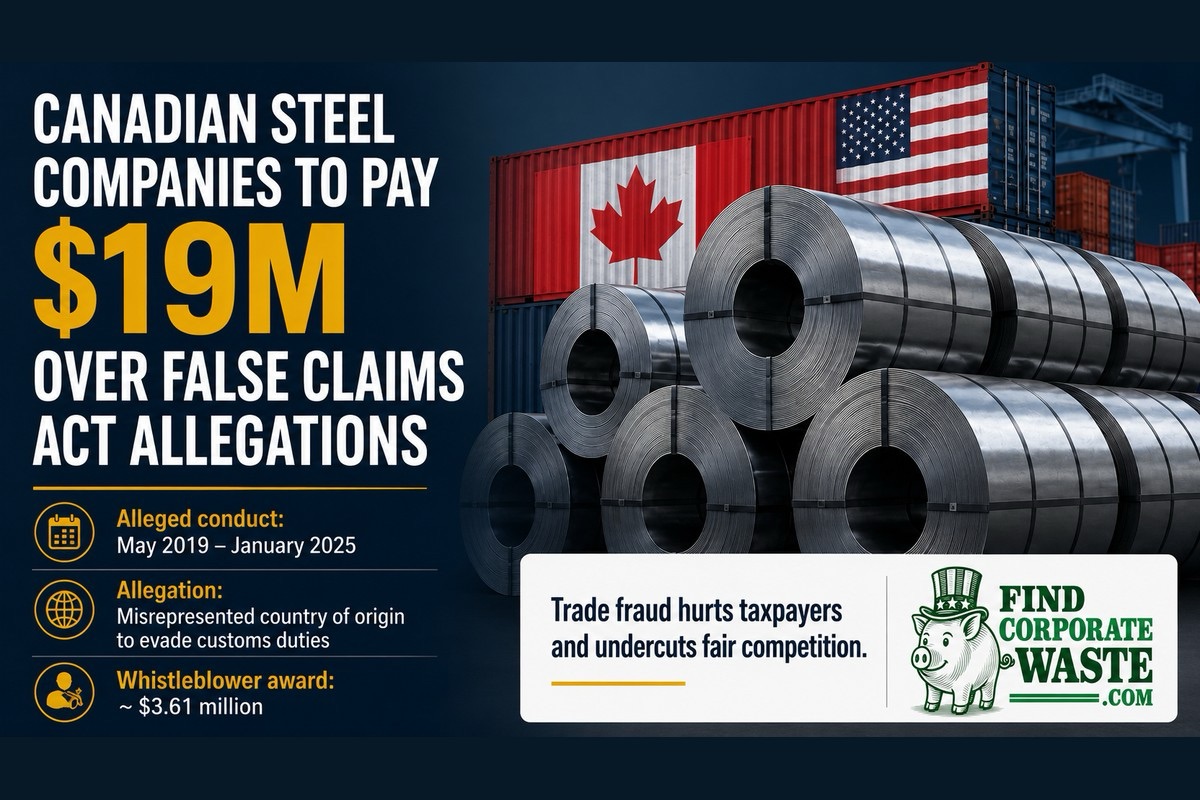
Two Canada-based steel companies and their owner have agreed to pay $19 million to resolve False Claims Act allegations involving evaded customs duties on imported steel.
According to the DOJ, Farjess Inc., Royal Canadian Steel Inc., and part-owner and president Feroz Jessani allegedly failed to pay duties owed on flat-rolled steel manufactured in Europe and Asia.
Federal officials said the companies represented that certain steel originated in Canada or the United States, when they allegedly knew the steel actually came from China, Indonesia, Italy, Turkey, or Vietnam.
The alleged conduct occurred from May 2019 through January 2025.
This case matters because trade fraud is not just a customs issue. It is a taxpayer issue, a market fairness issue, and a direct threat to American businesses that follow the rules.
Importers are required to accurately declare the country of origin, value, duty status, and amount of duties owed when goods enter the United States. When those declarations are false, the government can lose revenue while competitors gain an unfair advantage.
That is exactly why the False Claims Act remains one of the government’s strongest tools against corporate fraud.
The statute allows the government to recover funds when false statements or fraudulent conduct cause financial harm to the United States.
It also allows whistleblowers to bring cases on behalf of the government and share in any recovery.
The whistleblower in this case was Shamsh Dhala, a broker who worked with Farjess Inc.
Dhala filed the case under the qui tam provisions of the False Claims Act in the Eastern District of Michigan.
The case is captioned United States ex rel. Dhala v. Royal Canadian Steel Inc. et al., No. 2:23-cv-12097.
As part of the settlement, Dhala will receive approximately $3.61 million.
For Find Corporate Waste, the message is clear: corporate fraud often hides in ordinary paperwork. A customs form, shipment record, invoice, certification, billing file, or loan application can become the starting point for a major federal recovery.
This settlement also fits into a broader enforcement pattern. The DOJ said the case was coordinated through its Trade Fraud Task Force, a cross-agency effort focused on tariff evasion, customs fraud, prohibited imports, threats to domestic industry, and conduct that weakens national security.
The same logic applies across the areas covered by Find Corporate Waste: False Claims Act cases, government contracting abuse, pandemic relief fraud, healthcare fraud, customs fraud, and other schemes involving public money.
When companies cheat the system, the cost does not disappear. It is shifted onto taxpayers, lawful competitors, American workers, and the public.
If you have information about customs fraud, government contract abuse, healthcare billing fraud, pandemic relief misuse, or other misuse of taxpayer funds, Find Corporate Waste wants to hear from you.
The strongest cases often begin with a person willing to connect the dots.