Tag: False Claims Act

  • California Doctor Convicted in $45M Botox Medicare Fraud Scheme

    California Doctor Convicted in $45M Botox Medicare Fraud Scheme

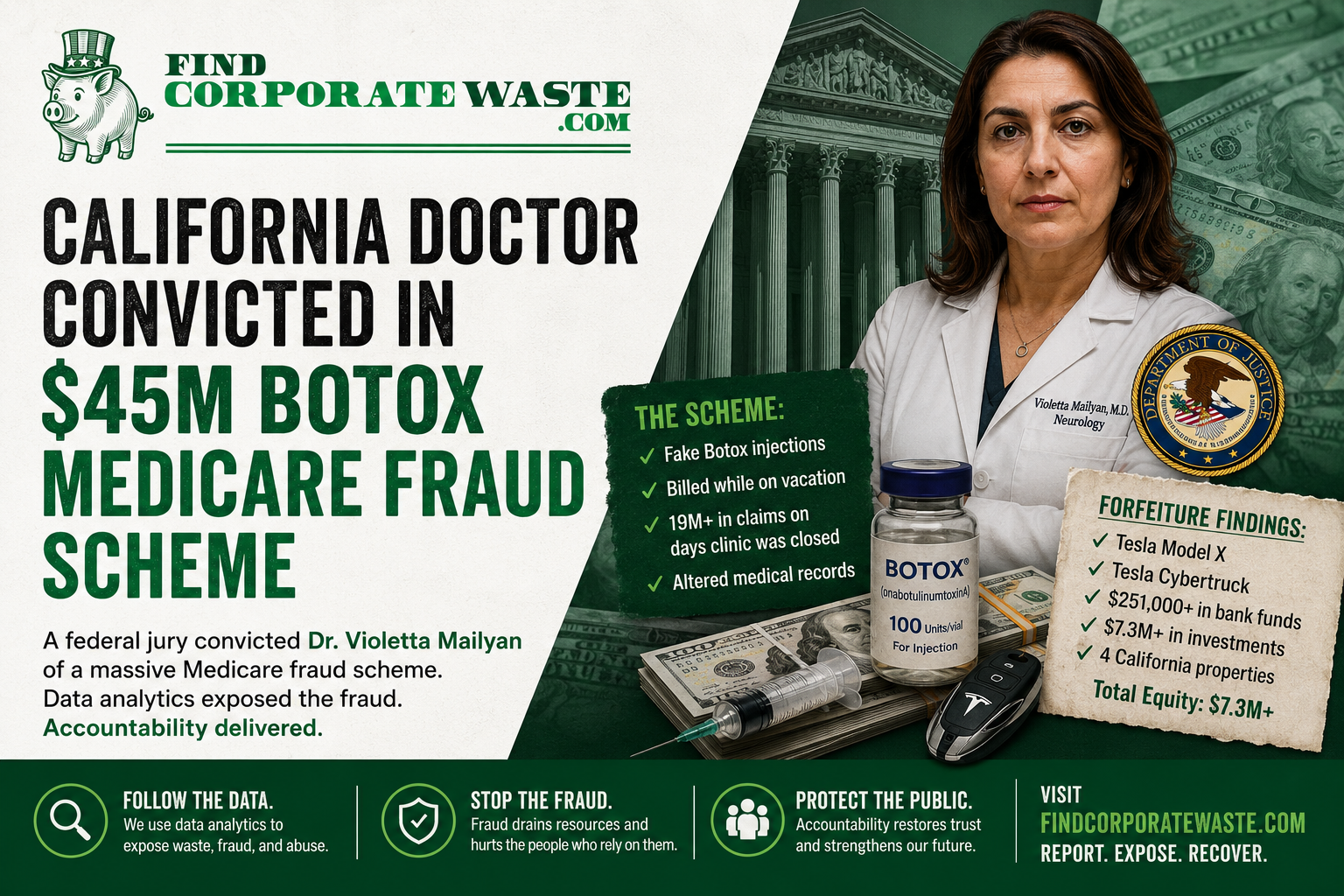
    A federal jury in the Central District of California convicted Dr. Violetta Mailyan, 45, of Glendale, California, for her role in a $45 million Medicare fraud scheme built around Botox billing. According to the DOJ, Mailyan submitted claims for Botox injections that were either never provided, medically unnecessary, cosmetic in nature, or unsupported by the medical records required for Medicare reimbursement. 

    The DOJ said the investigation began after the Health Care Fraud Section’s Data Analytics Team flagged Mailyan as an extreme Medicare outlier: she had been paid more for Botox injections than any other doctor in the country.

    At one point, she had received more than $24 million over four years, roughly six times more than the next highest comparison group, all of whom were neurologists.  

    The details are staggering. Prosecutors said Mailyan billed Medicare for Botox treatments while she was vacationing in Cabo, Maui, Las Vegas, Pennsylvania, and New York. She also allegedly billed for a Medicare beneficiary who was incarcerated in federal prison and submitted over $19 million in claims for injections supposedly performed on days when her clinic was closed.  

    According to trial evidence, Mailyan backdated claims, fabricated patient consent forms, altered medical records after receiving a grand jury subpoena, and tried to make it appear that patients suffered from chronic migraines requiring treatment. The jury convicted her of nine counts of wire fraud and three counts of obstruction. Sentencing is scheduled for September 10, 2026

    The forfeiture findings tell the rest of the story: a Tesla Model X, a Tesla Cybertruck, more than $251,000 in bank funds, brokerage accounts valued at over $7.3 million, and four California properties with estimated equity above $7.3 million were found subject to forfeiture as fraud proceeds. 

    This case shows that investigators must follow abnormal billing patterns, outlier providers, ownership trails, and public data signals before the money disappears.

    The DOJ’s new Fraud Division and Health Care Fraud Strike Force are now openly leaning into analytics, and that shift matters. Find Corporate Waste exists to follow that trail.

    If you have information about government funds being misused, inflated, concealed, or routed through questionable claims, now is the time to come forward.

  • California Medical Company Owner Pleads Guilty to Stealing More Than $1M in Pandemic Relief Funds

    California Medical Company Owner Pleads Guilty to Stealing More Than $1M in Pandemic Relief Funds

    A California medical business owner has pleaded guilty to stealing more than $1 million from federal pandemic relief programs.

    According to the DOJ, Mehrdad Tabrizi owned Life Fleet Inc. and Resonante Group, two Orange County medical businesses. During the COVID-19 pandemic, he used those companies to submit fraudulent applications for Paycheck Protection Program and Economic Injury Disaster Loan funds.  

    The DOJ said Tabrizi falsely claimed Life Fleet was operating and had employees who received wages in 2019 and 2020. In reality, the company had been shuttered in 2018 and was no longer operational. Those false PPP applications caused approximately $696,565 to be disbursed into bank accounts he controlled.  

    Tabrizi also submitted fraudulent EIDL applications claiming Life Fleet and Resonante Group had revenue and business expenses before January 2020. Those applications brought in another $319,800, even though neither company was entitled to the money. The DOJ also said he withdrew $60,000 of the fraud proceeds to help buy a 2019 Porsche Turbo Cabriolet.  

    He pleaded guilty to four counts of wire fraud and one count of money laundering. Sentencing is scheduled for September 28, 2026.

    For Find Corporate Waste, this case shows why pandemic relief fraud remains a major public-accountability issue. Relief programs moved quickly, but speed created opportunities for false certifications, inactive companies, inflated payroll claims, and misuse of taxpayer funds. FCW will continue tracking pandemic relief cases, False Claims Act recoveries, and public-record signals that expose waste, fraud, and abuse.

  • Children’s Medicaid Program Hit With $15.2M False Claims Judgment

    Children’s Medicaid Program Hit With $15.2M False Claims Judgment

    The operators of a children’s day treatment program have agreed to a $15,248,240.66 civil judgment in favor of the United States to resolve allegations that they defrauded the Kentucky and Ohio Medicaid programs, according to the U.S. Attorney’s Office for the Eastern District of Kentucky. 

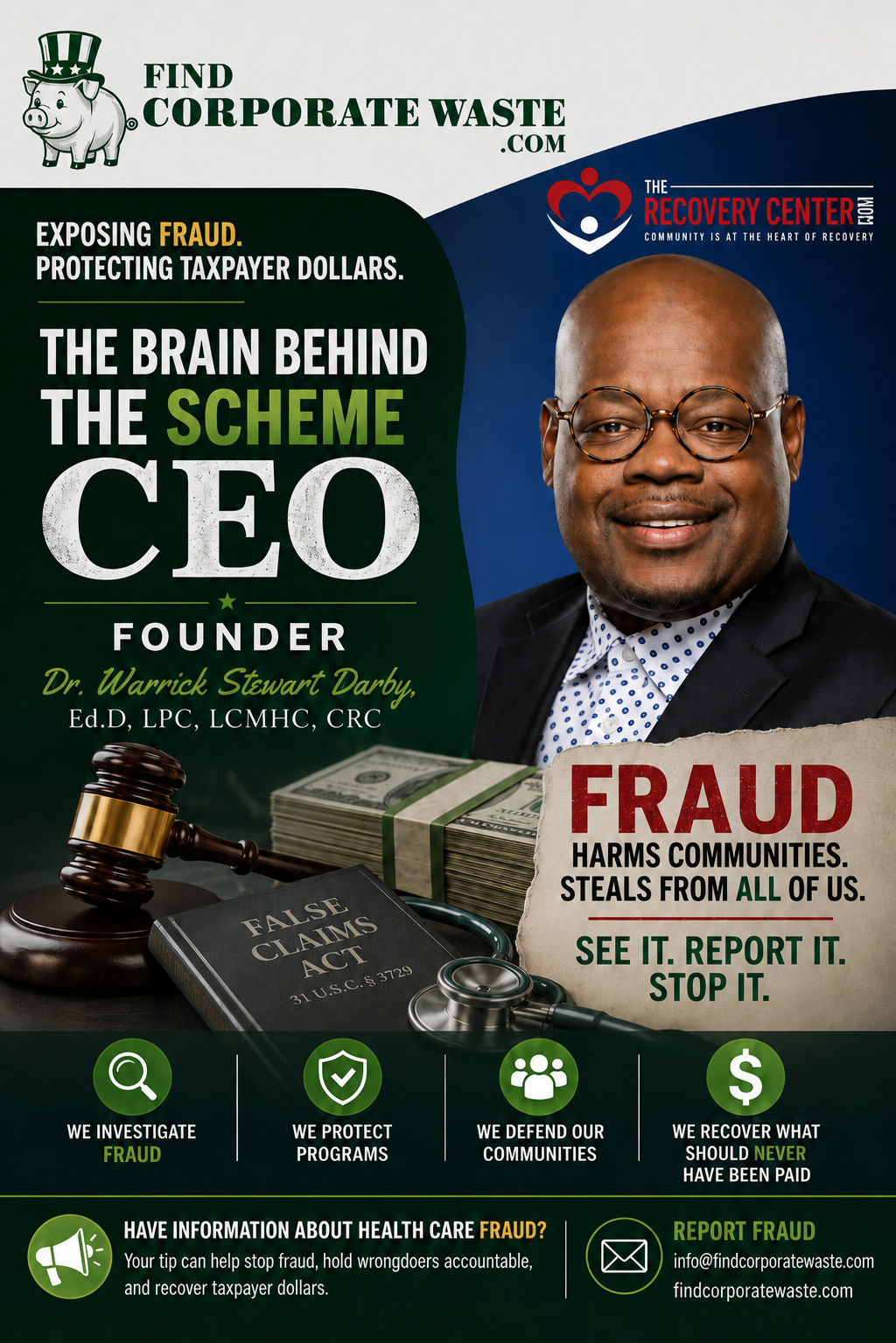
    The settlement involves Recovery Center of Kentucky, LLC, Recovery Center of Ohio, LLC, Recovery Center of Maryland, LLC, Recovery Center of USA, and CEO Dr. Warrick Stewart. The government alleged that the entities violated the False Claims Act, which prohibits submitting false claims for payment to government programs such as Medicaid.

    At issue was the Aspire Day Program, which served children with behavioral and mental health needs in Elizabethtown, Lexington, Louisville, and Radcliff, Kentucky, as well as Cincinnati, Ohio. These programs may include therapy and behavioral health services, sometimes alongside school or other activities.  

    The government alleged that, from August 2022 through June 2025, the Recovery Centers billed Medicaid for children’s time spent on education, recreation, and lunch breaks, even though Kentucky and Ohio Medicaid only covered time spent receiving behavioral health services.  

    The government also alleged that Recovery Center of Kentucky misrepresented staff qualifications to obtain higher Medicaid reimbursements. In some cases, services allegedly performed by lower-level staff were billed as if they had been provided by higher-level licensed professionals. In other cases, the government alleged that certain employees were not qualified to provide day treatment services at all.

    This case began as a qui tam lawsuit under the False Claims Act, meaning private whistleblowers helped bring the alleged misconduct to light. The docket information is United States ex rel. Harned, et al. v. Aspire Day School, LLC, et al., Case No. 3:23-cv-41-GFVT.

    As part of the resolution, Recovery Center entered into a five-year Corporate Integrity Agreement with HHS OIG, requiring strengthened compliance obligations going forward. The civil judgment will be satisfied under terms based on the defendants’ ability to pay.

    Find Corporate Waste tracks cases where taxpayer-funded health care dollars may have been misused through false billing, ineligible recipients, weak oversight, or improper certifications.

     If you have credible information about Medicaid, Medicare, PPP, Provider Relief Fund, or other government-funded health care fraud, your information may help expose waste and recover public money.

  • Michigan Home Health Owner Convicted in $1.6M Medicare Fraud Scheme

    Michigan Home Health Owner Convicted in $1.6M Medicare Fraud Scheme

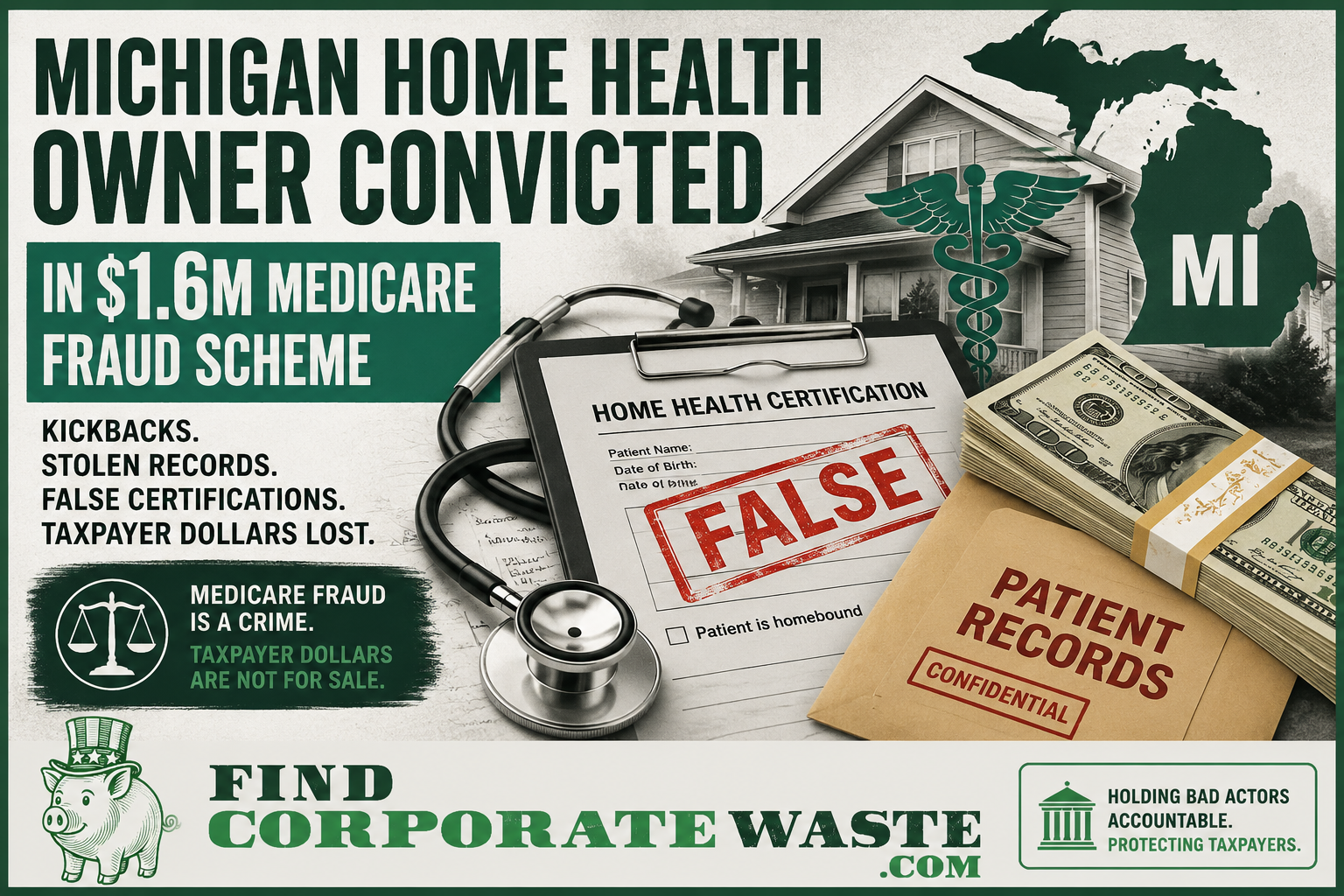
    A federal jury in the Eastern District of Michigan convicted Ruby Scott, a Michigan nurse and owner of Delta Home Health Care LLC, for a $1.6 million Medicare fraud scheme involving illegal kickbacks, stolen patient records, and false home health billing.

    According to the DOJ, Scott paid a discharge nurse at a Detroit hospital to identify Medicare patients and send their confidential records to Delta without the patients’ knowledge.

    From 2018 through 2021, Scott allegedly used those records to bill Medicare for home health services. The DOJ said she paid the nurse more than $130,000 through CashApp, PayPal, checks, and cash, including roughly $300 per patient when Delta successfully billed Medicare.

    Prosecutors said Scott falsely represented that doctors had certified patients as eligible for home health care, including that they were homebound, even though no doctor had evaluated those patients for Delta’s services. In some cases, Scott allegedly used real doctors’ identities to fabricate evaluations. One witness testified that a patient for whom Delta received thousands of dollars in Medicare payments never received services from Scott’s company.

    Delta also failed to maintain patient files for more than one-third of the patients it billed Medicare for. Medicare paid Delta more than $1.2 million for those patients alone. The DOJ said Scott caused approximately $1.6 million in losses to Medicare.

    The jury convicted Scott of five counts of health care fraud, conspiracy to defraud the United States and pay illegal health care kickbacks, and four counts of paying illegal health care kickbacks. She is scheduled to be sentenced on September 24, 2026.

    For Find Corporate Waste, this case shows how public health care dollars can be drained through kickbacks, fake medical necessity, stolen patient information, and false billing records. Medicare fraud is not victimless. Every false claim takes money from taxpayers, legitimate providers, and patients who depend on the system

  • Takeda to Pay $13.6M Over False Claims Act Allegations Tied to Physician Payments

    Takeda to Pay $13.6M Over False Claims Act Allegations Tied to Physician Payments

    Takeda Pharmaceuticals U.S.A. Inc. has agreed to pay $13,670,921 to resolve False Claims Act allegations involving improper payments to physicians who prescribed Trintellix, an antidepressant medication marketed for major depressive disorder. The Department of Justice said the alleged conduct caused false claims to be submitted to Medicare and other federal health care programs.  

    The settlement centers on the federal Anti-Kickback Statute, which prohibits offering or paying anything of value to induce referrals or prescriptions covered by Medicare, Medicaid, TRICARE, and other federal health care programs.

    DOJ alleged that from January 2014 through October 2020, Takeda paid improper remuneration to health care providers, including speaker honoraria and meals at high-end restaurants, to encourage prescriptions of Trintellix.  

    According to the government, Takeda selected certain providers for its Trintellix speaker bureau and gave them paid speaking opportunities with the intent that those payments and related benefits would influence prescribing decisions.

    The DOJ also alleged that some prescribers attended multiple programs on the same topic, received meals and drinks, and gained no real educational value from repeated attendance.  

    The case is important because it shows how False Claims Act liability can arise even when the drug itself is legitimate and the prescription may appear ordinary on paper. The issue is not simply whether a medication was dispensed. The issue is whether federal health care dollars were tainted by payments, perks, or side benefits that improperly influenced medical judgment.

    Assistant Attorney General Brett Shumate said that the DOJ remains committed to pursuing False Claims Act violations arising from illegal kickbacks, warning that such conduct can undermine patient trust and increase drug costs for taxpayers. The Eastern District of California, HHS-OIG, and the Defense Criminal Investigative Service also participated in the investigation.  

    This settlement also fits into DOJ’s broader enforcement posture. The release specifically ties the case to the Administration’s Task Force to Eliminate Fraud and the National Fraud Enforcement Division, both aimed at fraud, waste, and abuse in federal programs. DOJ emphasized that False Claims Act enforcement remains central to recovering taxpayer dollars and holding wrongdoers accountable.

    The Takeda settlement is another example that shows how federal fraud may not always look like a fake business or a forged invoice. Sometimes it involves more sophisticated schemes like a polished compliance program, a speaker event, a catered dinner, or a repeat “educational” session that quietly changes prescribing incentives.

    Find Corporate Waste exists to help taxpayers, whistleblowers, and concerned insiders spot the patterns others miss.

    If you have information about improper billing, kickbacks, false certifications, pandemic relief abuse, or corporate conduct that may have caused taxpayer money to be wasted, we want to hear from you. Federal fraud often hides behind paperwork that looks clean on the surface. The more people come forward, the harder it becomes for corporations to treat public money like private profit.

  • HealthSplash Owner Convicted in $1 Billion Medicare Fraud Conspiracy

    HealthSplash Owner Convicted in $1 Billion Medicare Fraud Conspiracy

    A federal jury in the Southern District of Florida convicted Brett Blackman, owner of HealthSplash, Inc., for his role in a Medicare fraud conspiracy involving more than $1 billion in fraudulent claims.

    According to the Department of Justice, Blackman operated through HealthSplash and Power Mobility Doctor Rx, LLC, also known as DMERx, an internet-based platform used to generate doctors’ orders for durable medical equipment and prescriptions.

    The DOJ said those orders falsely claimed that physicians had examined and treated Medicare beneficiaries, while in reality doctors were allegedly paid to sign paperwork with little or no meaningful patient interaction.

    As part of this fraud scheme, the DOJ described a broader fraud pipeline involving marketers, foreign call centers, telemedicine companies, pharmacies, durable medical equipment suppliers, and paid doctors.

    Medicare beneficiaries were pushed toward unnecessary orthotic braces and other items, while the paperwork moved through DMERx so suppliers could bill Medicare and other federal health care programs.

    DOJ said suppliers and pharmacies submitted more than $1 billion in claims, with Medicare and other insurers paying more than $450 million.

    Blackman was convicted of conspiracy to commit health care fraud and wire fraud, conspiracy to pay and receive health care kickbacks, and conspiracy to defraud the United States.

    Why This Matters

    This case shows how federal health care fraud can hide behind clean paperwork, corporate layers, software systems, and technical compliance language.

    A signed doctor’s order does not always mean a real medical exam happened, and a billing record does not always mean the service was necessary.

    For Find Corporate Waste, the lesson is clear: taxpayer money often moves through systems that look legitimate until the relationships, incentives, and eligibility rules are examined more closely. Health care fraud is not always obvious from the surface. It may require connecting billing records, ownership structures, provider relationships, exclusion data, and government payment databases.

    If you have seen suspicious billing, questionable federal payments, corporate abuse, or government money flowing to entities that may not have followed the rules, Find Corporate Waste wants to hear from you.

    Tips, documents, and public records can help expose fraud, recover taxpayer money, and hold bad actors accountable.

  • Perfectus Aluminum to Pay $549.5M in Major False Claims Act Trade Fraud Settlement

    Perfectus Aluminum to Pay $549.5M in Major False Claims Act Trade Fraud Settlement

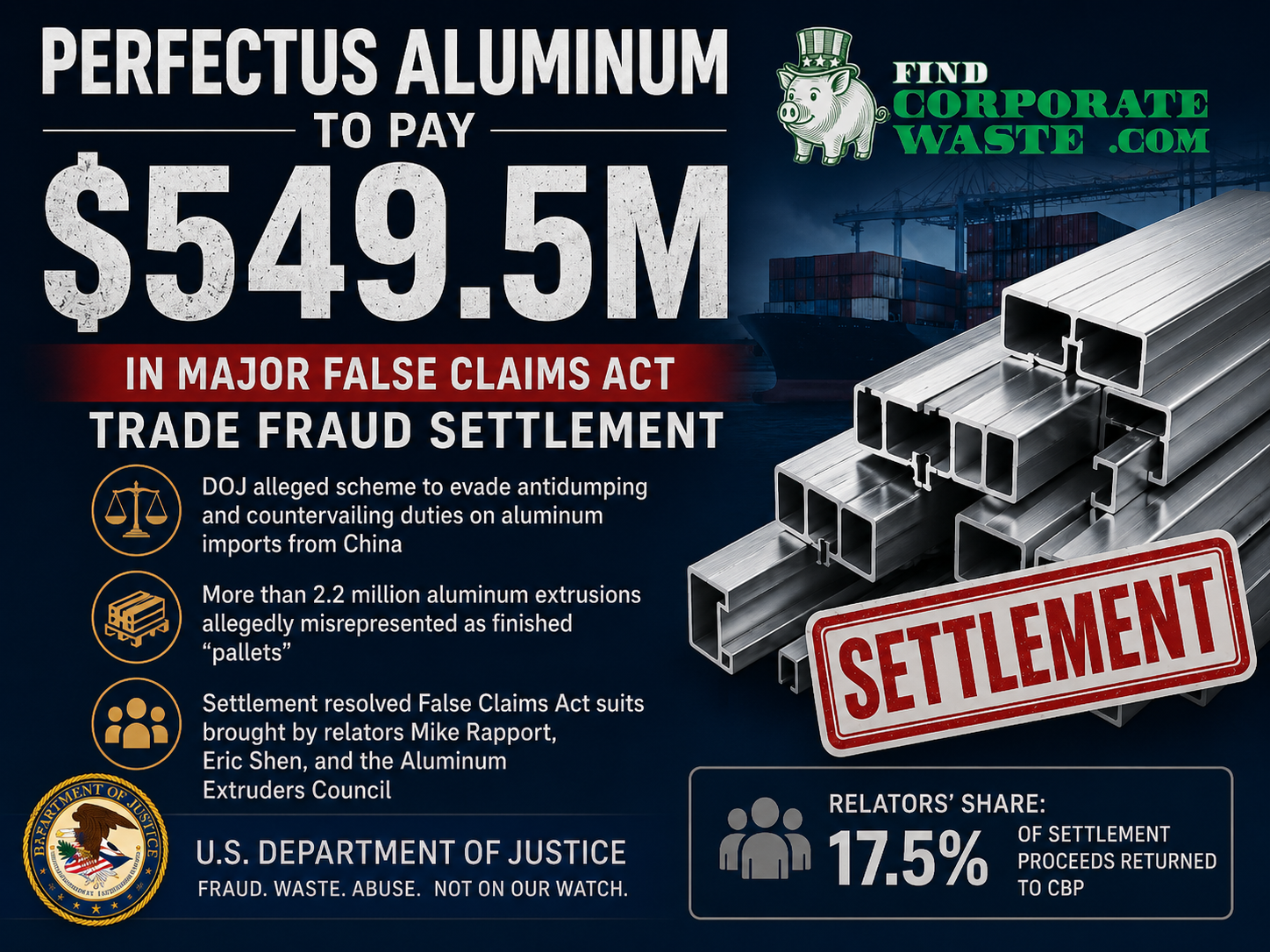
    Perfectus Aluminum Inc. and related California-based companies have agreed to pay $549.5 million to resolve False Claims Act allegations tied to evaded customs duties on aluminum imports from China. The Department of Justice announced the settlement on May 12, 2026, calling it part of a broader enforcement push against fraud, waste, and abuse in federal programs.  

    The DOJ alleged that Perfectus Aluminum Inc., Perfectus Aluminum Acquisitions LLC, and affiliated warehousing companies knowingly avoided antidumping and countervailing duties owed to U.S. Customs and Border Protection.

    According to the government, the companies imported more than 2.2 million aluminum extrusions from China and misrepresented them as finished “pallets” not subject to those duties.

    DOJ said the so-called pallets were merely aluminum extrusions spot-welded together to appear functional, and that no customers existed for them and no pallets were ever sold.  

    When an importer falsely avoids tariffs, the government loses revenue, U.S. companies face unfair competition, and legitimate businesses are forced to compete against a rigged price structure.

    The case also shows why the False Claims Act remains one of the federal government’s strongest tools. The settlement resolved lawsuits brought by whistleblowers under the FCA’s qui tam provisions. Those provisions allow private parties to sue on behalf of the United States and share in the recovery. In this case, the relators’ share will be 17.5% of the settlement proceeds returned to Customs and Border Patrol (CBP).  

    The DOJ connected the settlement to the Administration’s broader fraud enforcement infrastructure, including the Task Force to Eliminate Fraud, the National Fraud Enforcement Division, and the DOJ’s Trade Fraud Task Force. The Department said FCA enforcement will remain central to recovering taxpayer money and holding wrongdoers accountable.  

    Whether the issue involves evaded tariffs, pandemic relief funds, federal healthcare payments, or other taxpayer-backed programs, the same basic enforcement principle applies.

    When companies obtain or retain federal money by misrepresentation, omission, or false certification, the False Claims Act gives the government—and whistleblowers—a path to recover the funds.

    The Perfectus settlement is a major reminder that corporate fraud is often hidden in records that look routine.

    Find Corporate Waste will continue reviewing public datasets, federal spending records, exclusion lists, and enforcement releases to identify cases where companies may have received or retained taxpayer funds they were not entitled to keep.

    When companies exploit federal programs for private gain, they do not just cheat the government. They cheat taxpayers, honest businesses, and the people those programs were created to protect.

  • Florida Manufacturer Pays $2.6 Million To Resolve False Claims Act Allegations

    Florida Manufacturer Pays $2.6 Million To Resolve False Claims Act Allegations

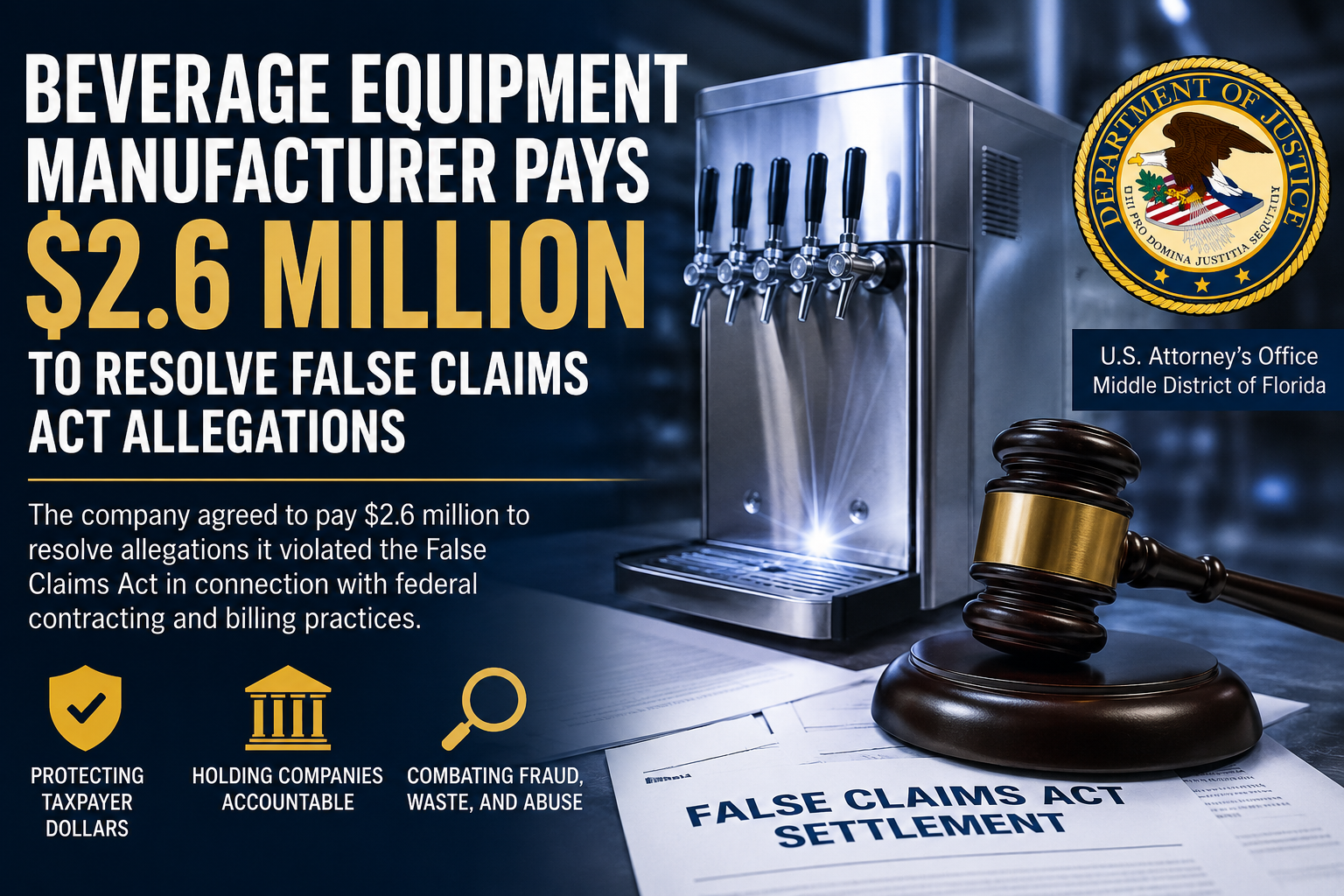
    Micro Matic USA, Inc., a beverage dispensing equipment manufacturer based in Brooksville, Florida, has agreed to pay $2,593,219.18 to resolve allegations that it improperly obtained a Paycheck Protection Program (PPP) loan.

    The settlement was announced by the U.S. Attorney’s Office for the Middle District of Florida on May 12, 2026. According to DOJ, Micro Matic allegedly violated the False Claims Act by obtaining a PPP loan despite being ineligible under the program’s rules.  

    Under the second round of PPP, businesses generally needed 300 or fewer employees to qualify. SBA affiliation rules required applicants to count employees and revenue from related companies, including foreign affiliates. The DOJ alleged that Micro Matic was not eligible because it was not a small business once its foreign affiliates were included.  

    The case began with a qui tam complaint filed by GNGH2, Inc., which alleged that Micro Matic improperly obtained a $2 million PPP loan. The settlement concludes the litigation, and GNGH2 will receive $259,321.91 as its share of the recovery.  

    This is exactly the kind of case Find Corporate Waste (FCW) tracks. A company certifies eligibility, federal money goes out, and later a relator identifies the missing connection between the application and the rules.

    The case also fits squarely within DOJ’s renewed fraud-enforcement posture. The announcement states that the matter is part of the Trump Administration’s Task Force to Eliminate Fraud and follows DOJ’s creation of the National Fraud Enforcement Division, whose mission includes investigating and prosecuting fraudulent misuse of taxpayer dollars.  

    At Find Corporate Waste, we specialize in identifying the discrepancies that led to the $2.59 million settlement with Micro Matic USA, Inc.

    Our investigation model is built on cross-referencing databases the government maintains but fails to connect. We use data science to detect patterns that suggest fraud, waste, and abuse.

    These cases are not rare. They are a symptom of the broader pattern of pandemic relief fraud. For more information about these cases, or to report potential waste of federal funds, reach out to info@findcorporatewaste.com and be sure to subscribe.

  • DOJ’s Fraud Reorganization Could Shape the Next Wave of FCA Enforcement

    DOJ’s Fraud Reorganization Could Shape the Next Wave of FCA Enforcement

    The Justice Department’s latest COVID-relief fraud case shows where federal enforcement is heading.

    In California, tax preparer Kerwin Aldric Jordan pleaded guilty after DOJ said he helped file false tax returns and fraudulently obtained pandemic relief loans. Prosecutors said the conduct caused more than $25 million in tax losses and involved false claims for PPP and EIDL funds. DOJ Press Release  

    DOJ Is Moving Toward Centralized Fraud Enforcement

    This DOJ is no longer treating pandemic fraud as a series of disconnected prosecutions.

    The Department is increasingly framing these cases as part of a broader effort to identify fraud, recover taxpayer money, and hold applicants accountable when federal funds were obtained through false statements or false certifications.

    That matters for the False Claims Act.

    The FCA remains one of the government’s strongest tools for recovering money obtained from the United States through false claims. DOJ reported that FCA settlements and judgments exceeded $2.9 billion in fiscal year 2024, with fraud in pandemic relief programs listed among the Department’s enforcement priorities.  

    What This Means for Future FCA Cases

    COVID-relief programs created a massive paper trail.

    Applicants made certifications, which claimed eligibility. They submitted business records, tax information, provider data, and other representations to the government.

    Now the DOJ can compare those claims against public records, exclusion lists, agency databases, tax filings, payroll records, and later-discovered facts.

    That is the future enforcement model: follow the money, test the certification, and recover funds where the record does not match the claim.

    Why Operation Clawback Fits This Model

    This is exactly the logic behind Operation Clawback.

    Operation Clawback focuses on pandemic-era healthcare relief recipients, including Provider Relief Fund recipients, whose eligibility may not match the public record. One key issue is whether providers excluded from Medicare, Medicaid, or other federal healthcare programs received relief funds despite being barred from participation.  

    The California case is not a Provider Relief Fund case. It involves tax fraud, PPP loans, and EIDL loans.

    But the principle is the same: when federal money was paid based on false information, the government can come back years later.

    FCW Bottom Line

    DOJ’s reorganization points toward a more data-driven future for FCA enforcement.

    Not every suspicious loan is fraud. Not every mismatch proves a case. But when the documents show that federal money was received through false eligibility claims, false certifications, or hidden disqualifying facts, the False Claims Act gives the government a path to recover that money.

    Find Corporate Waste is tracking these cases because taxpayers deserve to know where pandemic relief money went, who was eligible to receive it, and whether public funds can still be clawed back when the rules were broken.

  • FCW Welcomes DOJ FOCUS Initiative to Combat Waste, Fraud, and Abuse With Data Science

    FCW Welcomes DOJ FOCUS Initiative to Combat Waste, Fraud, and Abuse With Data Science

    The Department of Justice’s Civil Division has announced the new FOCUS initiative, short for Fraud Oversight through Careful Use of Statistics. The initiative is aimed at data miners who use public government records to identify potential False Claims Act cases. Find Corporate Waste has developed a sophisticated methodology for addressing Medicare Fraud committed during the COVID-19 Pandemic.

    DOJ Is Recognizing What Serious Data Miners Already Know

    For years, traditional whistleblower cases have often depended on insiders: employees, contractors, billing staff, compliance officers, or executives who saw misconduct from the inside.

    Under the leadership of Acting Attorney General Todd Blanche, the federal government now appears to be recognizing that some fraud patterns can also be found by carefully analyzing public records, payment data, provider databases, and regulatory rules.

    DOJ made clear that it welcomes data miners, but not sloppy work. The Department says it will prioritize data miners who can explain their methodology, validate their findings, understand the relevant program rules, and identify legally sufficient False Claims Act matters.  That is exactly the standard serious public-record investigators should want.

    FCW Welcomes the FOCUS Initiative

    At Find Corporate Waste, we welcome the FOCUS initiative because it encourages a disciplined approach to public-data fraud detection.

    The point is not to accuse every recipient of federal funds of wrongdoing, rather the FOCUS is to identify situations where public records raise a serious, documentable question about whether federal money was obtained or retained in violation of program rules.

    That requires matching payment data to eligibility rules, compliance obligations, provider identifiers, corporate records, exclusion data, licensing data, and other government sources.

    Why PRF Data Deserves Careful Review

    One area FCW plans to continue reviewing is the Provider Relief Fund, commonly known as PRF.

    The PRF was created to support healthcare providers during the COVID-19 emergency. Public PRF data identifies providers that received and accepted payments and agreed to the applicable Terms and Conditions. HRSA has stated that public PRF data reflects providers who received one or more payments, attested to receiving at least one payment, and agreed to the related Terms and Conditions.  

    That attestation piece is important.

    When a provider accepts federal relief money and agrees to Terms and Conditions, the question becomes whether the recipient was actually eligible, whether the money was properly retained, and whether any later reporting or compliance obligations were satisfied.

    How the Medicare Opt-Out Database Fits In

    FCW also plans to use the Medicare Opt-Out Affidavits database as part of its review process.

    The CMS opt-out dataset identifies providers who have decided not to participate in Medicare. CMS states that the dataset includes information such as provider NPI, specialty, address, and opt-out effective dates.  

    That database is useful because PRF payments were connected to healthcare providers operating within federal healthcare programs and subject to specific eligibility and compliance rules.

    If public PRF records appear to overlap with Medicare opt-out records, that does not automatically prove fraud. But it does create a legitimate line of inquiry worth reviewing.

    The key is timing, identity, and rule application.

    Data Mining Is Not Guesswork

    The strongest False Claims Act cases are built on public records.

    The goal is to determine whether a public-data anomaly is just an innocent mismatch, a clerical issue, or a real compliance problem involving federal funds.

    That distinction matters. It protects honest providers. It also helps the government focus on cases that are actually worth pursuing.

    Why This Matters for Taxpayers

    COVID-era relief programs moved enormous sums of federal money very quickly. Many recipients used those funds properly. Others may not have.

    The False Claims Act exists because public money comes with rules. When companies or providers accept federal funds, they do not get to ignore the conditions attached to those funds.

    The DOJ’s FOCUS initiative sends a clear message: public data can help uncover fraud, but only when it is used responsibly.

    FCW’s Position

    FCW welcomes DOJ’s FOCUS initiative and supports a high standard for data-driven False Claims Act work.

    Public records are an untapped way to identify waste, fraud, and abuse that would otherwise remain obscure and buried.

    Think You Have Information About Federal Healthcare Fraud?

    If you worked for a provider, billing company, healthcare contractor, clinic, management company, or related entity that received federal funds during the COVID-19 period, your information may matter.

    FCW reviews public records and potential False Claims Act leads involving federal healthcare payments, relief funds, and government program compliance.

    Whistleblowers play a major role in protecting taxpayer money. In many cases, relators who bring successful False Claims Act cases may be eligible to receive a share of the government’s recovery.

    If you have credible information about federal funds being obtained, retained, or reported improperly, FCW can help evaluate whether the facts may warrant attorney review.

    Find Corporate Waste exists to help turn public records into accountability.