Category: Healthcare Fraud

  • Guam Bingo Operators Sentenced in $34M Charity Fraud Scheme

    Guam Bingo Operators Sentenced in $34M Charity Fraud Scheme

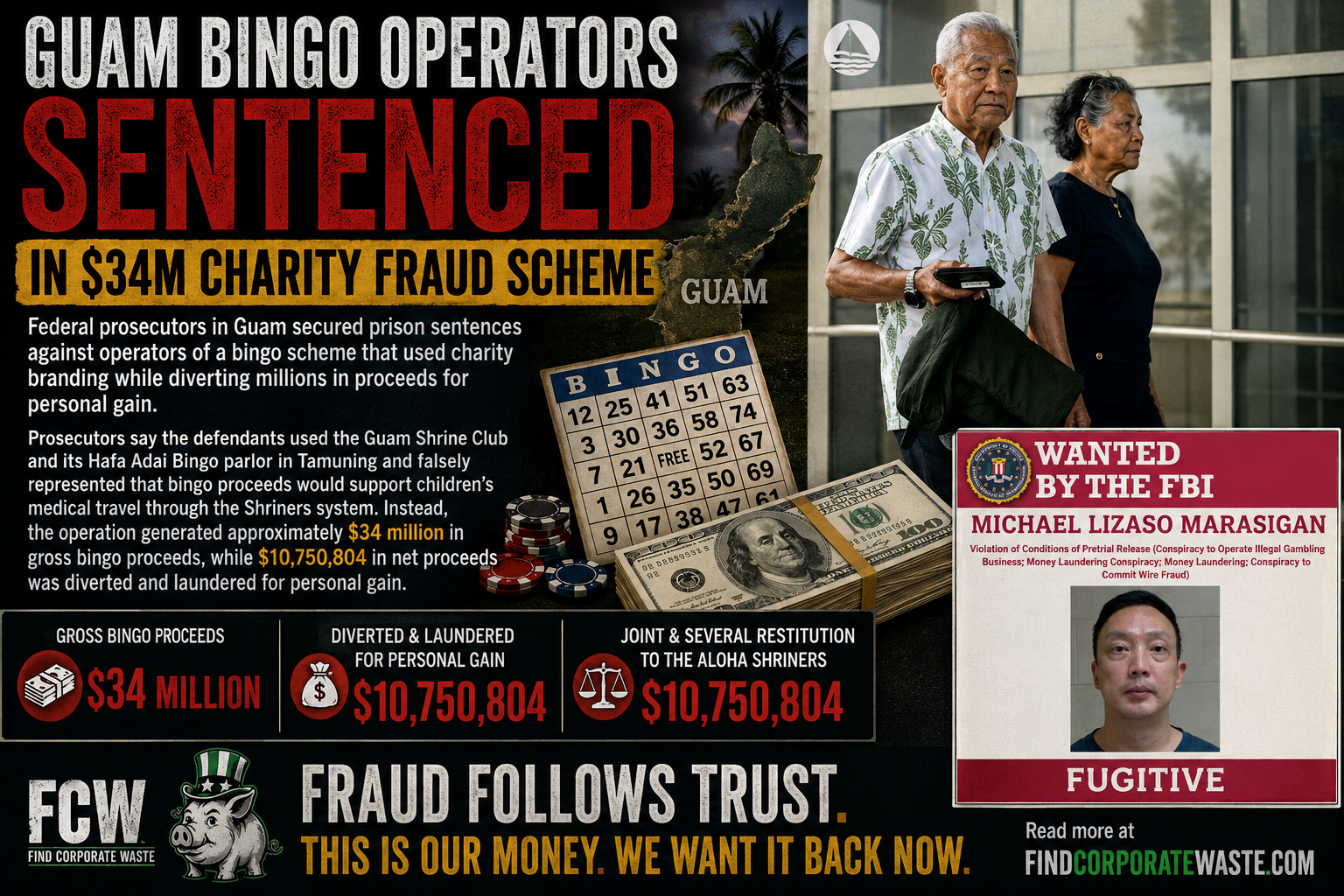
    Federal prosecutors in Guam secured prison sentences against the operators of a bingo scheme that used charity branding while diverting millions in proceeds for personal gain.

    According to the DOJ, Jose Arthur D. Chan Jr., Christine C. Chan, and Michael L. Marasigan were convicted by a jury in May 2025 of conspiracy to operate an illegal gambling business, money laundering conspiracy, and conspiracy to commit wire fraud. Christine Chan and Marasigan were also convicted of additional money laundering counts.

    The case centered on the Guam Shrine Club and its Hafa Adai Bingo parlor in Tamuning. Prosecutors said the defendants represented that bingo proceeds would support charitable purposes connected to children’s medical travel through the Shriners system. Instead, Hafa Adai Bingo generated approximately $34 million in gross bingo proceeds, while $10,750,804 in net proceeds was diverted and laundered for personal gain.

    The sentences were substantial. Art Chan received 60 months in federal prison. Christine Chan received 70 months. Marasigan, described by the DOJ as a fugitive, was sentenced in absentia to 262 months. Each defendant was tied to joint and several restitution of $10,750,804 to the Aloha Shriners, with additional forfeiture judgments imposed.

    This was not merely a bookkeeping fraud or a technical gambling violation. The scheme traded on the public’s willingness to support sick children, then converted that trust into private enrichment. That is the kind of fraud President Trump was elected with a broad mandate to confront: schemes where public-facing institutions, charitable language, and insider control are used to separate ordinary people from money meant for a legitimate purpose.

    For Find Corporate Waste, the lesson is straightforward: fraud follows trust. Whether the vehicle is a charity, a healthcare program, a federal benefit, or a relief fund, the warning signs often appear where public purpose and private control intersect. This case also matters to FCW’s broader review of nonprofit recipients, because charitable status should never become a shield against scrutiny.

    This is our money, and we want it back now.

  • California Doctor Convicted in $45M Botox Medicare Fraud Scheme

    California Doctor Convicted in $45M Botox Medicare Fraud Scheme

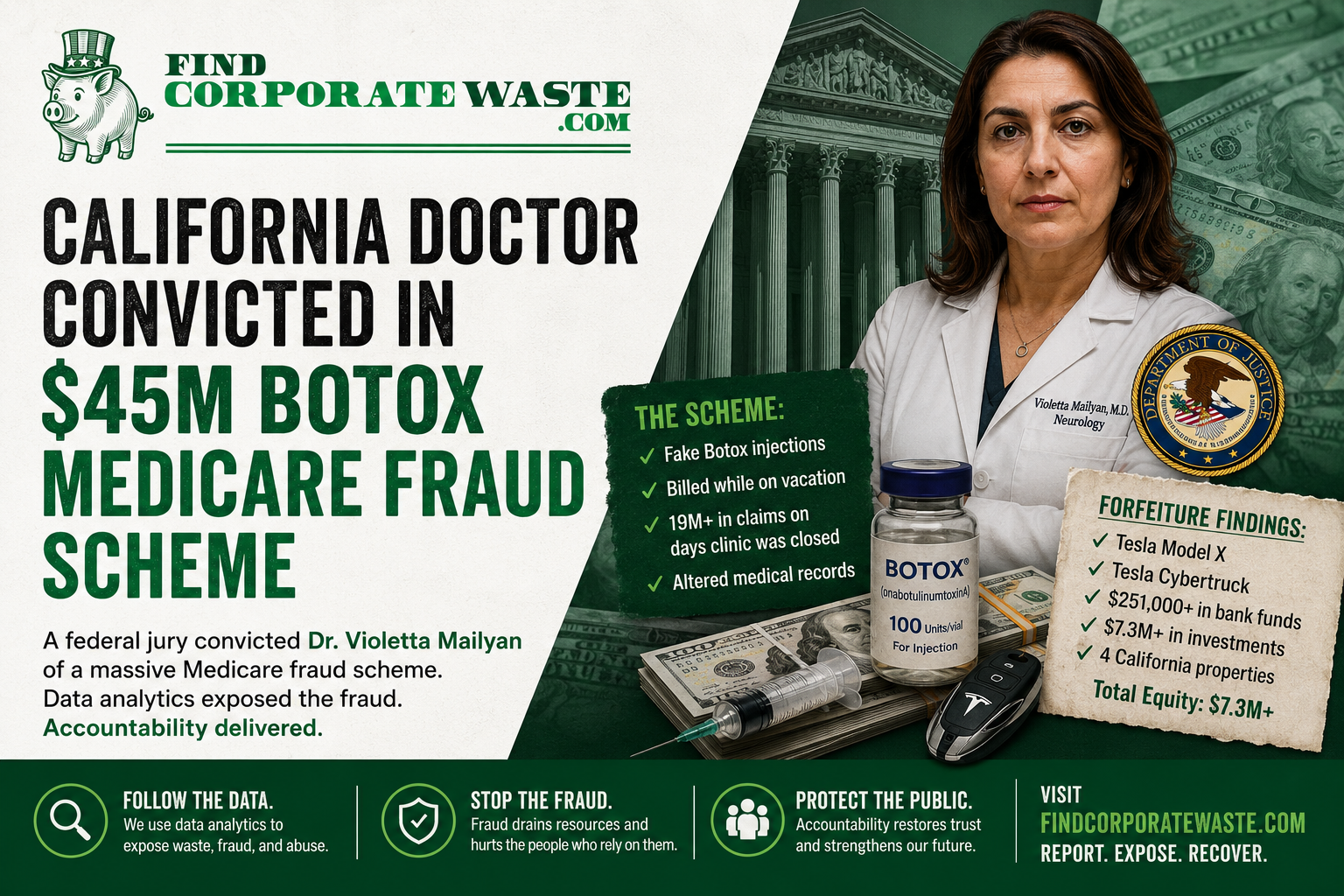
    A federal jury in the Central District of California convicted Dr. Violetta Mailyan, 45, of Glendale, California, for her role in a $45 million Medicare fraud scheme built around Botox billing. According to the DOJ, Mailyan submitted claims for Botox injections that were either never provided, medically unnecessary, cosmetic in nature, or unsupported by the medical records required for Medicare reimbursement. 

    The DOJ said the investigation began after the Health Care Fraud Section’s Data Analytics Team flagged Mailyan as an extreme Medicare outlier: she had been paid more for Botox injections than any other doctor in the country.

    At one point, she had received more than $24 million over four years, roughly six times more than the next highest comparison group, all of whom were neurologists.  

    The details are staggering. Prosecutors said Mailyan billed Medicare for Botox treatments while she was vacationing in Cabo, Maui, Las Vegas, Pennsylvania, and New York. She also allegedly billed for a Medicare beneficiary who was incarcerated in federal prison and submitted over $19 million in claims for injections supposedly performed on days when her clinic was closed.  

    According to trial evidence, Mailyan backdated claims, fabricated patient consent forms, altered medical records after receiving a grand jury subpoena, and tried to make it appear that patients suffered from chronic migraines requiring treatment. The jury convicted her of nine counts of wire fraud and three counts of obstruction. Sentencing is scheduled for September 10, 2026

    The forfeiture findings tell the rest of the story: a Tesla Model X, a Tesla Cybertruck, more than $251,000 in bank funds, brokerage accounts valued at over $7.3 million, and four California properties with estimated equity above $7.3 million were found subject to forfeiture as fraud proceeds. 

    This case shows that investigators must follow abnormal billing patterns, outlier providers, ownership trails, and public data signals before the money disappears.

    The DOJ’s new Fraud Division and Health Care Fraud Strike Force are now openly leaning into analytics, and that shift matters. Find Corporate Waste exists to follow that trail.

    If you have information about government funds being misused, inflated, concealed, or routed through questionable claims, now is the time to come forward.

  • Three Members of International Criminal Organization Sentenced in $2 Billion Telemedicine Fraud Scheme

    Three Members of International Criminal Organization Sentenced in $2 Billion Telemedicine Fraud Scheme

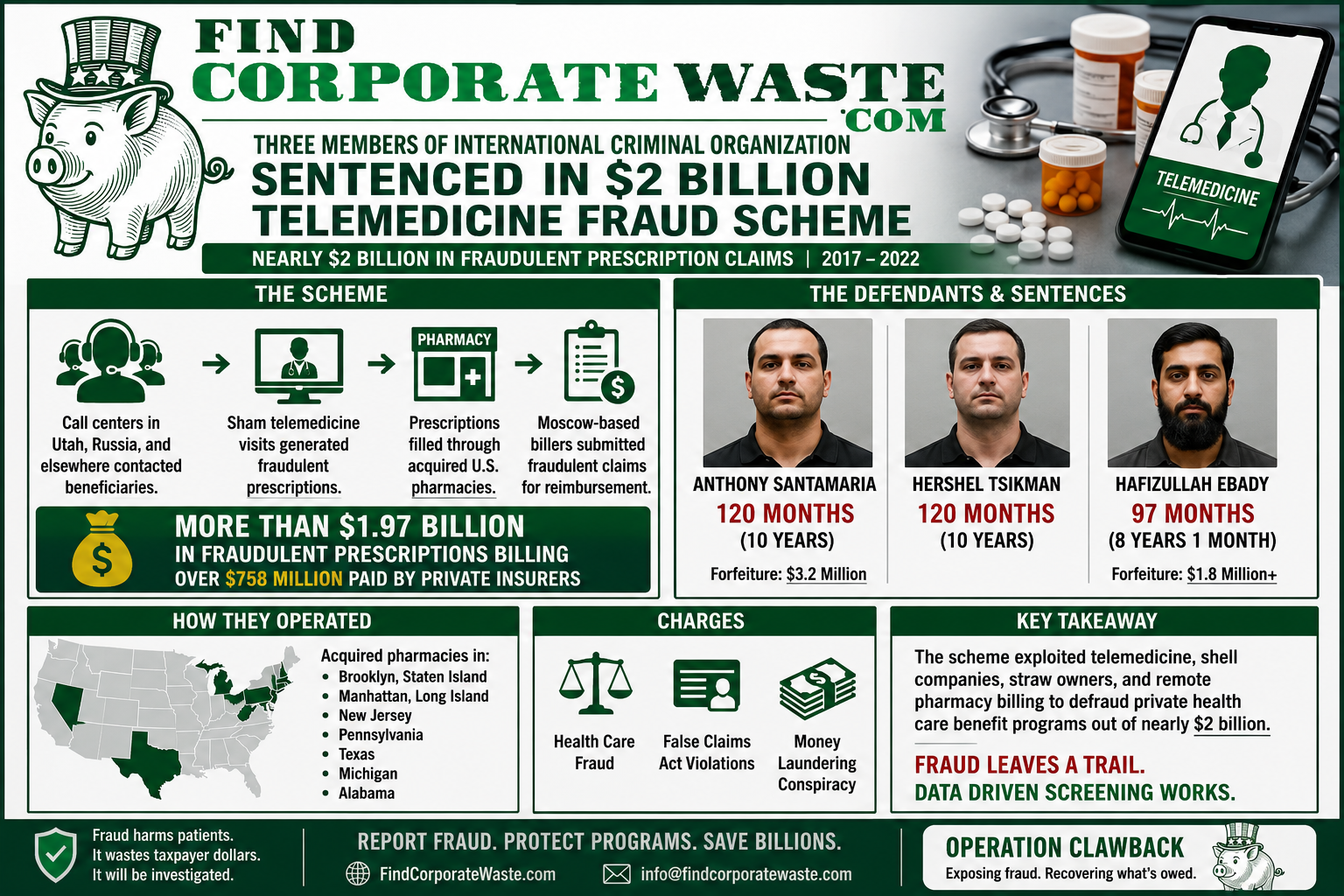
    Three members of a Moscow-based international criminal organization have been sentenced for their roles in a massive telemedicine health care fraud scheme that generated nearly $2 billion in fraudulent prescription claims.

    According to the DOJ, Anthony Santamaria was sentenced in Brooklyn federal court to 10 years in prison. Co-defendants Hershel Tsikman and Hafizullah Ebady were sentenced earlier this month to 120 months and 97 months in prison, respectively. Santamaria was also ordered to forfeit $3.2 million, while Ebady was ordered to forfeit more than $1.8 million. Restitution will be determined later.  

    The scheme allegedly operated from 2017 through 2022 and targeted private health care benefit programs. Prosecutors said the organization used call centers in Utah, Russia, and elsewhere to contact beneficiaries and offer medications without proper medical exams.

    In many cases, beneficiaries allegedly never had real telemedicine visits, yet fraudulent prescriptions were generated under physicians’ names and National Provider Identifier numbers.  

    The DOJ said the defendants acquired pharmacies across the United States, including in Brooklyn, Staten Island, Manhattan, Long Island, New Jersey, Pennsylvania, Texas, Michigan, and Alabama. Moscow-based billers then remotely submitted reimbursement requests through those pharmacies. Third-party billing records showed more than $1.97 billion in fraudulent prescriptions, with private insurers paying over $758 million.  

    This case shows the same structural fraud signals that matter across health care enforcement: shell companies, straw owners, remote billing, identity misuse, NPI abuse, and weak gatekeeping around payment systems. For Find Corporate Waste, the lesson is simple: complex fraud often leaves a public-data trail before prosecutors ever announce charges.

    Whether the target is private insurance fraud, Medicare billing abuse, or pandemic relief eligibility, the work begins by matching names, entities, addresses, program rules, and exclusion records.

    Operation Clawback applies that same logic to pandemic-era health care relief by reviewing PRF/CARES recipients against exclusion and eligibility data, including OIG LEIE records and PRF eligibility conditions.  

  • California Medical Company Owner Pleads Guilty to Stealing More Than $1M in Pandemic Relief Funds

    California Medical Company Owner Pleads Guilty to Stealing More Than $1M in Pandemic Relief Funds

    A California medical business owner has pleaded guilty to stealing more than $1 million from federal pandemic relief programs.

    According to the DOJ, Mehrdad Tabrizi owned Life Fleet Inc. and Resonante Group, two Orange County medical businesses. During the COVID-19 pandemic, he used those companies to submit fraudulent applications for Paycheck Protection Program and Economic Injury Disaster Loan funds.  

    The DOJ said Tabrizi falsely claimed Life Fleet was operating and had employees who received wages in 2019 and 2020. In reality, the company had been shuttered in 2018 and was no longer operational. Those false PPP applications caused approximately $696,565 to be disbursed into bank accounts he controlled.  

    Tabrizi also submitted fraudulent EIDL applications claiming Life Fleet and Resonante Group had revenue and business expenses before January 2020. Those applications brought in another $319,800, even though neither company was entitled to the money. The DOJ also said he withdrew $60,000 of the fraud proceeds to help buy a 2019 Porsche Turbo Cabriolet.  

    He pleaded guilty to four counts of wire fraud and one count of money laundering. Sentencing is scheduled for September 28, 2026.

    For Find Corporate Waste, this case shows why pandemic relief fraud remains a major public-accountability issue. Relief programs moved quickly, but speed created opportunities for false certifications, inactive companies, inflated payroll claims, and misuse of taxpayer funds. FCW will continue tracking pandemic relief cases, False Claims Act recoveries, and public-record signals that expose waste, fraud, and abuse.

  • Children’s Medicaid Program Hit With $15.2M False Claims Judgment

    Children’s Medicaid Program Hit With $15.2M False Claims Judgment

    The operators of a children’s day treatment program have agreed to a $15,248,240.66 civil judgment in favor of the United States to resolve allegations that they defrauded the Kentucky and Ohio Medicaid programs, according to the U.S. Attorney’s Office for the Eastern District of Kentucky. 

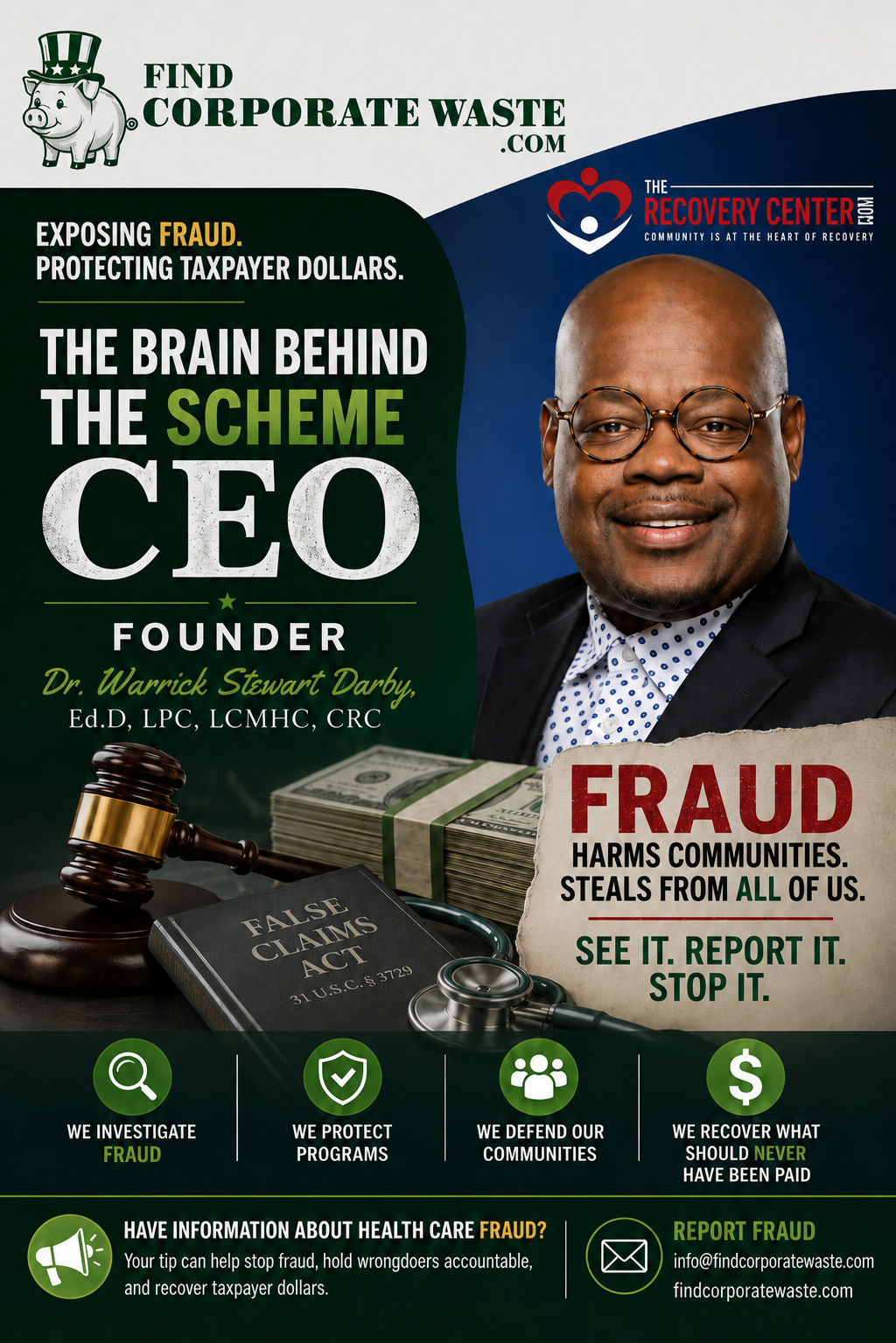
    The settlement involves Recovery Center of Kentucky, LLC, Recovery Center of Ohio, LLC, Recovery Center of Maryland, LLC, Recovery Center of USA, and CEO Dr. Warrick Stewart. The government alleged that the entities violated the False Claims Act, which prohibits submitting false claims for payment to government programs such as Medicaid.

    At issue was the Aspire Day Program, which served children with behavioral and mental health needs in Elizabethtown, Lexington, Louisville, and Radcliff, Kentucky, as well as Cincinnati, Ohio. These programs may include therapy and behavioral health services, sometimes alongside school or other activities.  

    The government alleged that, from August 2022 through June 2025, the Recovery Centers billed Medicaid for children’s time spent on education, recreation, and lunch breaks, even though Kentucky and Ohio Medicaid only covered time spent receiving behavioral health services.  

    The government also alleged that Recovery Center of Kentucky misrepresented staff qualifications to obtain higher Medicaid reimbursements. In some cases, services allegedly performed by lower-level staff were billed as if they had been provided by higher-level licensed professionals. In other cases, the government alleged that certain employees were not qualified to provide day treatment services at all.

    This case began as a qui tam lawsuit under the False Claims Act, meaning private whistleblowers helped bring the alleged misconduct to light. The docket information is United States ex rel. Harned, et al. v. Aspire Day School, LLC, et al., Case No. 3:23-cv-41-GFVT.

    As part of the resolution, Recovery Center entered into a five-year Corporate Integrity Agreement with HHS OIG, requiring strengthened compliance obligations going forward. The civil judgment will be satisfied under terms based on the defendants’ ability to pay.

    Find Corporate Waste tracks cases where taxpayer-funded health care dollars may have been misused through false billing, ineligible recipients, weak oversight, or improper certifications.

     If you have credible information about Medicaid, Medicare, PPP, Provider Relief Fund, or other government-funded health care fraud, your information may help expose waste and recover public money.

  • FCW Welcomes DOJ FOCUS Initiative to Combat Waste, Fraud, and Abuse With Data Science

    FCW Welcomes DOJ FOCUS Initiative to Combat Waste, Fraud, and Abuse With Data Science

    The Department of Justice’s Civil Division has announced the new FOCUS initiative, short for Fraud Oversight through Careful Use of Statistics. The initiative is aimed at data miners who use public government records to identify potential False Claims Act cases. Find Corporate Waste has developed a sophisticated methodology for addressing Medicare Fraud committed during the COVID-19 Pandemic.

    DOJ Is Recognizing What Serious Data Miners Already Know

    For years, traditional whistleblower cases have often depended on insiders: employees, contractors, billing staff, compliance officers, or executives who saw misconduct from the inside.

    Under the leadership of Acting Attorney General Todd Blanche, the federal government now appears to be recognizing that some fraud patterns can also be found by carefully analyzing public records, payment data, provider databases, and regulatory rules.

    DOJ made clear that it welcomes data miners, but not sloppy work. The Department says it will prioritize data miners who can explain their methodology, validate their findings, understand the relevant program rules, and identify legally sufficient False Claims Act matters.  That is exactly the standard serious public-record investigators should want.

    FCW Welcomes the FOCUS Initiative

    At Find Corporate Waste, we welcome the FOCUS initiative because it encourages a disciplined approach to public-data fraud detection.

    The point is not to accuse every recipient of federal funds of wrongdoing, rather the FOCUS is to identify situations where public records raise a serious, documentable question about whether federal money was obtained or retained in violation of program rules.

    That requires matching payment data to eligibility rules, compliance obligations, provider identifiers, corporate records, exclusion data, licensing data, and other government sources.

    Why PRF Data Deserves Careful Review

    One area FCW plans to continue reviewing is the Provider Relief Fund, commonly known as PRF.

    The PRF was created to support healthcare providers during the COVID-19 emergency. Public PRF data identifies providers that received and accepted payments and agreed to the applicable Terms and Conditions. HRSA has stated that public PRF data reflects providers who received one or more payments, attested to receiving at least one payment, and agreed to the related Terms and Conditions.  

    That attestation piece is important.

    When a provider accepts federal relief money and agrees to Terms and Conditions, the question becomes whether the recipient was actually eligible, whether the money was properly retained, and whether any later reporting or compliance obligations were satisfied.

    How the Medicare Opt-Out Database Fits In

    FCW also plans to use the Medicare Opt-Out Affidavits database as part of its review process.

    The CMS opt-out dataset identifies providers who have decided not to participate in Medicare. CMS states that the dataset includes information such as provider NPI, specialty, address, and opt-out effective dates.  

    That database is useful because PRF payments were connected to healthcare providers operating within federal healthcare programs and subject to specific eligibility and compliance rules.

    If public PRF records appear to overlap with Medicare opt-out records, that does not automatically prove fraud. But it does create a legitimate line of inquiry worth reviewing.

    The key is timing, identity, and rule application.

    Data Mining Is Not Guesswork

    The strongest False Claims Act cases are built on public records.

    The goal is to determine whether a public-data anomaly is just an innocent mismatch, a clerical issue, or a real compliance problem involving federal funds.

    That distinction matters. It protects honest providers. It also helps the government focus on cases that are actually worth pursuing.

    Why This Matters for Taxpayers

    COVID-era relief programs moved enormous sums of federal money very quickly. Many recipients used those funds properly. Others may not have.

    The False Claims Act exists because public money comes with rules. When companies or providers accept federal funds, they do not get to ignore the conditions attached to those funds.

    The DOJ’s FOCUS initiative sends a clear message: public data can help uncover fraud, but only when it is used responsibly.

    FCW’s Position

    FCW welcomes DOJ’s FOCUS initiative and supports a high standard for data-driven False Claims Act work.

    Public records are an untapped way to identify waste, fraud, and abuse that would otherwise remain obscure and buried.

    Think You Have Information About Federal Healthcare Fraud?

    If you worked for a provider, billing company, healthcare contractor, clinic, management company, or related entity that received federal funds during the COVID-19 period, your information may matter.

    FCW reviews public records and potential False Claims Act leads involving federal healthcare payments, relief funds, and government program compliance.

    Whistleblowers play a major role in protecting taxpayer money. In many cases, relators who bring successful False Claims Act cases may be eligible to receive a share of the government’s recovery.

    If you have credible information about federal funds being obtained, retained, or reported improperly, FCW can help evaluate whether the facts may warrant attorney review.

    Find Corporate Waste exists to help turn public records into accountability.
  • Misuse of NIH Grants: Dana-Farber’s $15M Legal Consequences

    Misuse of NIH Grants: Dana-Farber’s $15M Legal Consequences

    Overview of the Dana-Farber False Claims Act Settlement

    Find Corporate Waste reports that on December 16, 2025, the Dana-Farber Cancer Institute Inc. agreed to pay $15 million to resolve allegations that it violated the False Claims Act by making materially false statements and certifications related to National Institutes of Health research grants.

    Federal authorities alleged Dana-Farber misused NIH funding and caused false claims to be submitted to the agency between 2014 and 2024.

    Statement of Resolution Agreement: Department of Justice+1

    Allegations of Falsified Data in NIH-Funded Research

    The DOJ alleged that research supported by six NIH grants had led to numerous scientific publications containing misrepresented or duplicated images and data.

    These included reused figures presented as different experimental outcomes and manipulated imagery across multiple testing conditions.

    Department of Justice

    Misuse of Federal Research Grants and Unallowable Expenses

    Dana-Farber admitted it spent federal research funds on activities and expenses that were unallowable under NIH grant terms. Prosecutors maintained that these actions constituted misuse of taxpayer-funded research grants and breached federal stewardship obligations. Department of Justice

    Whistleblower Lawsuit and Qui Tam Recovery

    This matter originated from a qui tam complaint filed by whistleblower Sholto David under the False Claims Act. Under the settlement terms, the relator will receive approximately $2.625 million, reflecting the FCA’s whistleblower recovery provisions. Department of Justice+1

    Federal Enforcement and Interagency Effort

    The resolution resulted from coordinated enforcement by the Department of Justice and the Department of Health and Human Services Office of Inspector General.

    For more information about this effort: DOJ-HHS Launch New Initiative to Combat Healthcare Fraud

    Why This Case Matters for Federally Funded Medical Research

    The Dana-Farber Settlement demonstrates how integral the False Claims Act is to stopping massive fraud and abuse of government money.

    If you have credible information about misuse of federal funds, fraud, or false claims like those described above, you may be able to report it as a whistleblower under the False Claims Act and potentially receive a share of any government recovery.

    Find Corporate Waste can help you understand your options and connect you with experienced counsel to evaluate and report your information securely.

    Contact us to learn how your insight can hold fraud accountable and protect taxpayer dollars.

  • $6 Million Settlement for Fraudulent Lab Testing Kickbacks

    $6 Million Settlement for Fraudulent Lab Testing Kickbacks

    A former laboratory CEO, two Texas physicians, and seven marketers have agreed to pay more than $6 million. This settlement resolves allegations they took part in kickback schemes. These schemes funneled taxpayer dollars into fraudulent lab testing referrals.

    Christopher Grottenthaler, the former CEO of True Health Diagnostics, will pay $4.25 million to settle claims. He allegedly arranged kickbacks disguised as consulting fees. These included MSO (management service organization) distributions, processing fees, and even waived patient copays. These actions were to induce doctors to order unnecessary lab tests.

    Two physicians, Dr. Hong Davis of Plano and Dr. Elizabeth Seymour of Denton, agreed to pay a combined $358,842. Both were accused of accepting MSO payments to draw business to True Health, Little River Healthcare, and Boston Heart Diagnostics.

    Seven marketers will pay nearly $1.46 million for illegally routing MSO payments to doctors to generate referrals. They are Courtney Love, Stephen Kash, Laura Howard, Jeffrey Parnell, Stanley Jones, Jordan Perkins, and Ruben Marioni.

    These settlements are part of a wider federal crackdown. The Department of Justice has recovered over $59 million. This recovery is from more than 50 doctors and other participants in similar MSO-based lab testing kickback schemes.

    “Kickbacks to doctors can undermine medical decision-making, subject patients to wasteful treatments, and squander taxpayer money,” said Assistant Attorney General Brett A. Shumate.

    This case was sparked by a whistleblower lawsuit filed under the False Claims Act by STF LLC, whose members will receive $148,750. The lawsuit continues against other defendants.

    Why It Matters

    Lab testing is essential for patient care. When executives and doctors put profits ahead of patients, the medical system is corrupted.

    At Find Corporate Waste, we track these schemes to hold bad actors accountable. If you have information about healthcare fraud, waste, or abuse, you can report it confidentially. Reach out to us at info@findcorporatewaste.com.